Published 01/17/2026 16:07
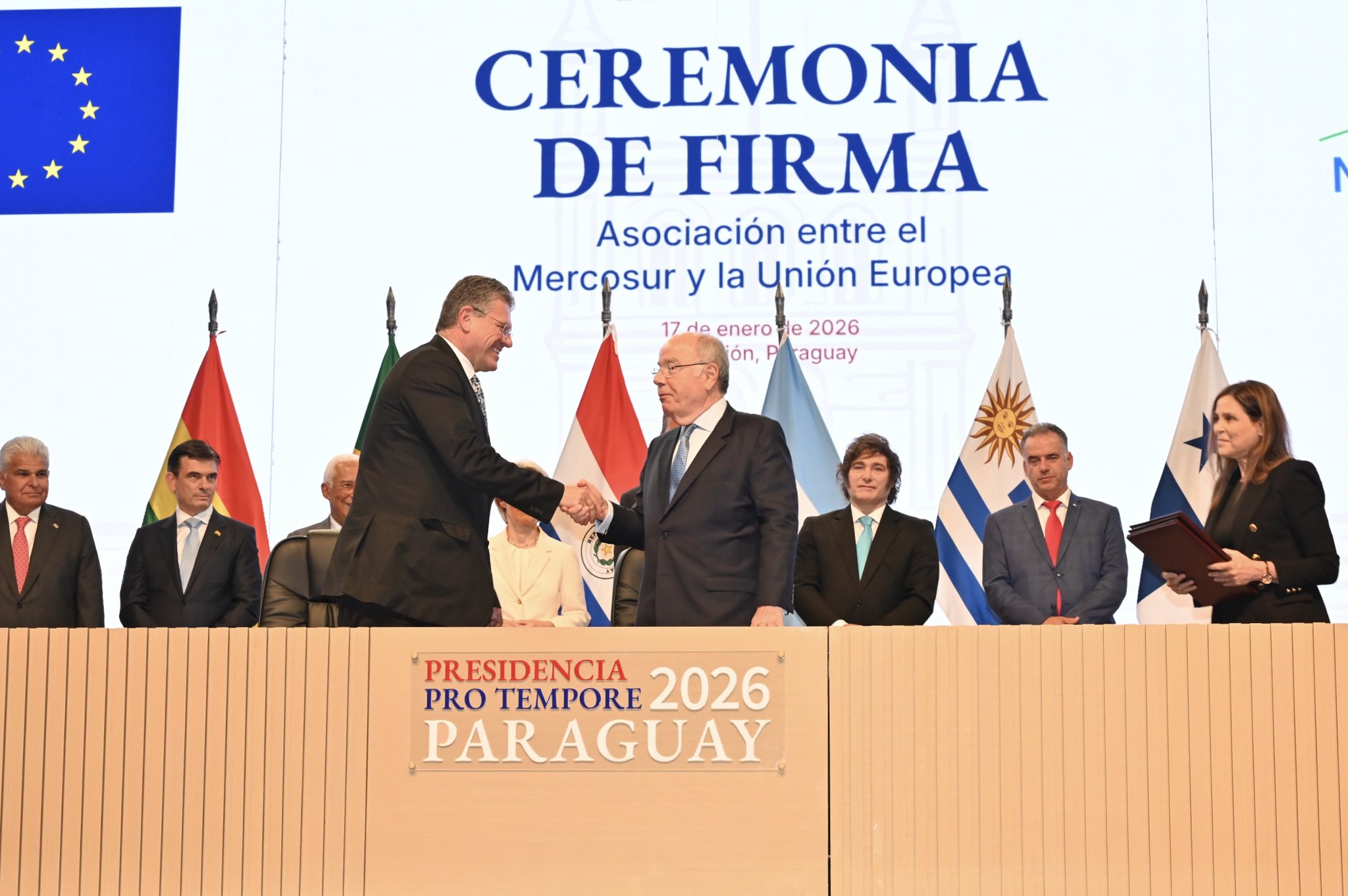
After more than 25 years, the agreement between Mercosur and the European Union (EU) was signed this Saturday (17), in Asunción, Paraguay. President Lula was not at the ceremony due to scheduling issues. In his place was Chancellor Mauro Vieira.
On Friday (16), Lula received the president of the European Commission, Ursula von der Leyen, and reaffirmed the agreement as a victory for multilateralism. At the signing ceremony, the president of Paraguay and Mercosur, Santiago Peña, highlighted the importance of President Lula in finalizing the treaty, negotiated mainly in the last year during Brazilian leadership of the South American group.
“Without President Lula, perhaps we would not have reached this day. He was one of those fundamentally responsible for this process,” said Peña.
Despite the progress, the agreement is viewed with reservations by the national industry — although it represents an important deal for agribusiness products, which will gain market share in the European bloc. According to Ipea (Institute for Applied Economic Research), there are risks for industrial sectors and jobs in the area.
read more: Lula celebrates Mercosur-EU agreement as victory for multilateralism
The understanding is that the Brazilian market is not prepared to face European products and will need sectoral policies to avoid losing space. Despite this, the institute rules out an industrial collapse. For the executive president of Abimaq (Brazilian Association of the Machinery and Equipment Industry), José Velloso, competition will be challenging for the national transformation industry, which has a higher cost and is less advanced.
Analysts such as Paulo Nogueira Batista Jr. and Manoel Casado are more critical. For them, the agreement places Brazil and the other Mercosur countries closer to neo-colonization than neo-industrialization.
Signature
During the signing ceremony, South American and European authorities celebrated the agreement, created over more than two decades, to safeguard multilateralism in times of threats to global governance, mainly coming from the United States.
Also present were the president of the European Council, António Costa, as well as the presidents of Uruguay and Argentina, Yamandú Orsi and Javier Milei, respectively.
In her speech, Ursula von der Leyen highlighted that the blocs chose “fair trade instead of tariffs” and “long-term partnerships instead of isolation”.
Peña said that the act is historic, as it involves 720 million people and a combined GDP of US$22 trillion between the blocs: “a truly historic day […] uniting two of the most important global markets, which demonstrates that the path of dialogue, cooperation and fraternity is the only path”, he highlighted.
Despite being signed, the agreement will need to be ratified by the countries of the two blocs involved, and may face erosion on the part of some countries in this process, such as France, the main opponent of the negotiation.
In a post on social media, the Brazilian Ministry of Foreign Affairs, Itamaraty, reinforced that “the European Union is Brazil’s second largest trading partner. In 2025, trade between Brazil and the EU reached US$100 billion, equivalent to 16% of our foreign trade.”
Furthermore, for Brazil, the “Mercosur agreements with the European Union, Singapore and EFTA are expected to boost GDP by R$67.6 billion, increase investments by R$25.3 billion and reduce prices for Brazilian consumers.”
Source: vermelho.org.br