Published 02/21/2026 14:29
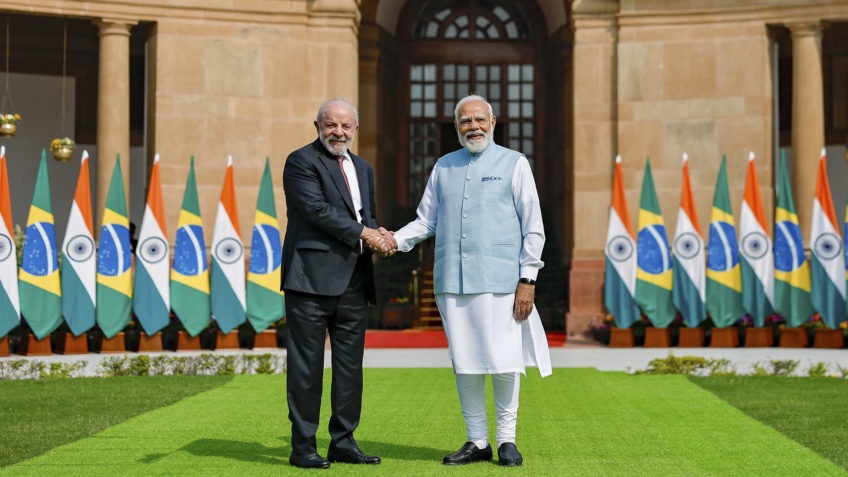
During a state visit to India, President Luiz Inácio Lula da Silva defended this Saturday (21) the reform of the UN Security Council, the strengthening of multilateralism and the expansion of strategic cooperation between Brazil and India.
Alongside Prime Minister Narendra Modi, Lula stated that the international scenario marked by conflicts, trade disputes and the use of tariffs as an instrument of pressure requires greater coordination between countries in the Global South.
According to the president, international governance “no longer reflects the correlation of forces in the current world” and needs to be reformulated to gain legitimacy and capacity for action.
“The world cannot remain hostage to structures created in the last century, incapable of responding to the conflicts we see today,” said Lula.
The president resumed his defense of the expansion of the UN Security Council and recalled the historical articulation between countries that demand greater representation in the body.
“It is important to remind the Indian and Brazilian press that, more than 20 years ago, Brazil, India, Germany and Japan built a group called G4 defending the expansion of the UN Security Council, something that has not happened until now, but will certainly happen soon”, stated the president.
The agenda takes place in a context of trade disputes sparked by the resumption of tariffs by the United States under the presidency of Donald Trump.
Without directly mentioning the North American president, Lula stated that Brazil and India share the view that unilateralism “weakens production chains, makes food more expensive and compromises development”.
Lula highlighted that cooperation between Brazil and India must be seen as a concrete response to this scenario.
In 2025, trade flow between the two countries exceeded US$15 billion, growth of 25% compared to the previous year. The target agreed by governments is to reach US$20 billion by 2030, a level that the Brazilian president suggested revising upwards.
“We are moving so fast that we should think about reaching US$30 billion in exchange,” he stated. For Lula, expanding bilateral trade involves diversifying international partnerships and strengthening agreements between blocks in the Global South.
In this context, the president defended the expansion of the Preferential Trade Agreement between India and Mercosur, in force since 2009, as a step towards a possible free trade agreement. “Two such important markets need a more comprehensive and ambitious framework,” he said.
During the visit, Brazil and India signed eight acts of cooperation, which cover areas considered strategic by both governments. Among the agreements are understandings in the areas of critical minerals and rare earths, health, energy, digital transformation, micro and small businesses, postal sector, mining and certification of commercial origin.
In the field of energy and critical minerals, Lula stated that cooperation seeks to guarantee productive autonomy in the face of the global concentration of these chains. “Expanding investments and cooperation in renewable energy and critical minerals is at the heart of the pioneering agreement we signed today,” he said.
In the health area, the acts provide for regulatory and industrial cooperation, with a focus on the production of medicines, vaccines and strategic inputs.
According to Lula, Brazil and India have worked “side by side for decades” in defending access to generic medicines and health sovereignty, especially within the scope of the World Health Organization.
Understandings were also reached in digital transformation and emerging technologies, including artificial intelligence. Lula stated that the digital partnership with India is the first of its kind signed by Brazil and aims to put technology “at the service of inclusive development”.
Peace and international governance
Lula once again defended diplomatic solutions to international conflicts and stated that there is no sustainable development in a world marked by wars.
The president reiterated support for efforts to end the war in Ukraine and defended urgent measures to alleviate the suffering of the Palestinian population.
“Terrorism cannot be associated with any religion or nationality, nor used as a pretext for actions outside international law,” he said, commenting on recent attacks in Kashmir.
The reference was made in the context of the situation in Kashmir, a region that has returned to the spotlight following recent episodes of violence between India and Pakistan.
According to Lula, Brazil and India play a central role in building a more balanced global governance, both at the UN and in forums such as the G20 and the BRICS. “This transition of presidencies between our countries strengthens the voice of the Global South and expands our ability to influence global decisions,” he said.
State Agenda
Before signing the acts, Lula participated in an official welcome ceremony at the Indian Presidential Palace and paid tribute to Mahatma Gandhi at the Raj Ghat memorial.
The president also met with the president of India, Droupadi Murmu, and participated in the Brazil–India Business Forum, which brought together around 600 representatives from the private sector of both countries.
At the end of the forum, Lula stated that the rapprochement between Brazil and India seeks to break the historical logic of dependence on major economic powers.
“For a long time, we were taught to only look at Europe and the United States. Now we have decided to look at each other,” he said.
Source: vermelho.org.br