Published 03/23/2026 08:01 | Edited 03/23/2026 08:21
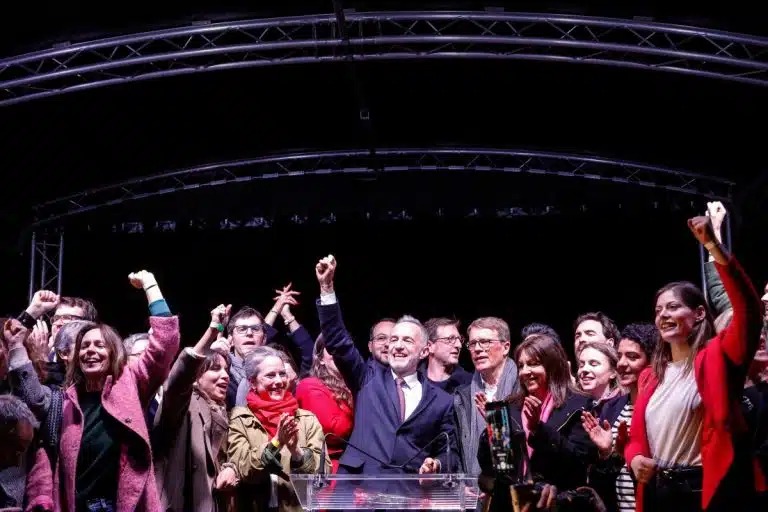
This Sunday (22), the left maintained the three largest cities in France in the 2026 municipal elections, confirming victory in Paris, Marseille and Lyon under progressive administrations.
The extreme right was unable to advance in large centers, but expanded its presence in medium-sized cities, in a scenario also marked by divisions between left-wing forces and the rapprochement of the traditional right with the camp led by Marine Le Pen.
The municipal elections take place amid political turmoil suffered by President Emmanuel Macron’s government and 13 months before the 2027 presidential elections.
In the French capital, Emmanuel Grégoire (PS) was elected mayor with 50.5% of the votes, defeating the conservative candidate Rachida Dati, who obtained 41.5%. Grégoire and the socialists succeed Anne Hidalgo (PS), keeping the city hall under left-wing control.
The victory occurred without an alliance with Jean-Luc Mélenchon’s Unsubmissive France (LFI), after Grégoire’s refusal to unify his candidacy with deputy Sophie Chikirou (LFI).
On the other side, conservative candidate Rachida Dati, from the Republican Party, the traditional right, tried to expand her base with a last-minute alliance with President Macron’s liberal right, and counted on the withdrawal of the candidacy linked to the far-right party Reconquista!.
In Marseille, the second largest city in France, the city hall was maintained by a coalition of progressive parties, which managed to contain the advance of the National Regroupment (RN).
In Marseille, socialist mayor Benoît Payan (PS) was returned to office with more than 53% of the vote, defeating the far-right candidate Franck Allisio.
In Lyon, environmentalist mayor Grégory Doucet was re-elected after signing an alliance with Unsubmissive France in the second round. The composition between ecologists and the left was decisive in guaranteeing the continuity of management in the city, in the face of a right-wing candidacy that sought to regain control of the city hall.
The second round recorded participation of around 57% of the electorate, one of the lowest levels in recent history outside the pandemic period.
What was Unsubmissive France like?
Unsubmissive France (LFI) has grown in number of cities, but still faces limits in wider centers.
The party won around a dozen relevant cities, with a prominent presence in popular and peripheral territories, such as Saint-Denis, in the Paris metropolitan region, as well as Roubaix, Creil and municipalities on the outskirts of Lyon, such as Vénissieux and Saint-Fons.
At the same time, the party played a relevant role in left-wing victories in large cities, even without leading the tickets.
In large cities such as Lyon, Nantes, Tours and Grenoble, the LFI’s participation in local alliances contributed to the formation of progressive majorities, underlining its ability to influence the electoral field.
Despite this advance, the party faced difficulties in strategic cities such as Toulouse and Limoges, where it was defeated even after compositions that, on paper, indicated an advantage.
The results in these centers, with a more heterogeneous electorate, exposed the limits of the strategy based on the mobilization of popular sectors and young people, which did not translate into an electoral majority.
LFI’s performance also highlighted the internal dispute in the progressive camp. The elections were marked by tensions between unity strategies and autonomous candidacies, in a scenario that anticipates the dispute for leadership of the left in the 2027 presidential elections.
Even with divergences, the results confirm that the party is expanding its territorial insertion, at the same time that it still faces obstacles to consolidating itself as a majority force on a national scale.
Source: vermelho.org.br