Published 03/19/2026 14:13 | Edited 03/19/2026 14:49
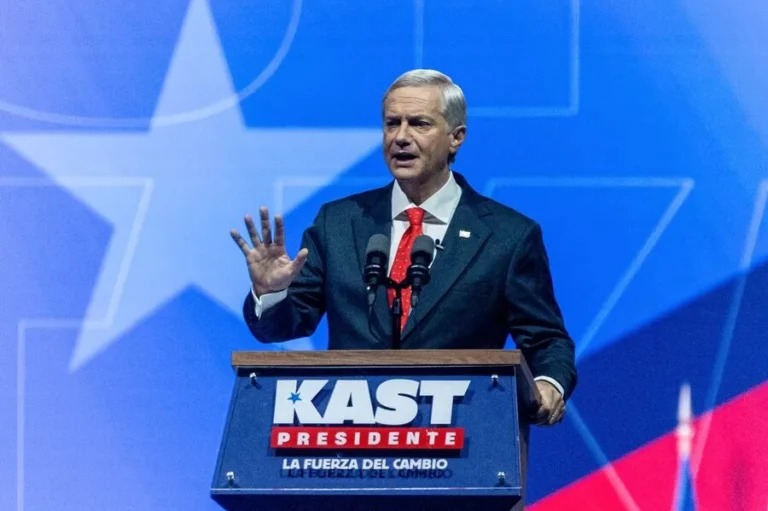
The new Chilean government, led by Pinochet leader José Antonio Kast, began its administration with a package of measures that combines fiscal adjustment, withdrawal of initiatives favorable to workers, advancement of extractive projects in partnership with the United States, environmental flexibility and tightening of migration policy.
The decisions include the withdrawal of a labor negotiation project under business pressure, a 3% cut in public spending, an agreement with Donald Trump for the exploration of rare earths, the withdrawal of environmental decrees and the construction of physical barriers on the border with Peru, outlining the first guidelines of the new government.
In the economic area, the Kast government began implementing a fiscal adjustment with a 3% cut in ministerial budgets, a measure that also affects the Judiciary.
The cut was formalized in a letter signed by the new Finance Minister, Jorge Quiroz, and is part of a plan that seeks to save around US$4 billion in the short term and up to US$6 billion in 18 months.
The president of the Supreme Court, Gloria Ana Chevesich, stated that the measure “will affect the continuity” of the functioning of the Judiciary and warned of possible difficulties in paying salaries, maintaining teams and serving the population.
On the other hand, Kast’s economic plan also includes a reduction in corporate tax from 27% to 23%, in addition to maintaining mechanisms such as tax reinstatement, which allows shareholders to use the tax paid by companies as personal credit.
The estimate is that these measures will reduce revenue by more than US$3.5 billion per year.
In the environmental field, the new management withdrew 43 decrees from the Comptroller’s Office that dealt with pollution, biodiversity and protected areas, suspending the entry into force of a set of standards focused on air quality, control of industrial emissions, waste management and environmental conservation.
The measure directly affects sectors such as mining, energy and forestry, as well as sensitive territories such as salt flats and areas of high ecological value.
Postponing these regulations could change deadlines and environmental requirements, in addition to maintaining critical conditions in regions already exposed to contamination, such as Quintero, Puchuncaví and Huasco.
At the same time, the government confirmed an agreement with the United States to explore rare earths, focusing on the Biobío region, where the mining project of the company Aclara Resources is located.
The project, located between Penco and Lirquén, faces resistance from local communities and has already undergone five environmental licensing processes between 2016 and 2023, with questions about environmental impacts and a lack of information in the studies presented.
In a community consultation held in 2022, 99% of participants voted against mining in the region.
In terms of migration policy, the government began on March 16, 2026, the construction of a physical barrier on the border with Peru, in the region of Arica and Parinacota, as part of the plan called “Border Shield”.
The work involves the installation of walls up to five meters high, trenches three meters deep and wide, as well as fences and surveillance systems. The first stage includes a 30-kilometer trench, with an execution period of 90 days, and the complete plan could reach more than 520 kilometers in length.
The operation is supervised by military forces and mobilized around 600 agents, double the previous contingent in the region.
The workforce includes heavy machinery operators, inspection teams and continuous use of drones. The works are concentrated in areas close to the Panamericana highway and are already visible between Tacna, in Peru, and Arica, in Chile.
During a visit to the Chacalluta Border Complex, Kast stated: “We want to use backhoes to build a sovereign Chile” and declared that the country had been “vulnerated by illegal immigration, drug trafficking and organized crime”.
The government also announced the sending to Congress of a bill that intends to classify irregular migration as a crime and establish sanctions for employers and property owners who facilitate the stay of migrants in an irregular situation.
The initiative is part of a regional context of tightening migration policies, amid flows that mainly involve Venezuelan citizens. In Chile, there are around 337 thousand migrants in an irregular situation, while the country’s total population is around 20 million inhabitants.
Peruvian authorities criticized the construction of the barrier. Interim President José María Balcázar compared the measure to the Berlin Wall and stated that this type of initiative does not solve structural problems, defending regional cooperation and respect for human rights.
The arrival of José Antonio Kast to power marks the return of a political tradition linked to the legacy of Augusto Pinochet’s dictatorship, a period in which Chile was converted into the inaugural laboratory of neoliberalism in Latin America under the direct influence of the United States.
It was in this context that economists trained at the University of Chicago — known as “Chicago Boys” — implemented policies of deregulation, privatization and reduction of the role of the State, consolidating an economic model aligned with the interests of international capital.
This alignment was once again expressed in Kast’s recent participation in the “Shield of the Americas” summit, called by Donald Trump in Florida, which brought together leaders of the Latin American right around a supposed agenda of security and military cooperation under the leadership of Washington.
Source: vermelho.org.br