Published 03/04/2026 16:29 | Edited 03/05/2026 14:18
Israeli Defense Minister Israel Katz has publicly declared that Iran’s next supreme leader will be targeted for assassination, “regardless of who is chosen.” The statement, published on social media, intensifies a warmongering and criminal escalation that has already resulted in the death of Ayatollah Ali Khamenei and dozens of Iranian officials in joint attacks by Israel and the United States.
Katz justified the threats in the name of defending the “free world”, stating that “any leader elected by the Iranian terrorist regime to continue leading the plan to destroy Israel (…) will be the target of assassination. It does not matter his name, nor where he hides”.
The declaration marks a break with traditional diplomatic protocols by transforming the political succession of a sovereign state into a declared military target. It also explains a doctrine of war that replaces diplomacy with the systematic elimination of political adversaries — a practice that directly violates the most basic principles of international law and the sovereignty of States.
Iranian succession under fire
While Israel and the US intensify bombings, Iran is carrying out, under extreme pressure, its internal process of choosing the new supreme leader. The main candidate for the role is Mojtaba Khamenei, second son of the murdered ayatollah, who would have survived the recent attacks, according to sources cited by the Reuters.
The Iranian theocratic regime elected Ayatollah Alireza Arafi as interim leader to lead the transition. The Assembly of Experts, the 88-member constitutional body responsible for nominating the supreme leader, continues its proceedings, albeit in exceptional war conditions. “The Supreme Leader will be identified at the first opportunity, we are close to a conclusion, but the situation in the country is one of war,” Ayatollah Ahmad Khatami declared on state TV.
Katz’s threat to eliminate any chosen successor raises questions about the limits of external intervention in sovereign political succession processes — a precedent that experts warn could further destabilize the international order.
No State has the right to veto, through assassinations, the political choice of another country — no matter how much one disagrees with its regime. Doing so under the cloak of the “free world” is a contradiction that exposes the selective and instrumental character of Western discourse on democracy.
Military offensive and human cost
Since the attacks began, the Israeli Air Force claims to have launched around 5,000 bombs against Iran, with an emphasis on the Tehran region. The US army, in turn, reports around 2,000 targets attacked, 17 Iranian ships and one Iranian submarine sunk, according to Admiral Brad Cooper, head of the American Central Command. It also reports the deaths of US soldiers and missiles hitting Israeli cities with victims.
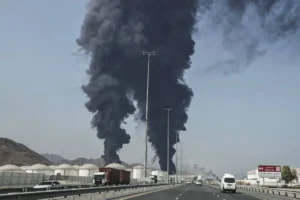
On the Iranian side, the Red Crescent reports 800 deaths, 740 injured and 153 cities affected. Among the victims were dozens of children. Explosions have been reported in the region north of Tehran, and the Iranian government accuses Israel and the US of deliberately targeting civilian infrastructure under the pretext of military targets.
Two-front war and mass displacement
In parallel to the conflict with Iran, Israel resumed operations against Hezbollah in Lebanon. The Israeli army reinforced positions in southern Lebanon and attacked a hotel in Baabda, leaving at least 11 people dead. Local authorities report more than 83,000 people have been displaced by the bombings.
The recurring justification of “terrorist targets” and “military infrastructures” does not stand up to minimal scrutiny: in dense urban conflicts like those in Tehran or southern Lebanon, the line between military target and civilian population is deliberately blurred. The result is a war that collectively punishes an entire population under the guise of neutralizing specific threats.
With two active fronts, the Israeli government projects a resolution of the conflict within ten days, according to RFI. However, the White House indicates a longer period: at least one month of operations. The divergence exposes tensions in strategic-political coordination between the allies.
The “final word” on ending the clashes would fall to US President Donald Trump, according to the same source. Before that, however, Trump publicly stated that the “worst case scenario” for Iran would be the rise of another leader hostile to American interests — a statement interpreted as an implicit endorsement of the policy of targeted killings.
International law under question
The offensive raises criticism for its non-compliance with the United Nations Charter, which prohibits the use of force between States, except in the case of self-defense against an effective armed attack — a condition not publicly demonstrated in the Iranian case.
Experts in international law point out that generic allegations about “future threats” or “hostile intentions” do not constitute a valid legal basis for armed intervention. The doctrine of “preventive self-defense”, tacitly invoked by Washington and Tel Aviv, is considered by many jurists to be a dangerous construction that weakens global legal security.
Furthermore, the resort to force was not preceded by exhaustion of diplomatic channels. It is worth remembering that it was the Trump administration itself that unilaterally withdrew from the 2015 nuclear agreement, dismantling one of the main mechanisms for containing tensions with Iran.
Strait of Hormuz and global impacts
In response to the escalation, the Iranian regime announced a focus on “total control” of the Strait of Hormuz, a critical route through which around 20% of globally traded oil passes. Any closure or disruption has immediate effects on the global economy, raising energy prices and reigniting global inflation. War thus ceases to be a regional conflict and becomes a vector of planetary economic crisis.
Iran’s Revolutionary Guards promised to act with “firmity and severity” against anyone who collaborates with the “aggressor enemy”. Iranian President Masoud Pezeshkian declared that the country “has no other option but to defend itself”, stating that diplomatic attempts were ignored in the face of “military aggression” from Israel and the USA.
Khamenei’s funeral postponed under threat
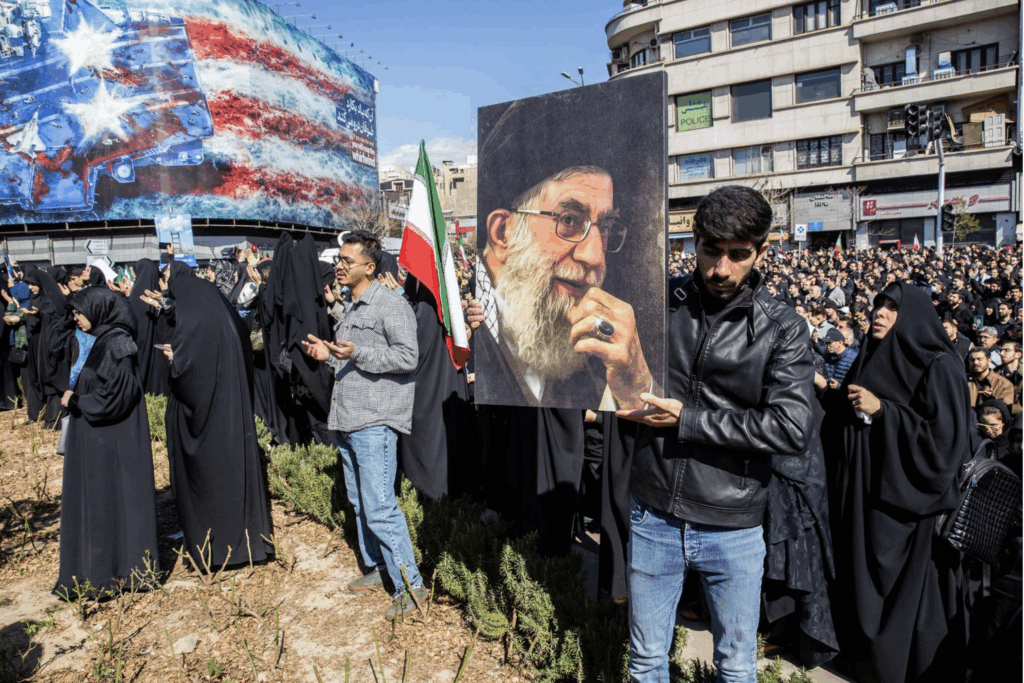
A ceremony in memory of Ayatollah Ali Khamenei, murdered at the age of 86, has been postponed in Tehran, according to the agency Tasnim. The Iranian government cited “logistical problems” and the expectation of a massive influx of mourners — Khomeini’s funeral in 1989 brought together around 10 million people.
The postponement comes amid fears that a mass mourning gathering could become the target of further airstrikes. The situation illustrates the dilemma facing Iran: honoring its dead leader without exposing the population to additional risks.
What lies ahead
As the Iranian succession process progresses under bombardment, the international community is watching developments with apprehension. However, the strategy of systematically eliminating Iranian leaders — now extended to any possible successor — raises questions about the ethical and legal limits of contemporary warfare.
Targeted assassinations, bombings of densely populated areas, and threats to sovereign processes of political succession are not “defense of the free world.” They are the denial of the values that this world claims to defend.
Source: vermelho.org.br