Published 01/15/2026 08:33 | Edited 01/15/2026 16:38
In December 2025, while the bombings in Gaza gave no respite and more than 68,000 Palestinians had already been killed, Benjamin Netanyahu’s government signed the largest contract in Israel’s history: US$35 billion to export gas from the Leviathan field to Egypt by 2040. The announcement was celebrated as a milestone of prosperity. But behind the numbers, there is a brutal reality: this gas is extracted from a sea where Palestinian fishermen are prevented from sailing, and its profits support a war machine that turns hospitals, schools and refugee camps into targets.
The contract provides for the supply of up to US$35 billion in natural gas to Egypt by 2040, from the Leviathan offshore field in the Mediterranean. The agreement deepens Egyptian energy dependence on Israel at a time of crisis in the sector and consolidates Israel as a central actor in the regional energy market.
Report from Algeria carried out a broad survey of the commercial agreements reached between Israel and its economic partners, despite international outrage over the genocide. In addition to Egypt, Germany and the USA will consolidate themselves in 2025 as the country’s main partners, with structural and industrial projects of global impact.
Egypt, despite its majority population supporting the Palestinian cause, insists that the pact is “purely commercial”, without “political dimensions”. This is a diplomatic farce. By consolidating its energy dependence on Israel in the midst of genocide, Cairo not only normalizes the occupation, but indirectly finances the continuation of violence. There is no commercial neutrality in the face of extermination. The transaction is seen as a tacit reinforcement of the normalization of relations between the two countries since the 1979 peace treaty — now anchored in strategic economic interests.
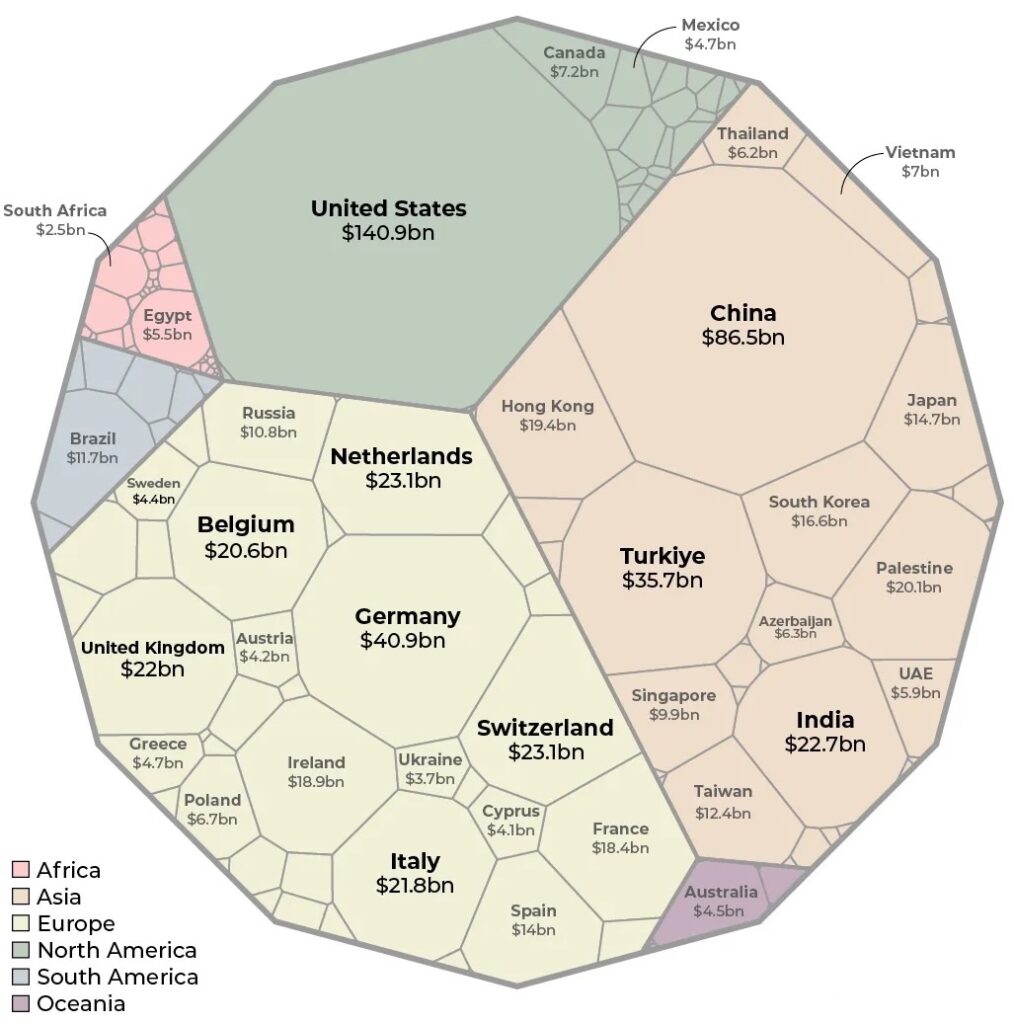
Trade data between 2019 and 2023 shows that more than half of Israel’s trade is concentrated in just ten countries. The United States leads, with almost 19% of total trade, followed by China (11.6%), Germany (5.5%) and Turkey (4.8%), Switzerland and
Netherlands (3.1% each). This concentration helps explain the recurrence of these countries in the largest agreements signed in 2025.
Apartheid technology: startups profiting from surveillance and destruction
Israel also broke records in the technology sector in 2025 — but few question where this “innovation” comes from. In 2025, Israel recorded a wave of acquisitions and investments in the technology sector. Alphabet, Google’s parent company, announced the purchase of Israeli cybersecurity company Wiz for US$32 billion, one of the largest transactions in the country’s history, still under analysis by the European Commission.
Wiz develops systems used in espionage operations against Palestinian activists. Nvidia, by investing US$1.5 billion in an AI center near Haifa, installs its infrastructure in occupied territory, benefiting from tax incentives paid with the blood of bombed civilians.
Nvidia’s investment will build, south of Haifa, the company’s largest artificial intelligence data center outside the United States. The complex is expected to house Blackwell AI processors and reinforces Israel’s role as a global hub for advanced technology.
Other megadeals include the purchase of CyberArk by Palo Alto Networks for US$25 billion and the acquisition of fintech Melio by New Zealander Xero for US$3 billion — the latter, the largest international purchase ever made by New Zealand.
These companies do not operate in a vacuum. They are part of a state-military-industrial ecosystem that transforms oppression into an exportable product. The “startup nation” is, in fact, a “nation of occupation”, whose ingenuity is put at the service of control, segregation and the systematic elimination of an entire people.
“Combat-tested” weapons: the trade in carnage
Nothing symbolizes the trivialization of horror better than the expression “combat tested” — a euphemism used by Israeli companies to sell drones, surveillance systems and interceptor missiles to governments around the world. In 2025, the largest military contract in Israel’s history was awarded to Germany: US$6.5 billion for the Arrow 3 system.
Berlin, which presents itself as the guardian of human rights in Europe, thus finances the same industry that supplies the weapons used to kill children in Khan Younis and Rafah. Developed in partnership with the US, the system is capable of intercepting long-range ballistic missiles and represents a milestone in defense cooperation between Berlin and Tel Aviv.
Companies like Elbit Systems and Rafael have profited from global demand for surveillance equipment, drones and urban combat systems — technologies often described as “combat-tested” in the Gaza Strip and in regional operations. This practical reputation, combined with technical innovation, has made Israel the fourth largest arms exporter in the world.
These sales reinforce the weight of the weapons industry in the Israeli economy, despite international criticism of the use of these systems in recent conflicts. Meanwhile, the Israeli arms industry flourishes: every death in Gaza is input into a new algorithm, a new prototype, a new contract.
Imports, exports and strategic sectors
The numbers are impressive: US$91.5 billion in imports, US$61.7 billion in exports, billion-dollar agreements with Google, Nvidia, Palo Alto Networks. But these indicators hide an uncomfortable truth: the contemporary Israeli economy is deeply dependent on maintaining the conflict. The occupation is not a “secondary problem” — it is the very engine of the frontier capitalism that Israel has built in recent decades.
Machines, electronics, vehicles and chemicals dominate imports, while electronics, pharmaceuticals and medical equipment lead exports. Diamonds cut in Tel Aviv shine on global markets, while in Gaza there is a lack of drinking water, electricity and oxygen in field hospitals.
The export economy is driven by strategic sectors such as advanced electronics, the pharmaceutical industry and the global diamond trade, in which Israel remains one of the main global hubs. In 2024, Israel exported $61.7 billion worth of electronic goods, pharmaceuticals (led by Teva Pharmaceuticals), cut diamonds and medical equipment. Imports totaled US$91.5 billion, mostly in machinery, vehicles and oil.
Despite the trade deficit, the country remains highly attractive for foreign investment, thanks to its innovation ecosystem, highly qualified workforce and advanced digital infrastructure.
Silence: the price of global complicity
The genocide in Gaza is not just the work of Israel. It is possible thanks to the active collusion of States that buy its gas, finance its technology and import its weapons. The European Union, which is still debating the ratification of the EU-Mercosur agreement due to “environmental concerns”, turns a blind eye to the war crimes committed by one of its main trading partners.
Meanwhile, the international community prefers to talk about “balance” and “dialogue”, as if it were possible to negotiate with those who are being erased from the map. There is no neutrality. Anyone who negotiates with Israel in 2025 — especially in strategic sectors — becomes part of the architecture of genocide.
Source: vermelho.org.br