Deep within the Shirkuh granite of Yazd lies a monumental military installation officially known as the “Imam Hussein Base”. Activated in 2026 after 40 years of construction, this facility is far more than a simple bunker; it represents a guarantee of strategic survival for Iran, allowing them to fire missiles at will, regardless of external surface bombardments.
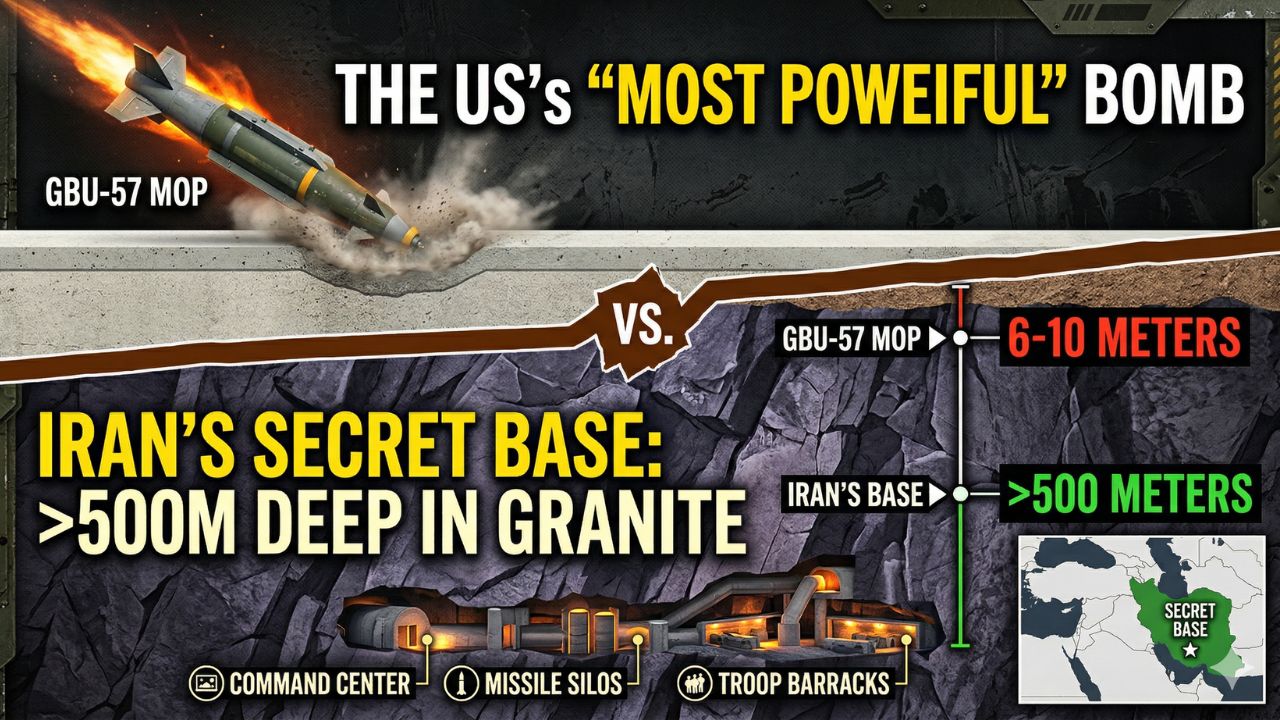
Geology as the First Line of Defense The base’s primary defense mechanism is its geological composition. The Shirkuh granite boasts a compressive strength of 25,000 to 40,000 PSI, which heavily dwarfs standard reinforced concrete’s 5,000 PSI. To put this into perspective, even the GBU-57 MOP—the most powerful anti-bunker bomb in the United States arsenal—can only penetrate 6 to 10 meters into this specific type of rock. Because the vital installations of the base are located more than 500 meters below the surface, they remain functionally and physically out of reach.
Between the surface and these deep installations lies a 440-meter “dead zone” of solid granite. This immense layer ensures that any explosive energy from conventional airstrikes completely dissipates before reaching the critical infrastructure below.
The Automated “Missile Subway” Inside the mountain, the base operates an advanced, automated underground railway system. This “missile subway” connects deep ammunition depots and assembly halls to between 3 and 10 exits distributed across different sides of the mountain.
The operational protocol of this system is highly efficient: a launcher travels on rails to an exit, emerges to the surface, fires its payload, and immediately retreats back underground. Following the launch, the exit is rapidly sealed by armored decompression chambers. This entire sequence is executed in less time than it takes for an enemy counter-attack to respond. The effectiveness of this system was confirmed when actual launches from this underground rail infrastructure were observed on March 20, 2026, proving the base is fully operational despite ongoing bombings.
International Supply Chains and Engineering The construction of this colossal project relied on a complex web of international technology and local engineering. The primary civil engineering and tunneling work was conducted by the Islamic Revolutionary Guard Corps (IRGC) and its affiliated companies. However, foreign technology played a crucial role:
- North Korea supplied Herrenknecht and Wirth/Sell tunnel-boring machines (TBMs) through intermediaries.
- China provided essential chemical routes (the ST8 network) via companies like Saman Tejarat Parman and Shangan Amour to supply solid fuel.
- Sensitive materials and industrial chemicals were transported through mixed networks via Parchin Chemical Industries (PCI).
Unprecedented Resilience The base features an incredibly robust survival strategy. If any of the mountain entrances are damaged during an attack, they can be rapidly sealed from the inside using ultra-high-strength Iranian concrete capable of withstanding 30,000 PSI. This allows any compromised entrance to be repaired in just a few hours without exposing personnel to the surface.
Ultimately, while external attacks might successfully neutralize mobile surface launchers, they cannot physically destroy the infrastructure buried 500 meters deep in the granite. As long as the Imam Hussein Base exists, it guarantees that Iran retains the capability to launch strikes whenever and from wherever it chooses.
Note: I can also generate a downloadable Tailored Report document containing this article for you to save. Let me know if you would like me to create that artifact!