Published 05/12/2025 13:12 | Edited 05/12/2025 13:25
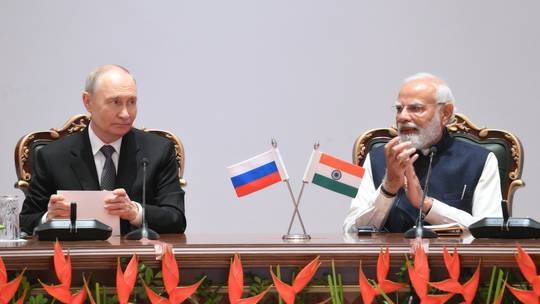
Russian President Vladimir Putin arrived in New Delhi this Thursday (4) for a two-day visit marked by the signing of new economic and military agreements with India, amid pressure from the Donald Trump administration for the Asian country to reduce its purchase of Russian oil. It is Putin’s first trip to the country since 2022, when the war in Ukraine began.
In the joint statement, the two governments stated that, “in the current complex, tense and uncertain geopolitical scenario, Russian-Indian ties remain resilient to external pressure”, in a direct reference to Washington’s effort to limit the relationship between the two BRICS members.
Modi treated the visit as a public demonstration of strategic autonomy. In a speech after the summit, he described the bilateral partnership as “a guiding star” and stated that, “based on mutual respect and deep trust, these relationships have always stood the test of time”.
Putin returned the gesture by praising India’s foreign policy. “Under the leadership of Prime Minister Modi, India is pursuing an independent sovereign policy and it is achieving great results in the economy,” he said.
The choreography reinforces a message that interests both sides. For Moscow, it is about indicating that, despite Western sanctions and the indictment at the International Criminal Court, Russia is not isolated.
For New Delhi, which has experienced years of strategic rapprochement with the US, the objective is to balance relations without submitting to pressure from Trump.
According to an analysis heard by the DWgiven by researcher Rajan Kumar, from Jawaharlal Nehru University, “Trump’s policies have generated a loss of trust in the United States and increased the importance of Russia” for India.
The assessment converges with recent episodes: the Republican imposed 50% tariffs on Indian products in response to purchases of Russian oil, a move that upset New Delhi and ended up bringing the two historical partners closer together.
The meeting produced a dozen memos in the sectors of energy, fertilizers, pharmaceuticals, infrastructure, media and maritime transport. Modi announced that both had defined “an economic cooperation program for the period up to 2030”, which would make trade “more diversified, balanced and sustainable”.
The goal is to increase exchange to US$100 billion by the end of the decade and reduce the imbalance caused by India’s high dependence on Russian oil — which jumped from 2% before the war to more than 35% after 2022.
Putin stated that there will be no changes in supplies to India and said that “Russia will continue to guarantee uninterrupted fuel supplies”.
The Russian also highlighted the construction of India’s largest nuclear power plant, in Kudankulam, and announced a joint anti-cancer drug factory in Kaluga, signaling that Moscow seeks to diversify India’s economic presence on its territory.
In the military sector, India remains the largest customer of Russian weapons, although it has been increasing its purchase of Western equipment in recent years.
The new bilateral guideline foresees an effort to adapt cooperation to demands for self-sufficiency in defense. According to the statement, there will be joint production of parts, components, assemblies and advanced platforms in Indian territory, reducing dependencies and expanding local technological capacity.
In an interview with India TodayPutin said that the military partnership will now be guided by research and development.
“In response to India’s aspirations for self-reliance, the partnership is now being refocused on joint research and development as well as production of advanced defense platforms,” he said.
Even with limitations on Russian industry — pressured by the war and by sanctions that restrict sensitive materials — the Kremlin presented new projects, resuming the intention to expand co-productions that have already yielded results, such as the Su-30 fighters and the BrahMos missile.
Trump tariffs and energy dispute push India closer to Russia
The backdrop of the visit is the North American tariff and diplomatic escalation. The surcharges imposed by Trump directly affected the Indian economy and provoked angry reactions from the Modi government.
Russia took advantage of the moment to present itself as a stable partner — and, at the same time, challenge Washington.
When asked about US pressure on New Delhi to reduce oil purchases, Putin mocked the US argument.
“If the US has the right to buy our [combustível] nuclear, why shouldn’t India have the same privilege?”, he said.
The speech exposes the double standard denounced not only by Moscow, but also by observers from the Global South in the face of the sanctions regime.
Public image, media and narrative dispute in the Global South
Throughout the visit, New Delhi reinforced the visibility of the meeting with billboards displaying images of the two leaders. Putin also took advantage of his visit to the capital to launch RT India, the Indian arm of the Russian state broadcaster. The president stated that the new channel will give “millions of Indian citizens the opportunity to learn more about the reality in Russia”.
The warm reception and widespread local coverage indicate that Russia retains significant space in Indian public opinion — where nearly half of Indians have a favorable view of the country, according to the Pew Research Center.
A satirical video that went viral in the local press shows Modi driving a motorbike, with Putin in the sidecar, to a gas station with Russian and American bombs; in the clip, the Indian man fills his tank with Russian fuel while Trump protests.
The caricature reflects the predominant reading in New Delhi: India reaffirms its autonomy and does not accept conditionalities. As former foreign secretary Kanwal Sibal said, “The US cannot dictate what India’s foreign policy should be. We need to adapt and resist.”
Russia and India project their places on the reconfigured board
Putin’s visit is both a piece of resistance in the face of Western sanctions and a signal to the Global South that traditional alliances remain alive. For Modi, the meeting helps to show that his policy of “strategic autonomy” is not a slogan, but a practice: relating to Washington when appropriate and strengthening ties with Moscow when necessary.
In an environment of growing dispute between great powers, Russia and India are looking for room for maneuver. Moscow’s reading is that closer ties with New Delhi reduce its dependence on China. For India, it is about balancing pressure from Trump, avoiding arguments with Beijing and reinforcing its role as a major Asian power — economically, demographically and militarily.
The phrase chosen by Modi sums up the message of the visit: “Humanity has gone through many challenges, but ties between Russia and India have been like the North Star.”
Source: vermelho.org.br