Published 05/02/2026 11:36 | Edited 05/02/2026 20:12
United States President Donald Trump’s expansionist rhetoric has begun to produce fissures in the far-right camp.
Leaders who a year ago celebrated their return to the White House began to adopt a more cautious or critical tone after the US military operation in Venezuela, tariff threats against European allies and explicit pressure on Greenland.
The movement exposes a growing tension between the sovereignist nationalism defended by these parties and the aggressive foreign policy adopted by Washington.
The first public demonstrations came after the military operation ordered by Washington on January 3, which ended with the capture of Nicolás Maduro and Cilia Flores.
Although parties on the European right have a history of opposing the Venezuelan government, the United States’ action was received with reservations.
Marine Le Pen, leader of the National Regroupment (RN), in France, wrote that “there are a thousand reasons to condemn Nicolás Maduro’s regime: communist, oligarchic and authoritarian, but state sovereignty is never negotiable”, introducing a line of criticism that does not start from the defense of Caracas, but from the defense of the principle of national sovereignty.
Discomfort increased when Trump began threatening to impose tariffs on European countries that resisted his plans to take control of Greenland.
Nigel Farage, British parliamentarian and leader of Reform UK, an extreme right-wing party, classified the stance as “a very hostile act”, stating that friends may disagree, but that conditioning commercial relations on the acceptance of a territorial appropriation goes beyond acceptable political limits.
The reaction exposed a sensitive point: the nationalist discourse of these parties encounters difficulties when external pressure comes from precisely the government they previously celebrated.
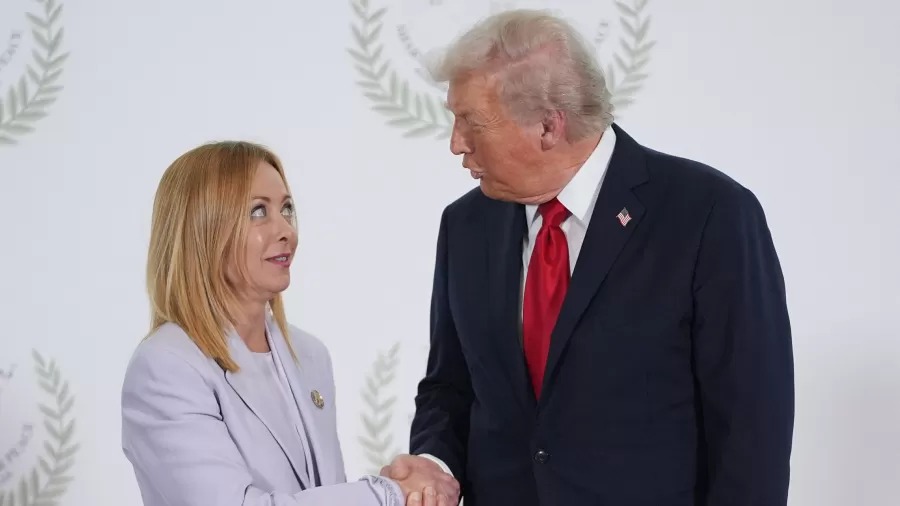
In Italy, Giorgia Meloni, prime minister and leader of the Brothers of Italy party, sought to preserve the bilateral relationship, but warned that “friendship demands respect”. The statement was made after Trump minimized the collaboration of NATO allies in the war in Afghanistan, an episode that worsened the unease between political forces that traditionally defend strategic alignment with Washington.
The criticism did not represent a rupture, but it signaled the need to demarcate limits in relation to its own electoral base.
In Germany, Alice Weidel, leader of the Alternative for Germany (AfD), stated that Trump would be failing to fulfill his promise not to interfere in other countries and declared that the American president “will have to give explanations to his voters”.
The position takes place in a context of deteriorating image of the United States in German public opinion. A survey cited in the country’s political debate indicates that only a small portion of the population supports both the action in Venezuela and the stance in relation to Greenland, and that trust in the USA as a partner has been falling significantly.
In the United Kingdom, research also points to a growing perception that the United States acts in a hostile manner. A significant portion of those interviewed would support economic sanctions if there were an attempt to invade Greenland, and a smaller contingent considers a military response to be appropriate.
This environment helps explain why Farage described the episode as the biggest rupture in transatlantic relations since the Suez Canal crisis in 1956.
The movement, however, is not uniform. Leaders such as Viktor Orbán, of Hungary, Andrej Babis, Prime Minister of Czechia, and Robert Fico, Prime Minister of Slovakia, chose to avoid public criticism, preserving alignment with Washington.
The Spanish party Vox also remained silent both in the face of tariff threats and in relation to the exclusion of María Corina Machado from the Venezuelan political scenario projected after Maduro’s capture.
The internal division shows that the European right does not act as a homogeneous bloc, although it shares ideological references.
Analysts heard in the European debate assess that the distance tends to be tactical. Direct association with Trump has come to represent an electoral risk in certain national contexts, especially where public perception of the US has deteriorated over the last year.
The so-called “Make Europe Great Again” agenda, inspired by Trumpism, faces the limit imposed by its own voters when North American foreign policy appears to collide with European sovereignty.
At the same time, Washington’s actions had the opposite effect in other sectors of the continent. The tension rekindled the Franco-German articulation and stimulated debates about strategic independence in relation to the United States.
It also brought the United Kingdom closer to the European Union on issues of geopolitical coordination, despite Brexit.
Whether the separation will be lasting is still uncertain. For now, what is observed is an adjustment in discourse. Trump’s imperialist rhetoric confronts the nationalism that these forces seek to present as the legitimate defense of their States.
When North American expansionism affects European territory, ideological affinity finds a political limit that is difficult to overcome.
Source: vermelho.org.br