Published 03/13/2026 15:37 | Edited 03/13/2026 16:17
The Chinese Red Cross announced, this Friday (13), the sending of US$ 200 thousand (more than R$ 1 million) in emergency humanitarian assistance to the Iranian Red Half Moon. The resources will specifically go to the families of children killed in the bombing of Shajareh Tayyebeh Primary School, in the city of Minab, Hormozgan province, in southern Iran.
The announcement was made by Foreign Ministry spokesman Guo Jiakun at a press conference in Beijing, marking a new front of diplomatic pressure against the United States and Israel in the context of the war escalation that began on February 28.
Firm condemnation: “violation of human conscience”
“China condemns all indiscriminate attacks against civilians and non-military targets. Attacks on schools and harm to children are particularly serious violations of international humanitarian law and go beyond the bounds of fundamental human morality,” Guo said.
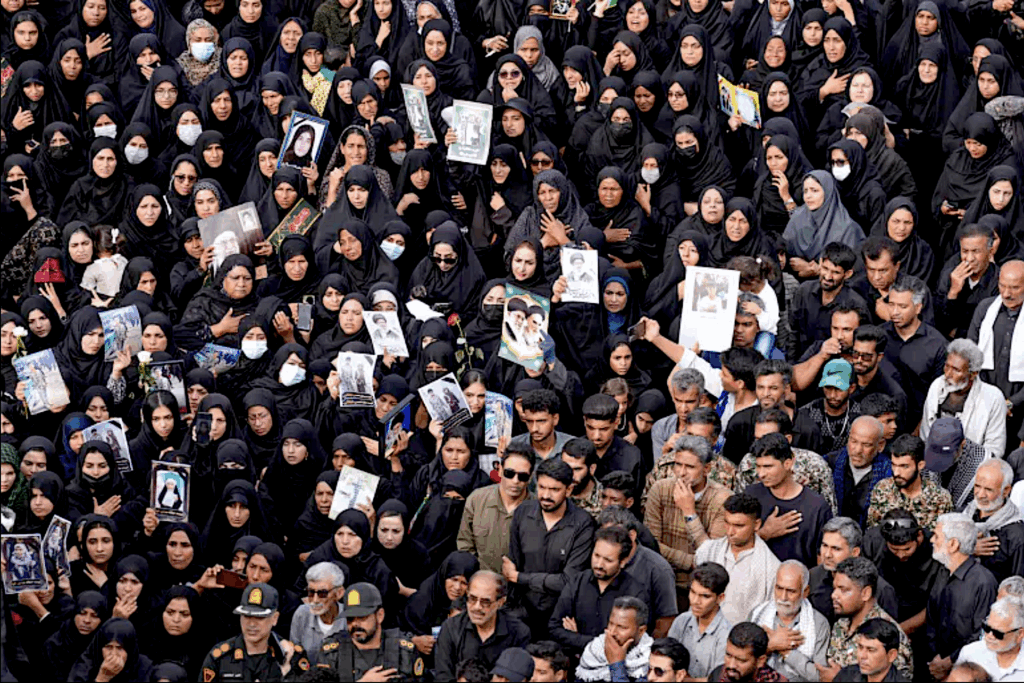
According to the Iranian government, the bombing of the girls’ primary school resulted in the deaths of 168 children and several teachers, totaling 176 fatalities. The attack occurred in the first days of Washington and Tel Aviv’s joint military offensive against strategic targets on Iranian territory.
Guo reinforced that Beijing “is willing to continue providing the necessary assistance to Iran in a humanitarian spirit, to support the Iranian people in overcoming the difficulties generated by the conflict.”
Chinese Red Cross: action under communist leadership
It is worth noting that the Chinese Red Cross operates independently, but under the leadership of the Chinese Communist Party, being supported and financed by popular governments at all levels. Its humanitarian activities therefore reflect both commitments to universal principles and alignment with the foreign policy of the Chinese state.
The donation of US$200,000, although symbolic in financial terms, carries diplomatic weight: it signals concrete solidarity with Iran and reinforces Beijing’s narrative as a defender of international law and the protection of civilians in conflicts.
UN position: China demands immediate end to hostilities
At the United Nations Security Council, China’s permanent representative, Fu Cong, raised the tone of criticism. He demanded that the United States and Israel “immediately cease military actions and refrain from attacking Iranian nuclear facilities under International Atomic Energy Agency (IAEA) safeguards.”
Fu warned of the risk of escalation and spread of the conflict throughout the Middle East region. “Iran’s sovereignty, security and territorial integrity must be respected. We urge the United States to reverse its position immediately, return to diplomatic negotiations, make a clear commitment not to use force,” he declared.
China voted in favor of the resolution proposed by Russia in the Security Council, which called for an immediate end to military activities and a return to diplomatic channels. The text received support from China, Russia, Pakistan and Somalia, but was vetoed by the United States, with Latvia also voting against.
“This is a war that should not have happened and that benefits no one. The history of the Middle East repeatedly demonstrates that force solves nothing and armed conflicts only increase hatred and generate new crises,” said Fu.
Humanitarian crisis: millions of displaced people
UN Secretary-General António Guterres classified the massive military attacks as a “serious threat to international peace and security”. According to data from the UN High Commissioner for Refugees (UNHCR), the conflict has already internally displaced more than 4.1 million people in Afghanistan, Iran, Lebanon and Pakistan.
In Iran alone, between 600,000 and 1 million families are temporarily displaced — around 3.2 million people —, a number that tends to grow as long as the aggressions persist. Another 117,000 sought refuge in neighboring countries.
Strategic interests and diplomacy
Chinese action in the conflict reflects a combination of humanitarian principles and geopolitical calculations. Analysts point to four central factors:
- Energy security: China is one of the world’s largest oil importers and depends on the flow through the Strait of Hormuz. Instability in the region directly threatens its supply routes.
- Strategic partnership with Iran: In recent years, Beijing and Tehran have strengthened economic and political ties, including long-term agreements on energy and infrastructure.
- Global competition with the US: China frequently criticizes US military interventions and defends non-interference in internal affairs, positioning itself as a counterweight to Western hegemony.
- Regional balance of power: Beijing does not want to see Iran completely isolated or weakened, which could expand the influence of the US and its allies in the Persian Gulf.
Ongoing investigation: US admits targeting error
While China condemns the attack, the New York Times reported that a US military investigation concluded that an American Tomahawk missile hit the school due to “targeting error”. Israel denied any involvement or prior knowledge of the episode.
President Donald Trump initially suggested that Iran itself could be responsible — despite Tehran not possessing Tomahawk missiles. He later stated that he could “live with” any outcome of the investigation, but when asked about the report, he said: “I don’t know about that.”
The lack of transparency and the delay in investigation reinforce criticism from Beijing and other international actors regarding the conduct of military operations.
Chinese diplomacy: between principles and pragmatism
China’s position in the conflict illustrates its strategy of principled diplomacy with strategic pragmatism. By condemning violations of humanitarian law and demanding negotiations, Beijing strengthens its image as a responsible power. At the same time, it protects its energy interests and expands its influence in the Global South.
As Guo Jiakun summarized: “China stands ready to continue providing necessary assistance to Iran in a humanitarian spirit.” The message is clear: in a world on fire, Beijing positions itself not as a spectator, but as a decisive actor in the search for diplomatic solutions — and in defending its own national priorities.
Source: vermelho.org.br