Posted 12/07/2025 12:37 | Edited 12/07/2025 13:43
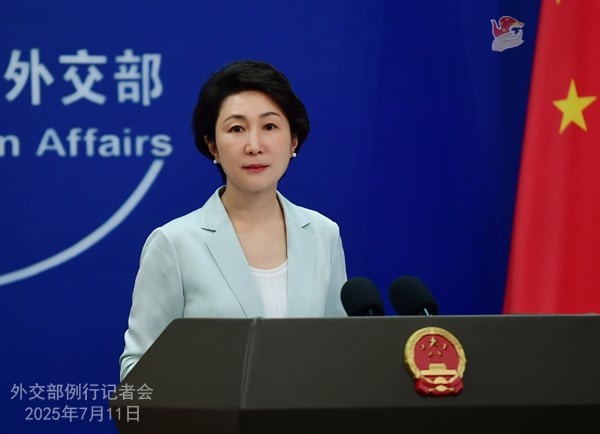
China harshly criticized the 50% tariff announced by Donald Trump against all Brazilian products. At a press conference on Friday (11), the spokesman for the Ministry of Foreign Affairs, Mao Ning, accused the United States of violating fundamental rules of international law and trying to interfere with Brazil’s internal affairs.
“Tariffs should not be used as a tool for coercion, intimidation and interference in internal affairs in other countries,” he said.
By justifying the surcharge to Brazil, the US President claimed that the South American country would be promoting “insidious attacks” against free elections and the freedom of expression of US companies and citizens-in reference to Jair Bolsonaro’s trial and STF actions against digital platforms.
“Sovereign equality and non -interference in internal affairs are important principles of the United Nations Charter and basic norms in international relations,” said Mao Ning, reaffirming the official position of the Chinese government.
She also warned that actions like this undermines global stability. “There are no winners in commercial and tariff wars, and protectionism leads nowhere,” he said.
Later this week, China had already spoken out against previous threats from Trump, which announced additional 10% tariffs to countries that adopt BRICS “anti -American” policies.
The bloc countries responded that BRICS “has no country as a target” and seeks only to strengthen cooperation between emerging. The Chinese government also pointed out that the US is trying to isolate its main geopolitical rival through a tariff offensive, even reaching Southeast Asia countries, such as Cambodia.
The international repercussion tends to grow with the escalation of US retaliation to strategic partners in Brazil. Itamaraty, in turn, has reiterated that it will respond firmly, and President Lula has already triggered the law of reciprocity and articulates joint reactions in the G20 and the WTO.
Russia criticizes surcharge and suggests expansion of BRICS
Russia also reacted to Trump’s tariff against Brazil, with a direct nod to the expansion of BRICS. According to the Deputy Minister of Foreign Affairs, Serguei Riabkov, the response to US protectionism can come with strengthening and enlargement of the block of emerging countries.
In a statement to the press, Riabkov stated that the group “is ready to receive new partners” and suggested that countries already informally associated, such as Bolivia, Cuba, Nigeria, Malaysia and Vietnam, could be next to BRICS formally.
“We are confident that the countries included in the first circle of partners will bring their own value elements to BRICS cooperation,” said the Russian diplomat, adding that there is “security that others will follow them.” According to him, the expansion process will be careful, but it represents a direct response to the political use of tariffs and sanctions by the Trump administration.
Riabkov’s speech echoes the dissatisfaction of several countries with Washington’s attempt to use trade as an instrument of geopolitical punishment.
In the Brazilian case, the 50% surcharge was announced after criticism from the former US president to the trial of Jair Bolsonaro and the Federal Supreme Court’s performance-elements that, for Moscow and Beijing, constitute clear interference in the internal affairs of a sovereign state.
In a speech in Espírito Santo this Friday (11), President Lula reinforced the need for multilateral responses. “I’m going to fight on the WTO, I’ll talk to my Brics companions. But if there’s no way in the chat, let’s establish reciprocity. He taxed here, we rate there.”
Brazil today accumulates commercial deficit with the United States, which empties Trump’s arguments about alleged damage to US industry. Lula mocked: “You are very poorly informed. The US has no commercial deficit with Brazil. It is Brazil that has a deficit with Brazil. We should tax it.”
Source: vermelho.org.br