Published 01/19/2026 15:34 | Edited 01/19/2026 16:42
China’s economy recorded an expansion of 5% in 2025, reaching exactly the target set by the government, even in the face of a challenging international scenario. According to the National Statistics Office (NBS), the performance was mainly supported by the strong dynamism of exports, which offset the persistent weakness in domestic consumption and the prolonged crisis in the real estate sector. The result confirms a strategic shift in Chinese economic policy since the 2021 housing collapse: instead of directly stimulating consumers, Beijing has channeled investments into the industrial and technological complex, strengthening its presence in global markets.
The result confirms the estimate anticipated by President Xi Jinping and highlights the country’s ability to sustain growth even under increasing external pressure, especially given the tariff policies adopted by the United States to contain China’s rise.
Exports as a pillar of resiliencea
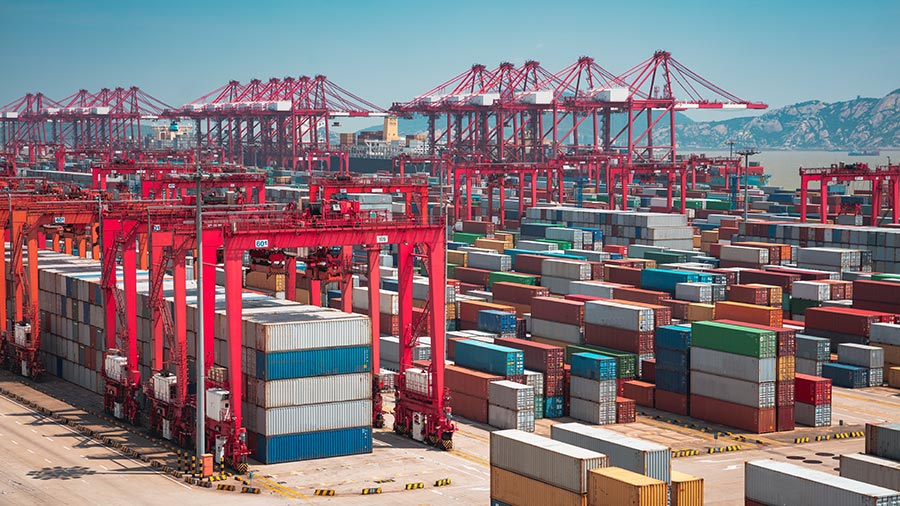
Exports accounted for about a third of GDP growth in 2025 — the biggest impact since 1997 — and allowed China to circumvent tariffs imposed by the United States government under Donald Trump. Although shipments to the North American market fell by around 20%, Chinese producers successfully redirected their sales to Asia, Africa, Latin America and Europe, gaining new trading partners.
This reorientation allowed China to record a record trade surplus of US$1.2 trillion, 20% higher than in 2024 — an amount equivalent to the size of entire economies, such as Saudi Arabia. The data reinforces the view that US attempts at containment failed to stop China’s advance, but only stimulated market diversification.
“China’s ability to quickly adapt to trade restrictions demonstrates the maturity of its industrial base and the effectiveness of its economic diplomacy,” notes Lynn Song, chief economist for Greater China.
Structural reconfiguration of the economy
The year 2025 marked a consolidation of the industrial turn promoted by Beijing. While real estate investment plummeted 17.2% and domestic consumption remained anemic — with retail sales growing just 0.9% in December — industrial production advanced 5.9%, driven by sectors such as electric vehicles, batteries, solar panels and high-tech equipment. This reorientation generated, however, an excess of production capacity, leading factories to seek markets across borders to absorb supply.
This strategy has not only sustained growth, but also reinforced China’s position as a key supplier of green and digital goods in a global economy in transition.
Internal challenges persist, but do not impede progress
Despite export success, the NBS acknowledged that economic development in 2025 was “hard won”. Domestic demand remains weak, aggravated by the historic drop in the birth rate — just 7.92 million births in 2025, the lowest level since 1949 — and the population contraction of 3.39 million people. The drop in birth rates increases the pressure to increase productivity and sustain growth in the medium and long term.
Furthermore, investment in fixed assets fell 3.8%, the first annual decline since 1996, reflecting fiscal retrenchment by indebted local governments. Analysts point out that, although the annual target was met, the quarter-by-quarter slowdown indicates fragility in domestic demand.
Even so, the fourth quarter closed with growth of 4.5%, above expectations, and within a trajectory considered stable by the government. “The national economy maintained the steady pace of progress in 2025 despite multiple pressures, and high-quality development recorded new achievements,” the NBS said in a statement.
Meanwhile, on the other side of the world…
To date (January 19, 2026), the final official data on economic growth in the United States in 2025 has not yet been released by the Bureau of Economic Analysis (BEA), the body responsible for the country’s economic statistics. However, based on the most recent estimates available — including projections from the IMF, the World Bank, the Federal Reserve (Fed) and financial institutions such as Goldman Sachs and JPMorgan — it is possible to make a preliminary comparison between the economic performance of China and the US in 2025
US real GDP growth (2025) is estimated at around 2.3% until January 2026, and could vary from 2.1% to 2.5%, depending on the institution. Numbers that reflect a context in the US of resilient consumption, a buoyant job market, and high interest rates. The BEA will release the official data on February 27, 2026.
China grew more than twice as fast as the US in percentage terms (5.0% vs. ~2.3%). This difference is consistent with the historical pattern: emerging economies tend to grow faster than advanced economies, even in times of slowdown.
China’s growing dependence on exports (accounting for about a third of GDP in 2025) and industrial production, combined with stagnant domestic consumption, contrasts with US growth, driven mainly by household consumption, supported by a robust labor market (unemployment rate around 4%) and recovering real wages. Investments in infrastructure and semiconductors — driven by the CHIPS and Science Act — also contributed.
The US operated with high interest rates (interest rates between 5.25% and 5.50% for almost all of 2025) to contain inflation, which moderated growth but preserved macroeconomic stability.
Although the nominal GDP of the USA (estimated at US$29 trillion in 2025) continues to be higher than that of China (around US$18.5 trillion), the Chinese remain the largest economy in the world in purchasing power parity (PPP), according to the IMF. Saying that China has the highest GDP at purchasing power parity means that its economy produces more in real terms within its borders, thanks to the combination of a large population and lower cost of living — but not that it has surpassed the US in wealth, innovation or global economic power.
Both countries, despite different trajectories, showed capacity to adapt in a year marked by geopolitical tensions, trade fragmentation and global uncertainties.
Looking to the future: towards the 15th Five-Year Plan
With the 15th Five-Year Plan (2026–2030) about to begin, Beijing’s focus now turns to balancing external expansion with domestic market revitalization. The goal of transforming China into a moderately developed economy by 2035 will require an average of 4.17% annual growth over the next decade — a viable challenge, according to analysts, given the resilience of the export sector and advances in innovation.
For Beijing, 2025 growth was “hard-won,” in the words of NBS chief Kang Yi, who acknowledged the combination of strong supply and weak demand as a central challenge. Still, the data shows that China managed to preserve economic dynamism and expand its global presence precisely at a time when Washington is trying to limit its influence.
“Achieving another year of solid growth in 2026 will be crucial to getting the new planning cycle off to a good start,” highlighted Lynn Song. Meanwhile, China’s ability to navigate turbulent waters — maintaining goals, expanding markets and restructuring its economy — reinforces its central role in the global economy, even under intense geopolitical pressure.
The result reinforces the perception that the dispute between China and the United States goes beyond the commercial field and takes on strategic and systemic contours. By sustaining growth via exports and industry, Beijing signals that, despite the barriers imposed by the US, it continues to advance towards the goal of becoming a moderately developed economy by 2035 — even if the path ahead will prove narrower and more complex.
Source: vermelho.org.br