Published 09/01/2026 12:25
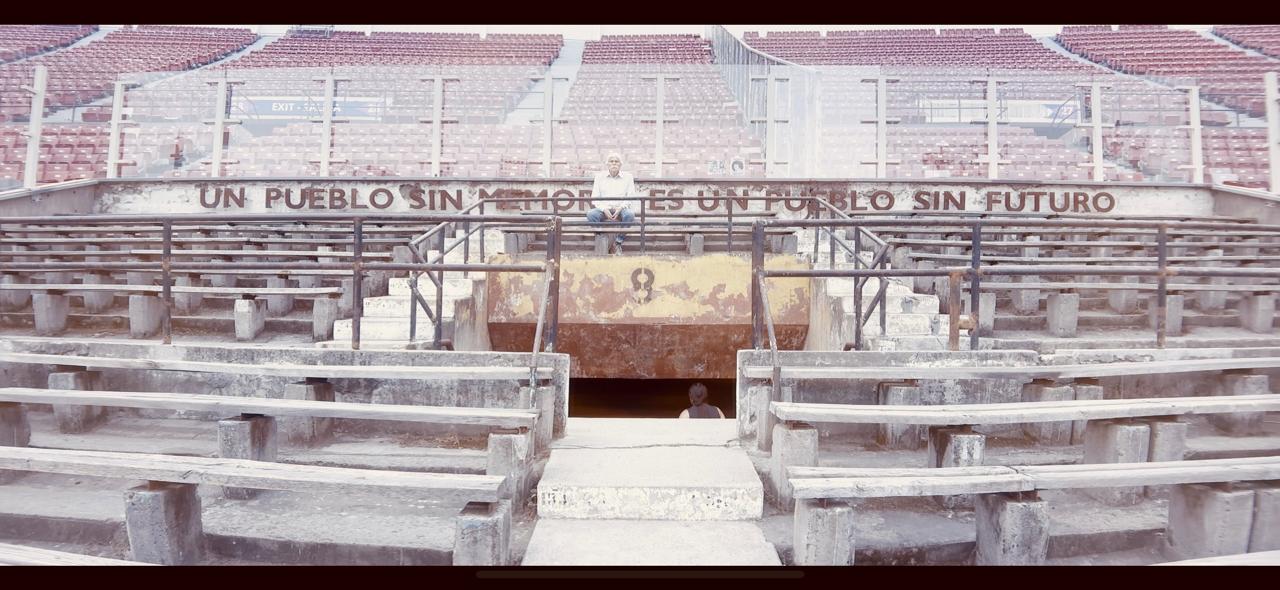
We came to Chile to cover the Fiesta de los Abrazos, one of the most important political and cultural events of the Chilean left. The agenda, however, would not be complete without a visit to one of the main symbols of repression during Augusto Pinochet’s dictatorship, the National Stadium, in Santiago. More than a sports stage, the place was transformed, after the coup of September 11, 1973, into an open-air concentration camp, where thousands of men, women and children passed through.
The visit was led by Patrício Sandoval Droguett, secretary of the National Corporation for the Memory of the National Stadium for Former Political Prisoners, former political prisoner and reference in preserving the memory of the National Stadium, and was accompanied by Romina Cabrera, administration manager of the Corporation. The reception was marked by care, generosity and political commitment to historical truth.
Opened in 1938, during the government of Arturo Alessandri Palma, the National Stadium was conceived as a space dedicated to sport, culture and popular coexistence. This vocation was violently interrupted after the civil-military coup, when the stadium began to function as a detention, interrogation, torture and execution center. It is estimated that tens of thousands of people were held there, in inhumane conditions, under permanent armed surveillance.
During the journey, Patrício reported how the stands, today associated with football matches and large concerts, were used to keep prisoners for long periods, exposed to cold, hunger and constant fear. In the same space, he mentioned episodes that reveal the complexity and brutality of repression, including cases of betrayal among former militants, encouraged and exploited by the dictatorship apparatus itself. One of the examples cited was that of Juan Muñoz Alarcón, “The Hooded Man”, a former militant who collaborated with repressive bodies and was later murdered, highlighting the perverse logic of a regime that even destroyed those it instrumentalized.
Another space with a strong impact is the women’s locker room, where Chilean and foreign women of different ages, origins and political trajectories were imprisoned. Currently, the place houses poems written by former prisoners and copper plaques with the names of the women who were detained and identified there. There are records of women from different countries, including Brazil. The space, previously marked by violence, became a place of homage, recognition and resistance.
Throughout the visit, Patrício also highlighted episodes that reveal the human capacity to build solidarity even in the most extreme conditions. Among them, the report of a wedding celebrated inside the stadium and the impromptu celebration of a birthday among prisoners. Simple but deeply political gestures that expressed fraternity, companionship and affirmation of life in the face of barbarity.
The route also included the Andes Norte Permanent Gallery, an exhibition that presents the context of Popular Unity, the coup d’état, the experiences of prisoners in the National Stadium and their subsequent evacuation. The space articulates documents, images and reports that help to understand the stadium as a territory of memory, where sport, culture and politics intersect inseparably.
Patrício highlighted the importance of the educational work carried out by the Corporation, especially with students, young people and social movements. For him, preserving memory is not about remaining in the past, but facing the present, combating denialism and affirming the centrality of human rights as the foundation of democracy.
At the end of the visit, we said goodbye in a fraternal hug, full of respect and emotion. The visit to the National Stadium was more than a journalistic record, it was a direct encounter with the living history of the Chilean popular struggle. In a context marked by attempts to relativize the crimes of dictatorships and rewrite the past, the work carried out at the National Stadium reaffirms that there is no possible democratic future without truth, memory and justice. Preserving these spaces is a political commitment to the victims of repression and to the new generations who continue fighting to ensure that barbarism does not happen again.
Source: vermelho.org.br