Published 07/07/2025 11:15 | Edited 07/07/2025 11:50
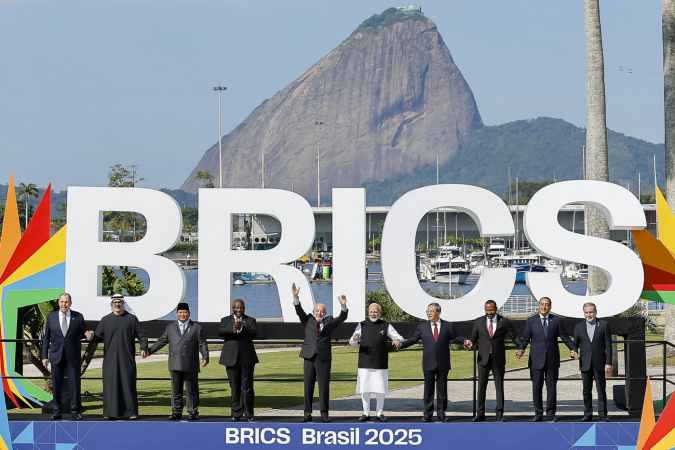
Hours after the completion of the 17th BRICS leaders summit in Rio de Janeiro, US President Donald Trump went to social networks to launch a new commercial threat against global southern countries.
Not to mention names, he said that “any country that alienates with BRICS anti -American policies” will be punished with an additional 10%rate, “without exceptions.” The announcement is interpreted as an indirect response to the growing international projection of the bloc, currently led by Brazil.
The tariff threat occurs amid the advancement of a new global articulation. With the presidency held by Luiz Inácio Lula da Silva, BRICS approved on Sunday (6) the declaration of Rio de Janeiro, a document that advocates deep reforms in multilateral architecture, with concrete proposals in areas such as commerce, climate, digital sovereignty, health, science and hunger fighting.
While denouncing unilateral sanctions and political use of northern -dominated financial institutions, the bloc proposes its own mechanisms for cooperation and financing – including trade in local currencies, green funds and autonomous digital infrastructure.
The annoyance of the White House with this movement is not new. Since returning to the presidency in 2024, Trump has scaled his rhetoric against BRICS, especially in the face of discussions on international trade dedolarization. In previous statements, he even threatened 100% rates to countries adopting an alternative currency to the dollar.
Read more: BRICS NO RIO: Declaration of the Summit Moths New Architecture of Global Governance
Now the new tariff offensive coincides with the end of a summit in which BRICS, for the first time, formalized proposals in the name of a multipolar governance based on cooperation and equity.
Despite not having quoted Brazil directly, Trump’s speech is seen as a veiled attack on the Lula administration, which has played a central role in reconfiguring the block.
The response from the BRICS countries to Trump pressure came quickly, albeit with different shades. Russia has stated that the block “has never been and will never be directed against any third countries.” Kremlin spokesman Dmitry Peskov reiterated that group countries share “a common view on how to cooperate based on their own interests.”
Already China, through its chancel, directly criticized the use of tariffs as an international coercion tool. “The use of tariffs does not benefit anyone,” said spokeswoman Mao Ning. South Africa has adopted a more cautious tone, reaffirming that it is not anti -American and is still committed to bilateral negotiations.
Malaysia, BRICS’s partner since 2024, also replied that its foreign policy is independent and focused on facilitating trade, not ideological alignments.
The reactions indicate that, even in the face of the US economic pressure, the BRICS countries and their partners keep the willingness to continue building an international order based on sovereignty, cooperation, and multilateralism – central pillars of the Rio Declaration.
The summit in Rio, the presence of more than 20 countries and the emphasis of the Brazilian president in the UN reform and in the defense of Palestine signals a strategic inflection: the global south also wants to presence at the center of the global debate. On the other hand, the US response did not come through dialogue, but through economic coercion.
Behind the scenes of diplomacy, the moment is also of tension. Sources heard by UOL They confirmed that delegations from Brazil and the US gathered by video conferencing on Friday (4) to try to negotiate a trade agreement and avoid the new round of tariffs.
The Brazilian government offered the reduction of tariffs on US ethanol, since the US suspended barriers to Brazilian sugar. So far, however, there has been no formal response from the White House. In the Planalto Palace, the pessimism grows that Brazil will be left out of the list of agreements to be announced by Trump this week.
Tariff pressure directly affects strategic sectors of the Brazilian economy. Since April, the US has imposed a general rate of 10% and taxed Brazilian steel by 50%. Data from the Brazil-Eua Chamber of Commerce show that five of the ten most exported products in Brazil to the US registered a drop, and the US commercial surplus with Brazil rose to US $ 1 billion. Instead of correcting distortions, the measure expands dependence and weakens trade balance on the Brazilian side.
Read more: BRICS may have its own high -speed submarine communication network
The tariff offensive must also be interpreted from a geopolitical perspective. By retaliating countries approaching Brics, Washington tries to contain the emergence of alternatives to his domain.
But unlike isolating the block, retaliation reinforces the need to consolidate its own development instruments, such as the BRICS Bank, the contingency reserve agreement and the land restoration partnership. For the global south, the response to coercion is more integration.
In the Rio Declaration, the member countries were categorical: the current international system is dysfunctional, excluding and anachronistic.
They reaffirmed the defense of inclusive multilateralism, with reform of the UN Security Council, rejection of the political use of the IMF and expansion of the role of the WTO. They supported Iran in the face of military attacks, denounced genocide in Gaza, proposed democratic regulation of artificial intelligence, and launched unprecedented commitments in health, science and poverty fighting.
In reacting with threats, Trump widens the fragility of the American position against the emergence of a multipolar order. The attempt to punish BRICS is not just a gesture of hostility, but the recognition that the bloc, under Lula’s leadership today, occupies a central place in the dispute for the future of global governance. Instead of retreating, the global southern countries seem willing to advance – with cooperation, sovereignty and solidarity.
Source: vermelho.org.br