Published 07/07/2025 17:03 | Edited 07/07/2025 17:22
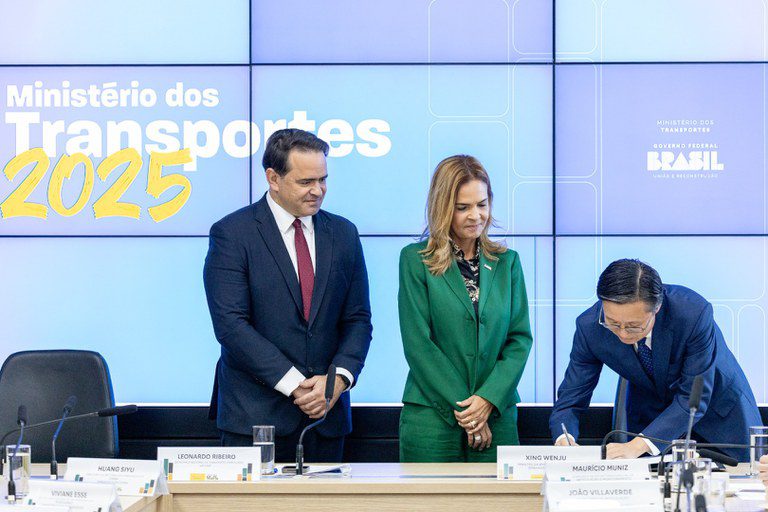
In another concrete gesture of approximation between the two giants of South Global, Brazil and China signed on Monday (7), in Brasilia, a memorandum of understanding for the conduct of joint studies on the Bioceanic rail corridor, which will connect the Atlantic and Pacific Oceans. The project, of great geopolitical and logistics value, aims to integrate Brazilian railways already in operation or construction with the newly opened port of Chancay, Peru, with infrastructure funded by Beijing.
The agreement was signed between the Brazilian state -owned company Infra Sa and the China State Railway Group Institute of Economic Planning and Research, the technical arm of the largest public railway company in the world. The ceremony symbolized a decisive step in the advancement of a partnership that unites the new Brazilian PAC with the Chinese Belt and Route initiative, under the attentive look of Presidents Luiz Inacio Lula da Silva and Xi Jinping.
Bioceanic Corridor: From Ilhéus to the Pacific with scale in continental integration
The rail corridor will start in Ilhéus, Bahia, by the Fiol (West-Leste Integration Railway), will follow Mara Rosa, Goiás, a meeting point with Fico (Midwest Integration Railway) and the North-South Railroad, until you reach Lucas do Rio Verde, Mato Grosso, starting point of the so-called Biocenic Railroad.
From then on, the layout will advance towards the border with Bolivia, cross Rondônia and Acre, and cross to the port of Chancay, about 70 km from Lima. The layout is not just a drawing on rails: it represents the productive and commercial integration of South America with Asia, opening new logistics routes for Brazilian exports of grain, ores and industrialized products.
Long -term technical cooperation: a development pact
Special Secretary of the Civil House, Maurício Muniz, celebrated the memo as “the beginning of a technical, institutional and diplomatic journey that aims to reduce distances and strengthen ties.” The president of Infra Sa, Leonardo Ribeiro, stressed that the project reflects a long -term joint view between the two countries, “with the Chinese railway expertise combining the Brazilian cargo flow potential”.
Infra SA Director of Administration and Finance, Elisabeth Braga, stressed that the state -owned company has already started work to enable the Fiol -fica Structuring Axis, whose auction is scheduled for 2026, and that studies on the international stretch will feature technical simulations, environmental analysis and investment modeling.
BRICS, PAC and belt and route: a strategic convergence
The signing of the agreement occurs at the wake of the XVII BRICS Summit, held in Rio de Janeiro, where the group reaffirmed, in a joint statement, the commitment to the construction of sustainable and resilient infrastructure as a axis of development. The agenda also fits the guidelines of the new PAC, the Ecological Transformation Plan and the New Industry Brazil, Pillars of the Lula administration.
On the Chinese side, cooperation fits into the strategy of the Cinturão and Rota initiative, which seeks to expand transport and commerce corridors in the developing world. For China Director-General Railway Group, Wang Jie, the partnership symbolizes “wisdom and mutual trust among our peoples.”
Logistic challenges and geoeconomic hope
Railway with the Pacific can dramatically reduce export logistics costs and accelerate access to new markets. Today, Brazilian Midwest production faces high costs with road transport to the southeast ports. The new – multimodal and transnational route – paves the way for a more efficient, less polluting and more strategic mesh.
The challenge now is to ensure that studies, to be conducted by Brazilian and Chinese technicians, advance quickly and not stay in the drawer as previous projects. The bet is that, with structured financing and articulation between the Ministries of Planning, Civil House and Transport, continental integration becomes reality-uniting Ilhéus to Chancay, the Atlantic with the Pacific, and Brazil with the new geography of global development.
“We celebrate not only rails, but a connected future,” said Maurício Muniz. If realized, the Bioceanic corridor may be the largest logistics project in South America in the 21st century – and a key to reposition Brazil at the center of regional and global integration.
Source: vermelho.org.br