Published 06/02/2026 13:57 | Edited 02/06/2026 13:58
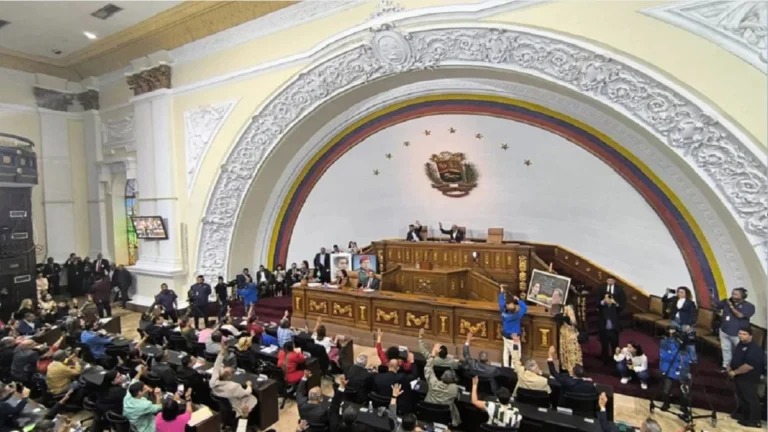
The National Assembly of Venezuela approved this Thursday (5), unanimously and in the first discussion, the Amnesty Bill for Democratic Coexistence, an initiative presented by interim president Delcy Rodríguez as part of an agenda aimed at consolidating institutional peace in the country.
The proposal covers the period of political violence from 1999 to the present and is part of a set of measures announced by the Executive to strengthen political participation mechanisms, promote national reconciliation and reaffirm Venezuelan sovereignty in the face of external pressure.
During the opening session of the 2026 judicial year, Delcy Rodríguez also announced the deactivation of Helicoide as a detention center.
According to information, the space will be transformed into a social, sporting, cultural and commercial center for the police family and the surrounding communities, a measure presented as a concrete gesture within the policy of democratic coexistence.
Political dialogue with national protagonism
The president of the National Assembly, Jorge Rodríguez, stated that the initiative seeks to ensure that “Venezuela’s issues are resolved by Venezuelans”, through peaceful, electoral and democratic means.
The interim president’s guidance included the immediate call on all political sectors — coinciding and divergent — for a dialogue with concrete and immediate results, without external interference.
The legislative proposal accompanies the installation of the Program for Coexistence and Peace, coordinated by the Minister of Culture, Ernesto Villegas.
The program articulates institutional actions with a view to political detente and the reconstruction of minimum consensus around institutional stability.
In the official statement, the government reiterated that the Venezuelan Constitution remains a framework and limit for any amnesty measure, keeping human rights violations and crimes against humanity excluded, in line with previous precedents.
Continuity of a reconciliation policy
The new law is part of a trajectory of measures adopted over the last 27 years. In 2007, then-president Hugo Chávez published an amnesty decree as a path to social peace and political coexistence, expressly excluding serious crimes against human rights.
In 2020, President Nicolás Maduro granted presidential pardons to 110 citizens, including opposition leaders, as a way of encouraging participation in that year’s parliamentary elections and strengthening institutional stability.
Between 2023 and 2024, judicial review processes linked to international negotiation tables — such as the Barbados Agreements — resulted in excarcerations through judicial decisions, consolidating mechanisms of political détente.
According to the explanatory memorandum presented in the Assembly, the Amnesty Law for Democratic Coexistence is a policy aimed at channeling the political dispute towards democratic debate.
Source: vermelho.org.br