Published 03/24/2026 14:50 | Edited 03/24/2026 14:57
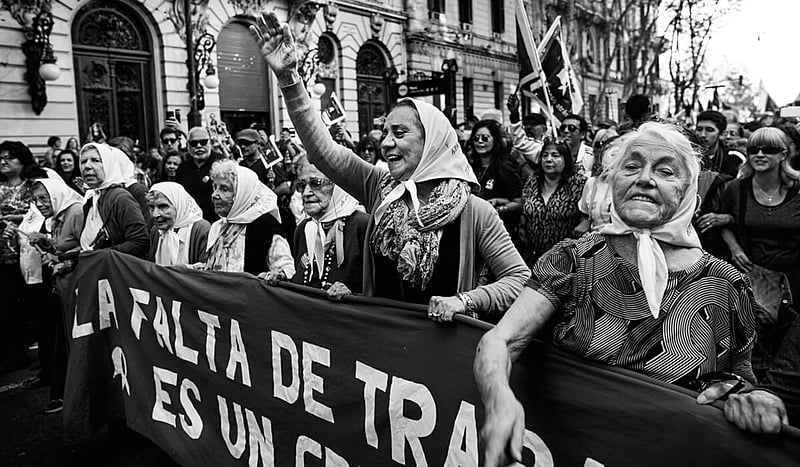
This Tuesday (24), Argentina celebrated 50 years since the 1976 military coup that established one of the bloodiest dictatorships in Latin America. Under the motto “Memory, Truth and Justice”, thousands took to the streets across the country to honor the victims and reaffirm the democratic commitment, at a time marked by tension between the historical construction of memory and the growing denialist discourse of Javier Milei’s government.
State terror: numbers and methods
The civic-military-ecclesiastical dictatorship that existed between 1976 and 1983 carried out a systematic plan of extermination against political opponents, trade unionists, students, artists and ordinary citizens. It is estimated that 30,000 people were missing, a number recognized by civil society, although underreported official data points to 8,600 victims.
The regime installed 814 clandestine detention centers throughout Argentina, with the Navy Mechanics School (ESMA) being the most emblematic. In these places, kidnappings, torture, summary executions and the theft of babies from political prisoners were carried out — crimes classified as against humanity and imprescriptible.
The so-called “Dirty War” was marked by psychological terror: entire families lived under constant threat, while the State denied any responsibility for those who disappeared. The repression did not even spare children: hundreds were illegally appropriated by families linked to the regime, in a deliberate project to erase identities.
The construction of memory: Mothers, justice and culture
Resistance to the dictatorship began during the regime. In 1977, a group of mothers whose children had been kidnapped walked in silence around the Pyramid of Mayo, in Plaza de Mayo, in Buenos Aires. Thus were born the Madres de Plaza de Mayo, a global symbol of the fight for human rights and justice.
After the return to democracy, in 1983, President Raúl Alfonsín created Conadep (National Commission on the Disappearance of People), which produced the report “Não Más”, a founding document of the official memory of the period. Argentina has become a regional reference in transitional justice: it annulled the amnesty laws (Punto Final and Due Obedience) in 2005 and, since then, it has sentenced 867 agents for crimes against humanity.
Memory has also been consolidated in urban space and culture. ESMA was transformed into a museum complex and declared a Cultural Heritage of Humanity in 2023. Films such as “Argentina, 1985” (2022) brought history to cinemas around the world, while annual demonstrations on March 24 re-update the collective commitment to the truth.
Milei’s revisionism and “complete memory”
Javier Milei’s government, however, promotes a shift in the treatment of the memory of the dictatorship. In a message marking the 49th anniversary of the coup, spokesman Manuel Adorni announced the breach of confidentiality of military documents and the proposal for a “complete memory”, which equates State crimes with the actions of guerrilla groups.
For critics, this narrative rescues the outdated “two devils theory”, which relativizes state violence by placing it on an equal footing with armed struggle. “The ‘Não Más’ report already stated that state terrorism was ‘infinitely worse’ because it had absolute power and impunity”, recall experts.
In addition to the speech, the government has promoted cuts in memory and human rights bodies. The National Memory Archive, located at ESMA, lost at least 36 of its 103 employees, and spaces such as the Haroldo Conti Cultural Center face dismantling. For human rights organizations, this is an institutional attack on the preservation of historical truth.
Civil resistance and warning for the future
Despite the adverse context, Argentine society remains mobilized. In 2026, demonstrations across the country reaffirmed that “we cannot forget”, as declared by Daniel Ghigliazza, a family member of the missing person. The Madres and Abuelas of Plaza de Mayo continue to be active, denouncing denialism and demanding that justice continues.
The current challenge is twofold: preserving the achievements of memory and justice in the face of official revisionism, and educating new generations so that they understand the dictatorship not as an “excess”, but as a political project of extermination. “Defending memory is defending democracy”, summarize protesters.
After completing half a century since the coup, Argentina reaffirms that “Não Más” is not just a slogan, but a permanent ethical commitment. In times of the global rise of authoritarian discourses, the Argentine experience reminds us that memory is a fundamental weapon against the repetition of barbarism.
Source: vermelho.org.br