Published 03/09/2026 14:07 | Edited 03/09/2026 14:21
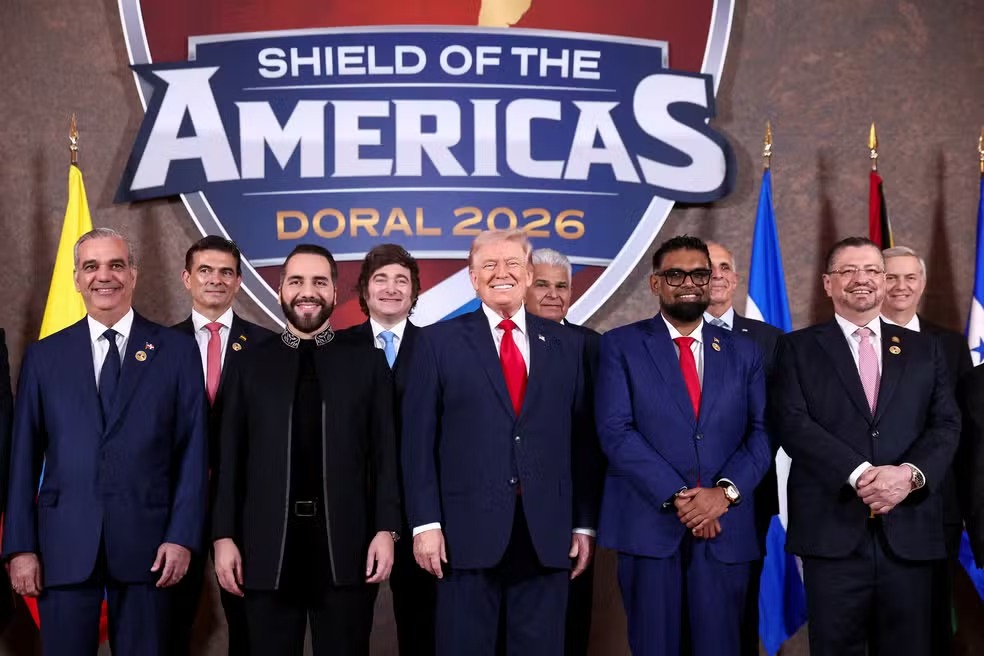
The military coalition announced by the President of the United States, Donald Trump, during the “Shield of the Americas” summit, held last Saturday (7) in Florida, represents an attempt to reaffirm Latin America as Washington’s zone of strategic influence, amid the geopolitical dispute with China.
The assessment comes from the political scientist and Secretary of International Relations of the PCdoB, Ana Prestes, who sees the initiative as a regional coordination instrument aimed not only at combating drug trafficking — as the White House maintains — but also at containing Beijing’s economic and political advance on the continent.
According to her, the North American strategy has as its backdrop the global competition between the two powers and seeks to limit the Chinese presence in strategic sectors in the region.
“Certainly what they are calling the Shield of the Americas is a coordination that also has as its guiding thread the withdrawal of any greater partnership that these countries and others in the region may have with China”, he states.
Ana Prestes observes that the dispute is already manifesting itself on several fronts, such as infrastructure, energy and trade. One of the examples she cited is the pressure exerted by the United States to reduce the Chinese presence in logistics projects in the region.
“Since the beginning of his term, Trump has made Panama leave the Belt and Road route and now there is also pressure on the port built by China in Peru to break this interconnection with global trade chains,” he says.
The so-called Belt and Road Initiative — a global infrastructure project led by Beijing — has expanded logistical and commercial integration between countries in the Global South through investments in ports, railways and transport corridors. In Latin America, the initiative began to include strategic works aimed at connecting the Pacific with global trade chains.
Also read: Trump summit exposes subordination of the Latin American far right
One of the most cited cases is the port of Chancay, in Peru, built with Chinese capital and designed to become a major commercial hub between South America and Asia. The venture is seen by Washington as a point of expansion of Chinese economic presence on the continent.
According to the analyst, initiatives such as the new regional coalition indicate that Washington seeks to reorganize its presence in the hemisphere and reduce the room for maneuver of Latin American governments in diversifying trading partners.
“This coalition only increases this risk because it provides support and support for possible measures by the United States, such as invasions, bombings and other actions that violate the sovereignty and self-determination of people in Latin America”, he states.
Latin America and US domestic politics
The expert also assesses that the policy towards Latin America has been used by Trump as an instrument of electoral mobilization in the United States, especially in states where the Latino vote has significant weight.
Also read: The Trumpist far-right offensive and the attack on sovereignty in Latin America
According to her, the choice of Florida as the host of the summit was not accidental, as the state has a conservative electoral base sensitive to anti-Cuba and anti-Venezuela discourse.
“Firstly, the Latino vote in the United States is around 10 to 15%. In the 2024 election it was around 10%, and the event was held in Florida, where there is a Latino electorate very aligned with Trumpism”, he states.
She notes that part of this electorate is made up of segments of the Latin American diaspora who support harsh policies against progressive governments in the region. According to her, “there is a niche of Latinos who are already US citizens who support the measures against Venezuela and Cuba”.
In this context, the presence and protagonism of Secretary of State Marco Rubio — a politician of Cuban origin and a central figure in Washington’s hard line against Havana and Caracas — also help explain the tone of the meeting.
During the summit, Rubio was repeatedly praised and flattered by Trump, who presented him as the centerpiece of American strategy for the Western Hemisphere.
Dispute for markets and economic influence
The assessment is that the Trump administration’s foreign policy seeks to guarantee space for North American companies in strategic sectors of the regional economy.
According to Prestes, recent national security and hemispheric security strategy documents indicate an attempt to consolidate the Americas as a priority area of influence for the United States.
“These strategies design the Americas as an almost exclusive territory of the United States, and with closer governments, Washington seeks to guarantee this predominance for North American businesspeople in these markets as well,” he states.
In the expert’s assessment, this policy manifests itself in disputes over infrastructure contracts, exploration of natural resources and energy projects.
She cites as an example the Venezuelan oil sector, which has historically maintained relevant commercial relations with China.
“Regarding Venezuela’s oil, there was strong trade with China. So, when there is any type of competition, the United States tries to intervene by interfering with China’s possibility of competing”, he says.
Risks to the region’s sovereignty
The creation of a military coalition led by the United States could increase the risks of interventions or external pressure on countries in the region.
According to Ana Prestes, the structure announced at the summit can function as a legitimizing mechanism for unilateral actions or military operations under the argument of combating drug trafficking.
“This coalition only increases this risk because it provides support and support for possible measures by the United States, such as invasions, bombings and other actions that violate the sovereignty and self-determination of people in Latin America”, he states.
The North American military presence on the continent has been intensifying in recent years, both through bilateral agreements and joint operations. Military actions on our continent are already a reality, with a growing presence of the United States in the Caribbean and Andean America and with increasingly closer military agreements with governments in the region.
The new coalition announced by Trump tends to deepen this trend and reinforce the role of the United States as the main security power in the Western Hemisphere.
Source: vermelho.org.br