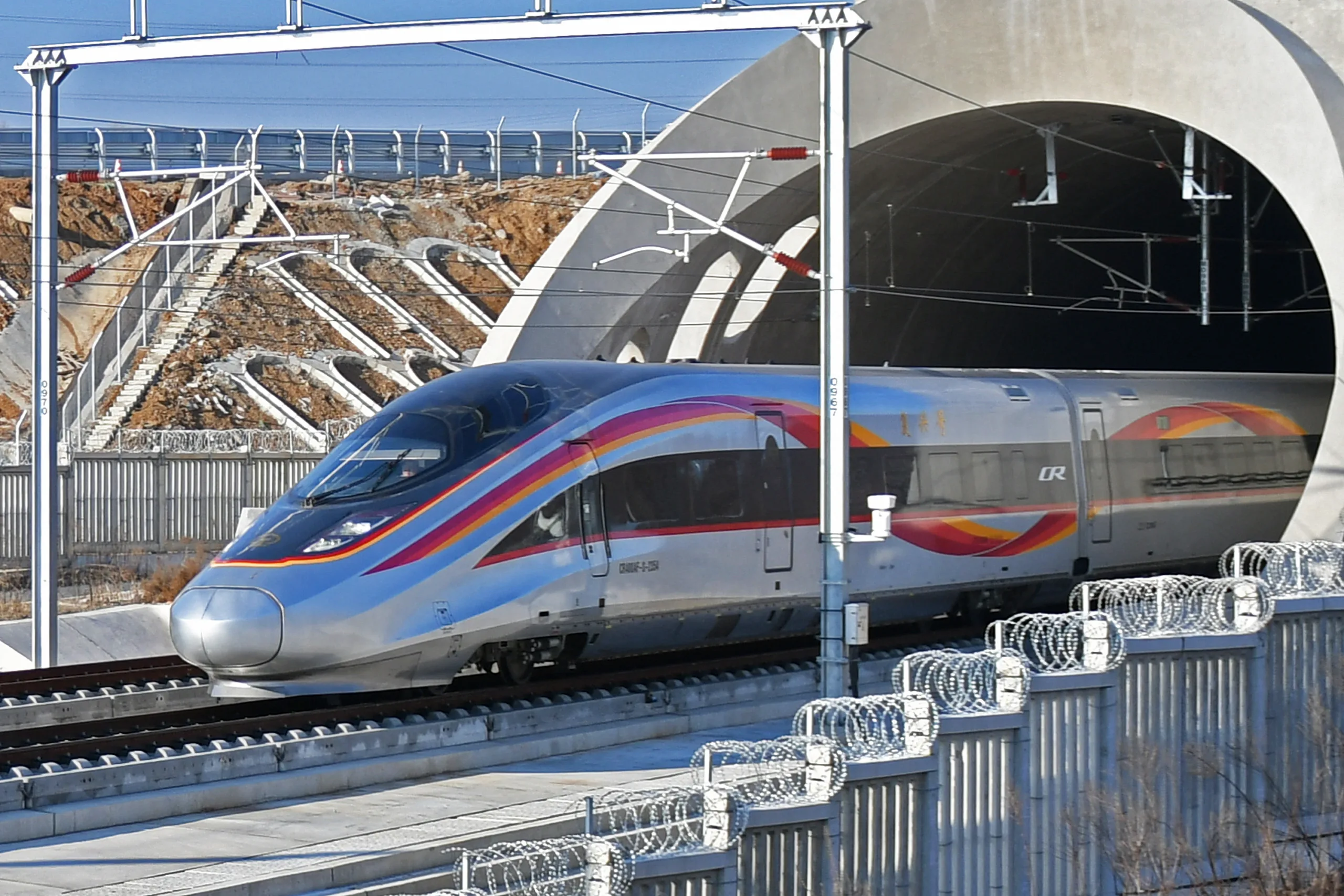
China inaugurated four new high-speed railways this Monday (28), adding more than 1,100 km to the largest fast train network in the world. Until last year, according to the International Union of Railways, the country had 70% of the world’s total high-speed railway lines.
The four new lines connect municipalities that did not yet have the service.
China has the goal of expanding the network to around 60 thousand km by 2030. At the end of last year, the figure surpassed 50 thousand km, and with the new ones it now reaches almost 52 thousand. The network grew by almost a third between 2021 and 2025, according to the China National Railway Group.
The routes
The longest railway is the stretch between Xiong’an, in Hebei province, and Shangqiu, in Henan province: 552 km that operate at up to 350 km/h, and which become part of the high-speed corridor between Beijing and Hong Kong. With this line, eleven municipalities in the provinces of Hebei, Shandong and Henan will have access to the high-speed network for the first time, according to the China National Railway Group.
In the northeastern province of Heilongjiang, the Harbin-Yichun line (318 km) becomes the northernmost high-speed railway in China, with a maximum speed of up to 250 km/h. The Yichun West station is the first to be built on permafrost in an extremely cold region, Shi Qinwei, responsible for the station project, told the news agency Xinhua. In winter, temperatures in Yichun vary between -16°C and -30°C.
The type of permafrost in this region is island, that is, it is not continuous, it is “islands” of frozen soil. As the temperature variation is very large during the year (70ºC on average, between summer and winter), the project had to develop new techniques to face these two challenges.
In the northwest, the Xi’an-Ankang line (171 km) cuts through the Qinling mountain range and reduces the journey between the two cities from three hours to 45 minutes, according to Xinhua. In the central region, the Yichang-Xingshan line (101 km), in Hubei province, shortens the journey between Wuhan (the provincial capital) and Chongqing (a mega-city in the center-south of the country) from almost five hours to just under four.
Three of the railways cross mountains or the northern plain; In them, almost the entire route is elevated or underground. The Xi’an-Ankang, which cuts through the Qinling mountain range, is almost entirely made up of tunnels or bridges (94.6%), the highest proportion among high-speed railways that cross this mountain range, according to the China National Railway Group. In Yichang-Xingshan this figure is 95.13% and Xiong’an-Shangqiu records 94.47% of the route over bridges.
The Harbin-Yichun line is the only one that does not have any tunnel, but 72% of the 188 km stretch between Harbin and Tieli is made up of viaducts designed to isolate the railway from temperature variations in the region’s permafrost soil.
Source: www.brasildefato.com.br