Russia faces a gasoline supply crisis in several regions amid intensifying Ukrainian drone attacks on energy infrastructure. The problem is already causing shortages and queues at gas stations around the country, leading the government to develop a series of measures to overcome the crisis.
The escalation of the war, with the increase in Ukraine’s drone attack capabilities, is the main cause of the supply problems faced by Russia, but the situation reveals other particularities of Russia’s economic structure – and how the current scenario can be reversed.
In an interview with Brazil in factthe chief analyst at Russia’s National Energy Security Fund, Igor Ushov, explains that the main cause of the fuel crisis is that many oil refineries went into “unscheduled maintenance”, that is, they had to stop oil refining, harming gasoline production.
“The problem is that we don’t know exactly which refineries are undergoing maintenance, how much each one is producing, and so on. Statistics with absolute numbers have been under secrecy since 2022. We only know the data on the dynamics of oil refining, which the Russian statistics agency continues to publish. In April, the refining volume fell by just over 11% compared to April 2025. In May, the reduction reached about 13.2% compared to May 2025. 2025. Therefore, there has been a drop in refining and, naturally, it is logical to assume that there will also be a shortage of gasoline”, he argues.
According to the analyst, gasoline has been most affected because, historically, Russia produces less gasoline than diesel. “In a normal year, without attacks, around 85% to 90% of the gasoline produced was destined for the domestic market, while only 10% to 15% was exported. In the summer, this proportion changes even more in favor of the domestic market, because consumption increases”, he states.
“In the case of diesel, approximately half of production was exported, while the other half was sufficient to supply the domestic market. In other words, Russian refineries have always been designed, since Soviet times, mainly to produce diesel. This is because diesel was essential for the Armed Forces, agriculture, public transport, municipal services and other sectors. At that time there were very few private cars, so it made no sense to build refineries mainly focused on gasoline production”, explains Ushkov.
According to him, this orientation remained over time because Russia exported large volumes of diesel to Europe, where, in turn, practically the opposite occurs: “Many European refineries are dedicated to the production of gasoline, and diesel has always been relatively scarce. That’s why Russia supplied Europe with diesel”, he adds.
In practice, what happens is that Russia already produces gasoline at a level close to the consumption margin, which, in turn, increases significantly in the summer due to the intensification of agricultural production and the population’s vacation trips. In a scenario of attacks on refineries, and a consequent lag in gasoline production, this set of factors has generated the current shortage problems. Add to this the logistical factor of distributing gasoline in a country the size of Russia, affecting the Far East and South regions of the country more.
Analyst Igor Ushkov states that, although the situation is difficult in practically the entire country, “fuel is still available in most locations”. “Yes, there are queues and some stations are temporarily out of product, but others continue to supply normally. The government’s intention is precisely to guarantee a more uniform distribution”, he highlights.
“This redistribution is one of the main measures adopted to combat shortages. For this reason, several regions began to impose limits on the amount of fuel sold per supply. These restrictions do not necessarily mean that there are specific problems in each region, but they reflect the need to distribute available production in a relatively balanced way to prevent some areas from being completely without fuel while others have abundance”, he adds.
Government reaction
Commenting on the situation for the first time last week, in an interview with Russian state TV, Russian President Vladimir Putin acknowledged that the attacks on refineries had affected fuel supplies, but sought to mitigate the damage caused by the crisis and detailed some of the government’s actions to normalize the situation.
“In relation to attacks on critical infrastructure in general, and energy infrastructure in particular, it is clear that these attacks on our facilities create problems, that is obvious. We are currently facing a certain shortage, but it is not critical,” he said.
According to him, the most urgent issue at the moment is to ensure the reinforcement of air defense systems to prevent further Ukrainian attacks on refineries, “taking into account what the enemy is using and the fact that they are receiving new unmanned aerial vehicles with new technologies from Europe.”
“In fact, we have all these defense systems. The question is how quickly we can increase their production and deliver them to troops or to protect critical infrastructure facilities,” he added.
One of the measures adopted by the Russian government is to increase the import of gasoline. Russia has suspended fuel exports, zeroed import tariffs and seeks to increase supplies from countries such as Belarus, Kazakhstan and, possibly, India.
Russian Deputy Prime Minister Alexander Novak instructed oil companies to ensure additional fuel supplies to the regions “in order to quickly meet domestic demand.” The Central Bank of Russia assesses the fuel situation as a “temporary supply shock”.
“The government is taking all possible measures to ensure that this is the case, that this is a temporary shock. And if this is the case, the impact of the fuel market situation, which is significant for monetary policy, is limited to its impact on expectations of future inflation and future price growth,” said Russian Central Bank Deputy Chairman Alexey Zabotkin.
Race for jobs and ‘peak demand’
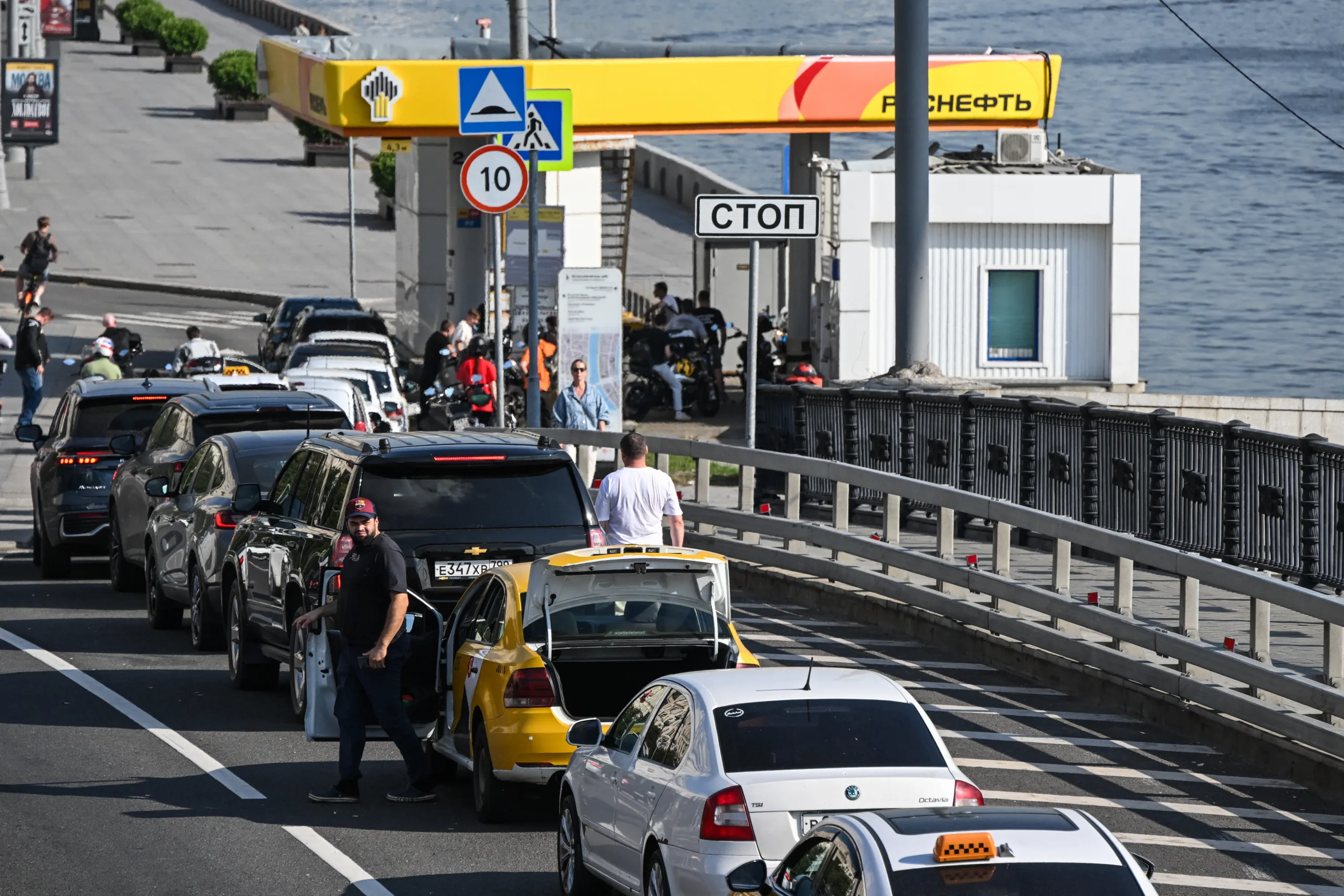
Another reason that has worsened the problem is precisely the increase in consumption due to news of attacks on refineries. In Moscow, although fuel remains available, drivers face longer queues due to the rush to gas stations, generating extraordinary demand.
“Before, it was common to fill only half a tank; now, many seek to completely fill the tank and even fill gallons of reserve. This excessive demand further aggravates supply problems, causing waiting times at gas stations to increase”, points out Igor Ushkov.
The chief analyst at Russia’s National Energy Security Fund explains that average prices for gasoline and diesel have also risen, but mainly at so-called “independent stations”. According to him, “at stations belonging to large vertically integrated companies — those that extract oil, refine and directly sell their own products — prices practically remained unchanged”.
In this scenario, Igor Ushkov believes that the tendency is for the crisis to be stabilized based on market dynamics and the measures that the government has been adopting in the coming months.
“All these measures should stabilize the fuel market in the coming months. Furthermore, from September onwards gasoline consumption normally decreases. Therefore, probably at the end of September or October the market should return to balance, when domestic production will be sufficient to meet domestic consumption and imports will no longer be necessary”, he states.
“Although imports represent an additional cost for a public budget that is already facing a deficit, the government considers this expenditure justifiable to avoid a significant increase in gasoline prices across the country”, he adds.
Source: www.brasildefato.com.br