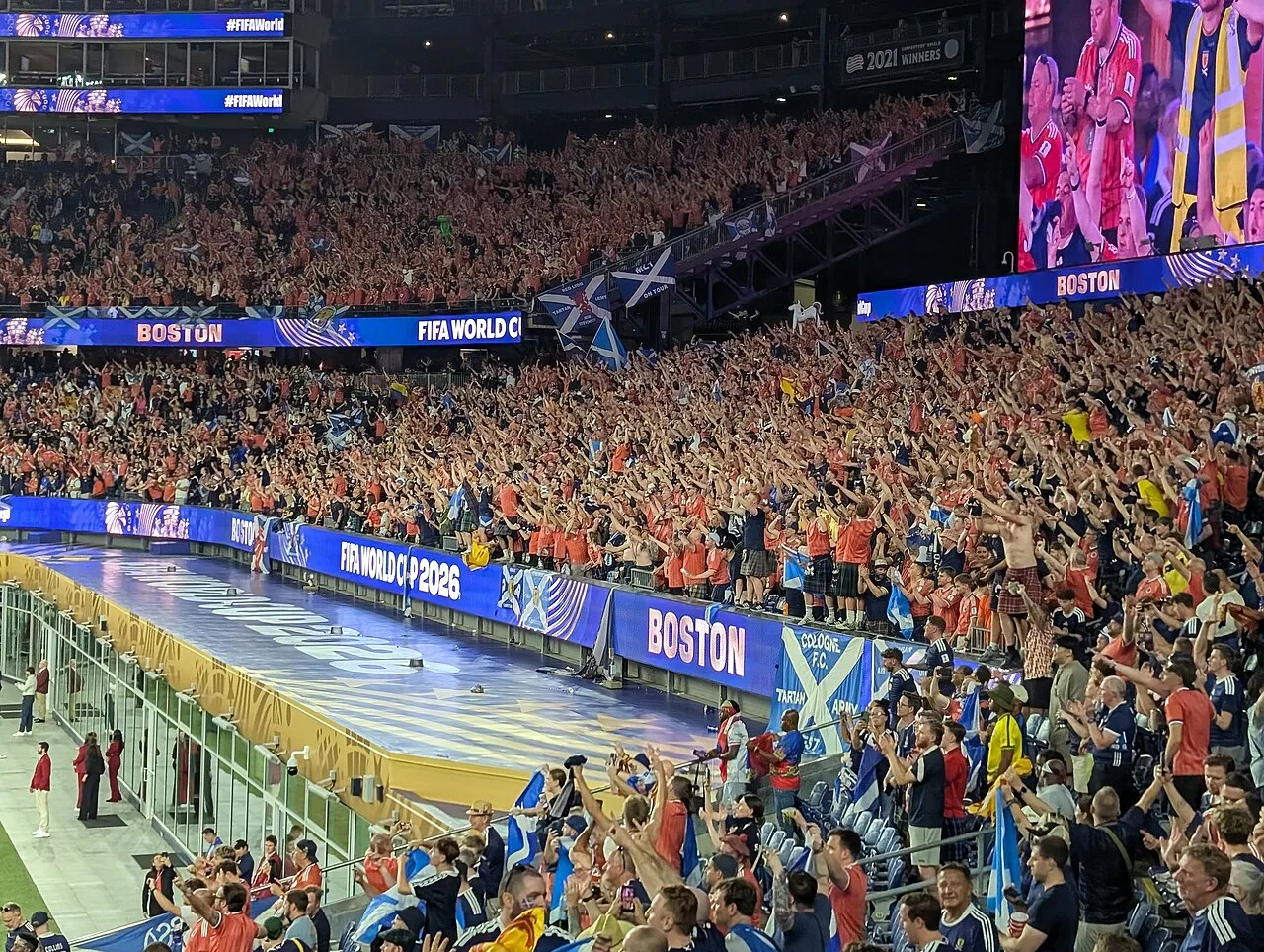
The Scottish team will take the field against Brazil this Wednesday (24), in their first World Cup after 28 years, seeking an unprecedented feat for their fans, the traditional Tartan Army: qualifying for the decisive stages of the tournament, the so-called knockout stage.
However, the match takes place amid a painful memory for the Scottish people, in a different arena than football: on the morning of June 24, 2016, when the results of the Brexit referendum were released, the country was forced to leave the European Union, despite 62% of its population having voted against such a measure.
With 5.5 million inhabitants, Scotland is one of the four nations that make up the United Kingdom, alongside England, Wales and Northern Ireland. The English population is ten times larger than the Scottish population and, therefore, its approximately 53% vote in favor of leaving was enough to change the result at a national level.
In the end, considering the votes from across the United Kingdom, 51.89% preferred to leave, against 48.11% who voted to remain. Therefore, Scotland was forced to separate from the European bloc.
“England is much bigger than all these countries, with around 50 million inhabitants. They are like cities in terms of population”, highlights Hassam Akram, professor of public policy at Universidad Diego Portales, in Chile.
According to Akram, in the face of widespread frustration after Brexit, which was chosen by the majority of English people, the country’s separatist desires intensified even more. The capital, Edinburgh, massively supported remaining in the European bloc, with 74.4% of the vote, almost three in every four Scots in the city.
The frustration was made even more acute by the fact that the Scots held, two years before the Brexit vote, a referendum to decide whether to separate the country from Great Britain.
The separatist referendum, called in September 2014 by the then British Prime Minister, David Cameron, was rejected by 55% against 45%. The proposal was fiercely defended by the Scottish National Party (SNP) and led by party leader Alex Salmond.
According to Akram, one of the reasons why most Scots voted to remain in the United Kingdom was, precisely, to continue belonging to the European Union.
Ten years ago
In an interview this week with The Guardianthe former leader of the Scottish Labor Party, Kezia Dugdale, opposed to the separatist proposal, said she was “completely devastated” on the morning of June 24, when the Brexit results were confirmed.
That day, Dugdale spoke to the then Scottish First Minister Nicola Sturgeon (SNP), in favor of separatism, summing up the feeling of many Scottish compatriots who voted to remain in the United Kingdom, but found themselves assaulted by Brexit: “This changes everything”.
As soon as Brexit was approved, the then Scottish Prime Minister stated that she would do everything she could to “protect Scotland’s place in the European Union”. In Brussels, she met with the then president of the European Parliament, Martin Schulz, and even created a council of experts in law, economics and diplomacy to study ways to preserve Scottish ties with the European bloc.
The obstacles, however, prevented the country from remaining in the European Union, after strong resistance from the then French president, François Hollande, who maintained the thesis that “negotiations will be conducted with the United Kingdom, and not with a part of the United Kingdom”.
Spain also reiterated this position, fearing that Scotland’s stance would strengthen the country’s separatist regions, such as Catalonia. At the time, then Prime Minister Mariano Rajoy stated that “if the United Kingdom leaves, Scotland also leaves”.
Progressive tradition
Akram points out that Scotland and Wales have always been more left-leaning than England. “England has not had an election in which the left has won since the 1940s”, he states, highlighting the contribution of these countries in elections to the British left.
In his assessment, “the Labor Party has collapsed because, nowadays, it is so right-wing that these countries no longer support it”.
Currently, Scotland is governed by the SNP, a center-left nationalist party whose main historical banner is independence. According to him, Scottish nationalism has “a strong critical component to the political centralization exercised by London and the British Union itself”.
Despite this, Akram points out a paradox: although many voters support nationalist and autonomist parties, this does not automatically translate into support for separation from the United Kingdom.
“People in these countries vote for nationalists, whose politics, technically, are independent, but when they hold referendums, they don’t want independence. They want to be governed by independentists, but they don’t want to be independent”, he observes.
separatist spirit
After Brexit, Sturgeon, who would leave the government in 2023, continued her fight to achieve a new separatist referendum, but the British government of Prime Minister Theresa May (2016-2019), who replaced Cameron, rejected these demands and support for Scottish independence fell to less than 40%.
In the 2017 general elections, the SNP lost 21 seats in the British Parliament and saw its vote fall by 13 percentage points, in a context of implementing the United Kingdom’s withdrawal from the European bloc, initiated by May that year.
May is among six British prime ministers whose terms were interrupted after Brexit. She was replaced by Boris Johnson in 2019, whose arrival would revive Scottish separatist desire. In October 2020, independence reached 59% in the country’s polls.
Over the last decade, however, the debate has been overshadowed by a succession of crises, encompassing Johnson’s radical Brexit, his handling of the Covid-19 pandemic, the war in Ukraine and the current crisis in the United Kingdom, including the high cost of living and the deterioration of public services in the region.
In March this year, a decade after the referendum, a survey revealed that Scotland remains deeply divided over separatism: 44% support it compared to 56% who are against the measure. Other surveys indicate rates close to 50%.
According to Akram, the main explanation for this division is economic. Despite having oil reserves in the North Sea, Scotland remains deeply integrated into the British economy. “Economically, the union with England is total”, with the prevailing feeling that the country “does not have much capacity to function outside of this context”.
In the expert’s assessment, most Scots do not necessarily want to break with Great Britain, but to reformulate the terms of this relationship. “They can’t leave. What they want is for England to change, they want a more equitable union for them. They know it’s worse outside, but they think it’s pretty bad inside and they want things to get better,” he said.
Historic charm
Currently, the economic crisis and concerns about the National Health Service (NHS) have come to dominate Scotland’s public agenda. To the British newspaper, the Scottish Minister for Europe, Stephen Gethins, highlighted that Brexit caused a loss of income of 3.3 billion pounds (R$22.6 billion), increasing families’ annual spending on food by around 250 pounds (R$1,700).
It is in this context that the Scottish players, applauded by the Tartan Army, will take to the field against Brazil, reaffirming a national pride that, in addition to the tartan kilt (the famous plaid skirt), the bagpipes — whose sound divides opinions — and the most famous brands of whiskey, also gave the world Adam Smith, Graham Bell and the legendary detective Sherlock Holmes, through the pen of its author, Arthur Conan Doyle.
The tradition doesn’t stop there. Considered one of the most talented generations of recent decades, the Scottish team, led by Steve Clarke, will enter the battle for first place in the world cup, competing with the historic charm of a team that played the first international match recognized by the International Federation of Association Football (Fifa).
The game was against England, in Glasgow, in November 1872, and ended with a score of 0-0, but it was enough for the Scottish team to make football history.
Source: www.brasildefato.com.br