Published 06/10/2026 22:21 | Edited 06/11/2026 09:23
In a meeting marked by geopolitical tension and class solidarity, the former president of Bolivia, Evo Morales, met this Wednesday (10) with activists from the Socialist Youth Union (UJS) and PCdoB leaders in a virtual meeting. The debate went beyond Bolivian borders and became a reflection on the challenges of the Latin American left in the face of the advance of the extreme right and geopolitical pressure from the United States in the region.
One of the central points of Evo Morales’ intervention was the defense of the idea that the Bolivian crisis cannot be analyzed as an isolated phenomenon. According to him, what is happening in the Andean country is part of a broader offensive against governments and popular movements throughout Latin America.
More than a report on the Bolivian internal crisis, Morales’ speech functioned as a strategic warning about the reconfiguration of the United States’ security doctrine for Latin America: the replacement of the anti-communist struggle with the “war on narco-terrorism” as a pretext for control of the region’s natural resources.
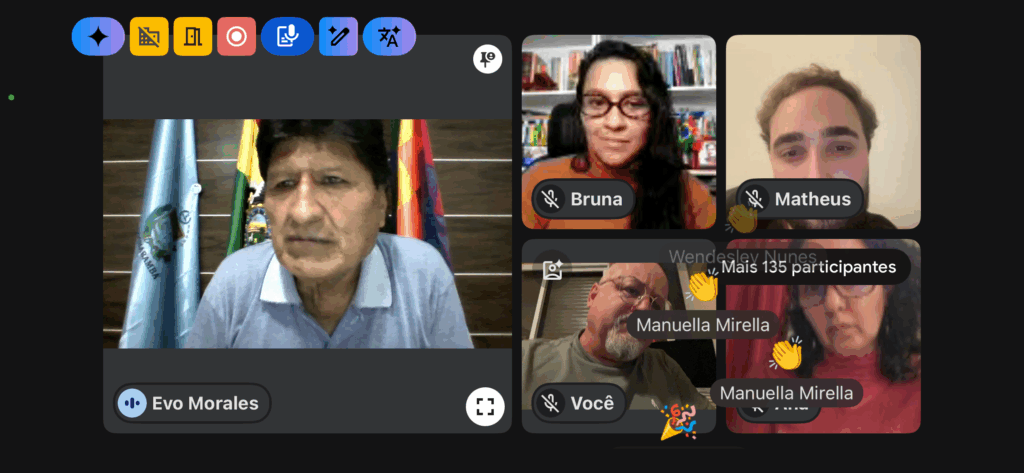
The indigenous root and the memory of sovereignty
Morales dedicated a significant part of his speech to recovering the long trajectory of indigenous resistance in Bolivia, drawing a parallel between the colonial siege and the current imperialist siege. By remembering historical leaders such as Túpac Katari and Bartolina Sisa, he sought to place the Bolivian popular movement as the heir to centuries of struggle against colonial domination and social exclusion.
According to Morales, the rise of indigenous movements to the government made it possible to combine union organization, political participation and defense of economic sovereignty. The former cocalero leader revived the memory of his government as a period of exception in Bolivian history, where indigenous dignity translated into economic sovereignty.
He recalled measures adopted during his governments, such as the nationalization of strategic resources and the closure of North American military bases in Bolivian territory. The narrative presented to young people sought to demonstrate that structural transformations require not only social mobilization, but also the conquest of political power.
“We nationalized hydrocarbons. We said: if you want to be partners, be partners, but not bosses”, he recalled, highlighting the inversion of the logic of exploitation that increased Bolivian GDP from US$9 billion in 2005 to more than US$42 billion in 2019. For Evo, the current economic collapse, marked by the lack of fuel and inputs, is not an accident, but the deliberate result of the return of neoliberalism and the delivery of lithium and from rare earths to foreign interests.
Criticism of the “new Condor Plan”
Among the most striking moments of the debate was Morales’ analysis of contemporary forms of political persecution in Latin America.
The former president maintained that the old Condor Plan of military dictatorships had been replaced by institutional mechanisms of judicial and electoral persecution. According to him, judges, prosecutors and courts began to play a role similar to that previously played by the repressive apparatuses of dictatorships on the continent.
Morales also once again denounced the legal proceedings filed against him after the 2019 coup, classifying them as attempts to prevent his political participation and weaken the Bolivian popular movement.
Lithium, the “Shield” and the inversion of the narrative
The highlight of Morales’ analysis was the deconstruction of the “narcoterrorism” narrative used by Washington and endorsed by the government of Rodrigo Paz. Evo reversed the accusation: “There is no narcoterrorism here. Here there is state narcoterrorism.” He cited cases of corruption involving the current elite, such as the transport of tons of wooden cocaine and marijuana on Bolivian Air Force planes, to demonstrate that the “terrorist” label is a tool of hybrid warfare to criminalize social protest and justify intervention.
Morales denounced the existence of the “Shield of the Americas”, a new political-military alliance that, under the guise of combating organized crime, aims to prevent regional integration and protect lithium monopolies. “It is no longer a fight against communism, but against narco-terrorism. We are not communists, we are already narco-terrorists for them”, he ironized, explaining that the Monroe Doctrine is still alive, now carried out not only by generals, but by judges, inspectors and financial intelligence operations.
The youth trench and internationalism
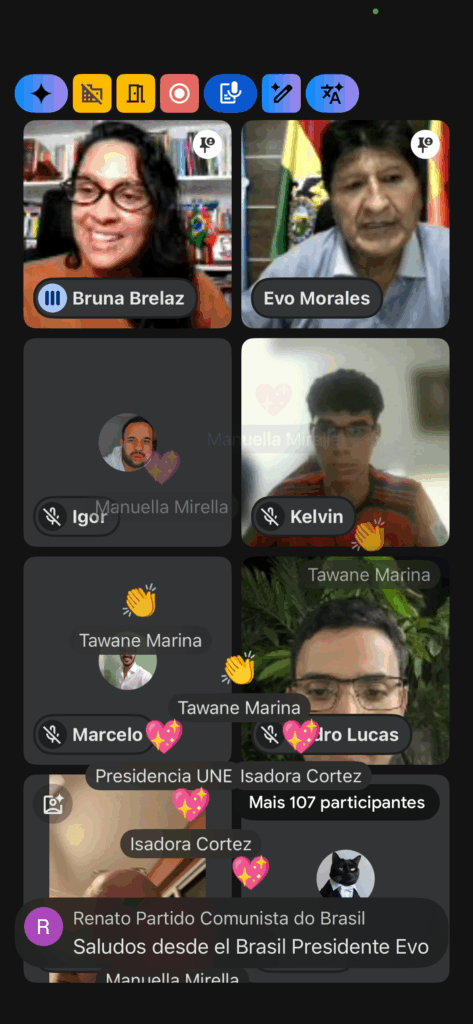
The response of Brazilian youth was total alignment with the Bolivian struggle. Ana Prestes, Secretary of International Relations at PCdoB, and Rafaela Elisário, from the direction of UJS, reinforced that the battle in Bolivia is a trench in the same war fought in Brazil against the extreme right.
Morales heard expressions of solidarity with the Bolivian political situation and popular mobilizations against the government of Rodrigo Paz. The organizers highlighted the trajectory of the indigenous leader as a symbol of the struggle of original peoples, national sovereignty and regional integration.
Morales, in turn, emphasized the need for political formation, popular organization and unity of progressive forces to face the advance of neoliberalism and conservative currents in the region. For him, the main task of the new generations is to transform social indignation into a collective organization capable of building sovereign national projects.
For UJS, the meeting also had a formative nature. In their greeting, the organization’s management highlighted that Latin American youth have the responsibility to confront inequalities, defend peace and strengthen solidarity among the people of the region.
“What is happening in Bolivia is part of the same offensive that the Yankee Empire is carrying out throughout Latin America”, stated the UJS representative, reaffirming that Brazilian national sovereignty is intrinsically linked to the defense of Bolivian resources. The meeting ended with the commitment that the “Great Homeland” is not just a slogan, but a material necessity for survival in the face of the greed of global powers over the continent’s strategic reserves.
At a time of reconfiguration of international disputes and the advance of conservative forces in several countries, the meeting served to reaffirm an idea that runs through the history of popular movements in the region: that national sovereignty and Latin American integration remain inseparable objectives of the same political project.
Source: vermelho.org.br