Published 03/31/2026 15:02 | Edited 03/31/2026 16:27
Donald Trump’s military adventure against the Islamic Republic of Iran completed 30 days, consolidating a classic paradox of contemporary wars of aggression: military supremacy does not translate into political control. Begun on February 28, the conflict, which promised to be a “quick surgery” with the aim of dismantling Tehran’s nuclear program and missile capabilities, has turned into an economic and geopolitical drain that threatens global stability and the very internal support of the Republican government.
Although the Pentagon declares the destruction of around 90% of the Iranian ballistic missile arsenal and the infrastructure of the Revolutionary Guard (IRGC), the material balance is alarming. According to the Center for Strategic and International Studies (CSIS), US military spending exceeded $30 billion in March alone, with average daily spending fluctuating between $500 million and $1 billion.
Trump’s additional request for US$200 billion to the US Congress generated an institutional crisis. In Washington, Democratic opposition figures, such as Representative Adam Schiff (former chairman of the Intelligence Committee) and Senator Cory Booker, classify the conflict as an “illegal war”, while Republican Senator Lisa Murkowski (Alaska), a moderate voice in the ruling party, demands transparency about the absence of an “exit plan”.
The coup de grace in the official narrative came with the dismissal of Christopher Miller, director of the National Counterterrorism Center (NCTC), on March 15, stating that the justification for the war was a “hoax” and that there was no solid intelligence corroborating an imminent nuclear threat from Iran.
The check-mate of Hormuz and the war economy
Strategically, the closure of the Strait of Hormuz has proven to be Tehran’s most effective weapon. With a 15% reduction in global oil supply, a barrel of Brent crude jumped to US$116, raising the price of gasoline in the US to more than US$4 per gallon. Ironically, the analysis of The Economist points out that, contrary to expectations, Iran doubled its pre-conflict revenue by exporting between 2.4 and 2.8 million barrels per day through alternative routes and Asian markets, profiting from the rise in prices generated by Trump’s aggression. Furthermore, the Iranians are trading oil in Yuan, deepening the disuse of the North American currency as a global currency.
The inventory of lives lost up to March 31 reveals that the joint offensive does not spare civilian areas or national borders: while the bloc led by the United States records 15 military casualties and more than 300 injuries — in addition to critical damage to 17 bases and Aramco refineries —, Iran accounts for between 1,300 and 1,900 deaths amid the destruction of more than 500 targets, including ports and missile depots. This trail of blood extends severely to Lebanon, where Israeli aggression in the south of the country has already killed 773 people, demonstrating a scorched earth tactic.
Resistance in Tehran and Isolation in Washington
At the international level, the diplomatic resistance is led by Sergei Lavrov (Minister of Foreign Affairs of Russia) and Wang Yi (Chief Diplomat of China), who denounce the aggression as a breach of International Law. Unilateral aggression unified the Security Council against Washington. Russia and China condemned the attacks as a direct violation of the UN Charter. Beijing went further, classifying the US as “instigators of the crisis”, while Moscow highlighted that the IAEA never confirmed the diversion of Iran’s nuclear program for military purposes.
Internally, the Iranian regime, now under the leadership of Mojtaba Khamenei, demonstrates resilience. Tehran summarily rejected the 15-point plan presented by the White House, demanding not only an end to bombings, but war reparations and recognition of its sovereignty over the waters of Hormuz.
Trump with no honorable exit
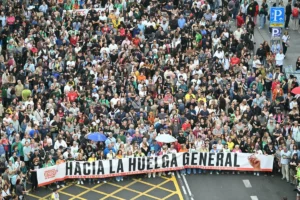
The balance of this first month reveals that, although the US has helped Israel against Hezbollah and the Iranian Revolutionary Guard, the central objective of “regime change” or total neutralization of Iran remains a mirage. On the other hand, internally, Trump is also facing a wave of street protests in all 50 North American states that promise to grow on the eve of the elections (midterms) of November. Last weekend, demonstrations with the slogan NO KINGS brought together 9 million people against the US entry into the war in Iran; against the explosion of inflation, due to the increase in the price of oil; and against Trump’s immigration police, ICE. Even if it withdraws from the war now, neither Iran nor the Americans from the NO Kings are willing to stop.
For international analysts, the Republican’s “war of choice” could become the biggest strategic mistake of the 21st century, consolidating the influence of the yuan and accelerating de-dollarization in a Middle East increasingly hostile to the North American presence.
If Donald Trump demonstrated an appreciation for historical knowledge or if his advisers did not disregard the science of strategy, the current quagmire in the Middle East could have been avoided. The White House ignored the maxim of World War II strategists: “It is not worth fighting a battle in which, if you win, you gain nothing.”
Source: vermelho.org.br