Published 03/17/2026 16:21 | Edited 03/17/2026 16:50
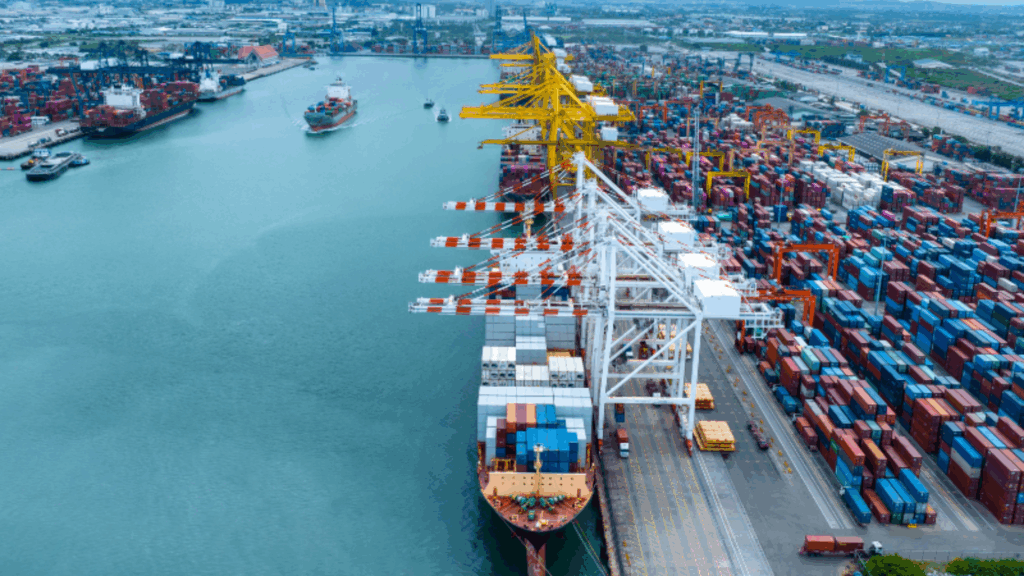
The Donald Trump government’s offensive to contain China’s global advance has found a new and strategic battlefield: the Port of Santos, on the southern coast of the state of São Paulo. What was once treated as a matter of logistics and commercial efficiency is now openly discussed by the United States as a matter of “national security” and “hemispheric predominance.”
Washington’s message about the Port of Santos
In the first week of March (5), at the Rebouças Convention Center, in São Paulo, the US consul general in São Paulo, Kevin Murakami, raised the tone during the Brazil Logistics & Supply Chain Forum, with businesspeople, especially from the port sector. According to the participants, Murakami threw his teeth out when he stated that it would not be in Washington’s interest for the Tecon 10 auction — a mega container terminal project valued at R$6.45 billion with a 25-year contract — to end with the victory of a Chinese company.
The diplomat — without mentioning China by name — used terms such as “risks of dependence on strategic assets” and “reliable partners” to insinuate that the US, under Trump, sees Chinese companies (such as Cosco, which built the Peruvian port of Chancay) as a security threat, as they can give Beijing control over vital trade routes. Analysts interpret Murakami’s words in this context as an obvious message: “Avoid Chinese in the Tecon 10 auction”.
Murakami’s speech is not an isolated fact, but part of the “Maritime Policy” of the Trump era, which aims to restore US dominance in the oceans. In April 2025, Trump imposed 100% tariffs on Chinese cranes (Executive Order 14257) and began investigations into China’s logistics practices. In Brazil, the Port of Santos is the largest in Latin America and transports most of the country’s soybean and ore production. For the US, allowing China to control a terminal of this size in the heart of Brazilian agribusiness is seen as an “unacceptable” loss of ground.
The ghost of Chancay and regional sovereignty
The White House’s nervousness already has a geographic repercussion: the Port of Chancay, in Peru. Opened in November 2024 and financed with US$3.5 billion by Chinese state-owned Cosco Shipping, Chancay is today the largest port in South America. It functions as a “hub” that directly connects the region to Asia, drastically reducing travel time and freight costs.
In the paranoia of the US Southern Command (Southcom), Chancay is the perfect example of what they call “dual-use” infrastructure: facilities that, although commercial, could serve as a base for the Chinese Navy or for monitoring regional trade. More than a year ago, the US ambassador in Lima, Lisa Kenna, warned the Peruvian government about China’s presence. However, for Peruvian analysts, North American intentions are the real offense to sovereignty that occurs when an external power tries to dictate with whom countries should or should not do business.
The current US strategy seeks to pressure nations to block Chinese investments in vital sectors such as energy, 5G and logistics. This stance ignores the need for investment in infrastructure that countries in the region have. While China provides financing and technology for megaprojects like Chancay, Washington’s response has been based on sanctions, tariffs and diplomatic pressure to dehydrate Asian influence.
Despite Murakami’s advances and Trump’s aggressive rhetoric, the Brazilian government has maintained its focus on logistical efficiency and attracting diversified investments. The Tecon 10 auction, scheduled for the second half of 2026, follows the rites of Antaq and the Ministry of Ports and Airports. Brazilian ports are responsible for 97% of Brazilian foreign trade.
The challenge for Brazil is not to give up its national autonomy. Giving in to pressure from Washington to exclude Chinese companies, in addition to harming sovereignty, makes the development of national infrastructure more difficult and expensive.
Source: vermelho.org.br