Published 03/13/2026 09:47 | Edited 03/13/2026 15:08
The military agreement signed between Paraguay and the United States that authorizes the presence of US troops in the country represents a reduction in Paraguayan national sovereignty and could expand Washington’s military surveillance capacity in the Southern Cone, with direct repercussions for neighboring countries such as Brazil.
The assessment comes from the president of Cebrapaz (Brazilian Center for Solidarity with People and the Fight for Peace) and member of the PCdoB Central Committee, José Reinaldo Carvalho, who sees the treaty — approved by the Paraguayan Congress and signed by President Santiago Peña — as an instrument that grants unusual legal and operational prerogatives to North American forces in the country’s territory.
According to him, this type of agreement creates a situation of extraterritoriality for United States troops and establishes a legal framework that limits the authority of the State that receives the foreign military presence.
“They create a kind of special legal zone for their own troops, for their own commands. This is in fact a reduction of national sovereignty”, he states.
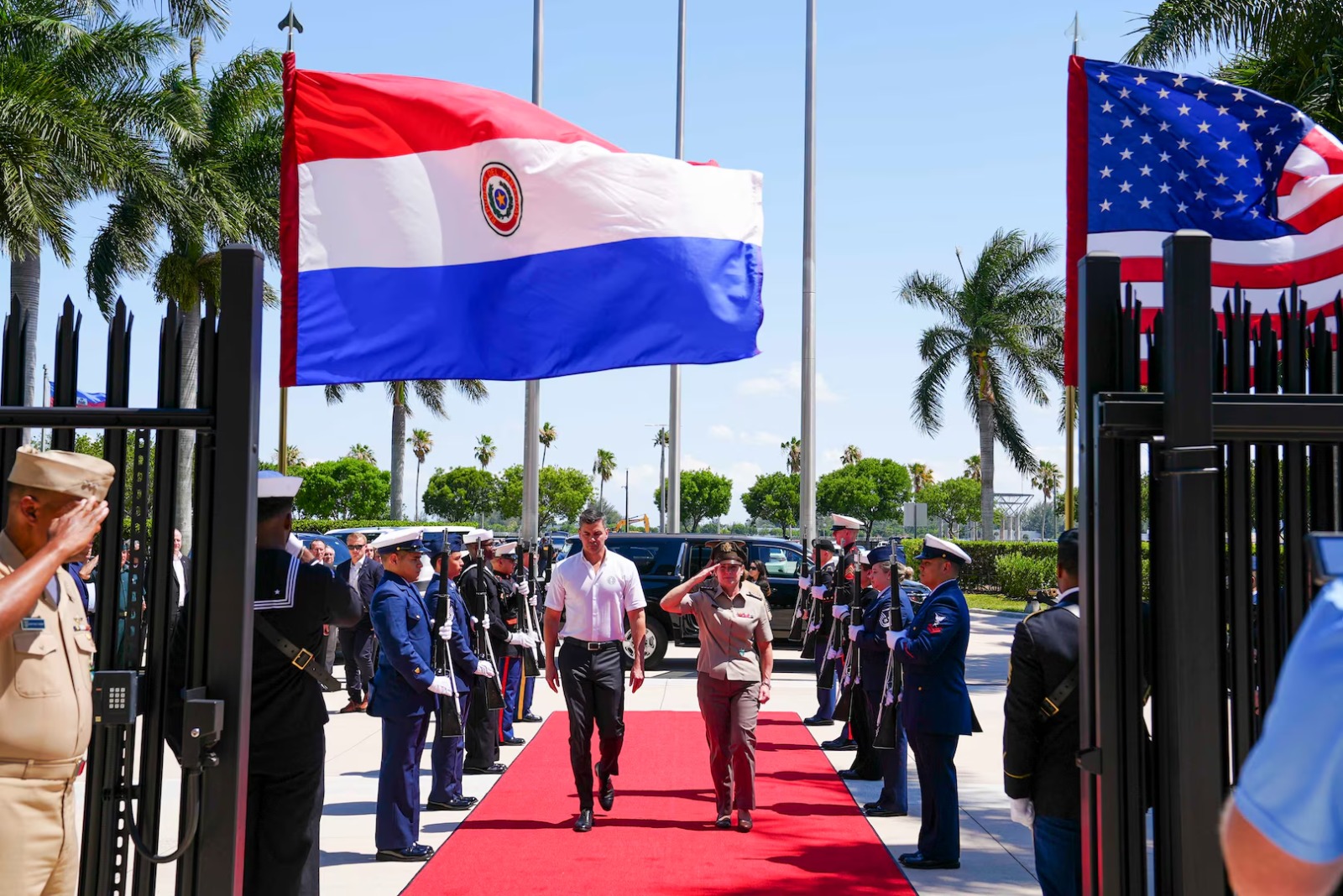
The treaty approved by the Paraguayan Congress and signed by President Santiago Peña establishes a legal framework for the presence of United States military personnel in the country.
The agreement authorizes the entry of US troops, equipment and military materials into Paraguayan territory and provides that these items can enter the country without inspections or customs controls by local authorities.
The text also grants legal immunity to military personnel and contractors linked to the United States armed forces. In practice, this means that any crimes or incidents involving US military personnel will not be judged by the Paraguayan courts, remaining under the exclusive jurisdiction of the United States authorities.
Furthermore, the agreement allows US forces to operate their own telecommunications systems and move freely throughout Paraguayan territory, including in areas close to the border with Brazil.
The region surrounds the so-called Triple Border — which includes Foz do Iguaçu — often cited by US authorities as a focus of attention in US security policy towards Latin America.
The analyst notes that this type of legal provision is common in agreements signed by Washington with countries that receive a US military presence and usually works as a guarantee of immunity for foreign soldiers and contractors.
“You see that the agreement describes that these soldiers can circulate in uniform, move freely and operate within the country’s territory. This serves as cover for situations in which, for example, they commit some arbitrariness or some act that would be subject to punishment according to the laws of the host country”, he explains.
“Sometimes they claim that if a soldier commits a crime, he will be judged according to the laws of the United States. But he may not be punished either. In any case, it is an extraterritorial sovereignty that the United States begins to exercise over these countries.”
Read also: Agreement for US troop presence in Paraguay threatens border with Brazil
Read also: Noboa admits US troops in Ecuador and bombings on the border with Colombia
Paraguay as a strategic point in the Southern Cone
For José Reinaldo, the analysis of the agreement must also consider Paraguay’s geographic position on the strategic map of South America.
According to him, the country occupies a central point in the La Plata Basin and maintains borders with Brazil, Argentina and Bolivia, which increases the regional impact of any foreign military presence in its territory.
“Paraguay has a very peculiar and strategic geographical position. It is in the center of the La Plata Basin, which is one of the most important areas of the Southern Cone, with relevance for regional trade, agriculture and logistics of the countries in the region”, he states.
The analyst highlights that the installation of North American military forces in this space could have direct repercussions for neighboring countries, especially Brazil.
“This opens up the possibility of a United States military presence in a region that is very close to Brazil. So there is no way it won’t reach us,” he says.
He considers that the agreement does not necessarily mean an immediate threat of military intervention in the region, but considers that the permanent presence of foreign troops could affect the strategic interests of the Southern Cone countries.
“We cannot say that Brazil is under an imminent threat of military aggression because of this agreement. But potentially this military presence could affect Brazilian interests”, he says.
Read also: Trump summit exposes subordination of the Latin American far right
Surveillance and data collection in the region
Another point highlighted by the analyst is the possibility of expanding United States surveillance and military intelligence activities in the Triple Border region.
According to him, operations carried out under the argument of combating drug trafficking can also serve for strategic monitoring of the regional territory.
“Under this pretext of combating drug trafficking, these troops will carry out surveillance, data collection and regional monitoring. And there is no way this will not affect Brazil in some way”, he states.
According to him, this type of military presence facilitates obtaining information about economic activities, movement of people and military movements in neighboring countries.
“It is collecting data about life in the border region, about military movements and about everything that they can observe from this presence close to Brazilian territory”, he concludes.
José Reinaldo also mentions the strategic importance of the region that involves the Triple Border and the Guarani Aquifer.
“Take into account the Triple Border, Brazil-Paraguay-Argentina. Take into account the aspect of the Guarani Aquifer, which is something that has been discussed for a long time, the existence of this aquifer and the strategic importance it has”, he states.
The Guarani Aquifer is one of the largest reserves of underground freshwater on the planet and extends across Brazil, Paraguay, Argentina and Uruguay. The region has been frequently cited in geopolitical debates about natural resources and water security in South America.
The proximity between sensitive areas of the Triple Border, logistical corridors of the La Plata Basin and aquifer recharge zones reinforces the strategic nature of the territory where the Paraguayan military agreement authorizes the operations of North American forces.
Read also: Ana Prestes sees Trump’s coalition as an offensive against China
Drug trafficking as a political justification
The expert also questions the justification presented by the United States that the expanded military presence in Paraguay would have as its main objective the fight against drug trafficking.
For him, the argument functions above all as a political instrument to legitimize the increase in North American military presence in the region.
“I think the fight against drug trafficking is a pretext. Preventing the entry of drugs into the United States must be done at the United States’ own borders and with internal policies aimed at its population”, he states.
According to him, international cooperation in combating organized crime can occur between countries, but within clearly defined diplomatic and institutional protocols.
“Each country must combat organized crime within its own institutions. If there is international cooperation, it must occur within diplomatic procedures and with strictly established protocols,” he said.
Precedent for new agreements in the region
For the analyst, the growing presence of military agreements with Washington tends to alter the regional political balance and weaken a historical tradition in Latin America of avoiding permanent foreign bases in its territory.
“For a long time there was a political awareness in the region of rejecting the installation of foreign military bases. This type of agreement begins to open gaps in this tradition”, says José Reinaldo.
In his opinion, the treaty signed by Paraguay can serve as a precedent for similar initiatives in other South American countries.
“This agreement with Paraguay sets a precedent for other similar agreements. It could pave the way for initiatives of this type in several countries in the region.”
He mentions that governments aligned with Washington can be encouraged to sign military agreements of the same type, gradually expanding the United States’ presence on the continent.
According to him, this scenario can also generate political pressure on countries that have historically maintained greater autonomy in their foreign policy.
“This can create constraints and challenges for countries in the region, including Brazil, which is the main country in South America.”
Source: vermelho.org.br