Published 03/09/2026 06:57 | Edited 03/09/2026 08:37
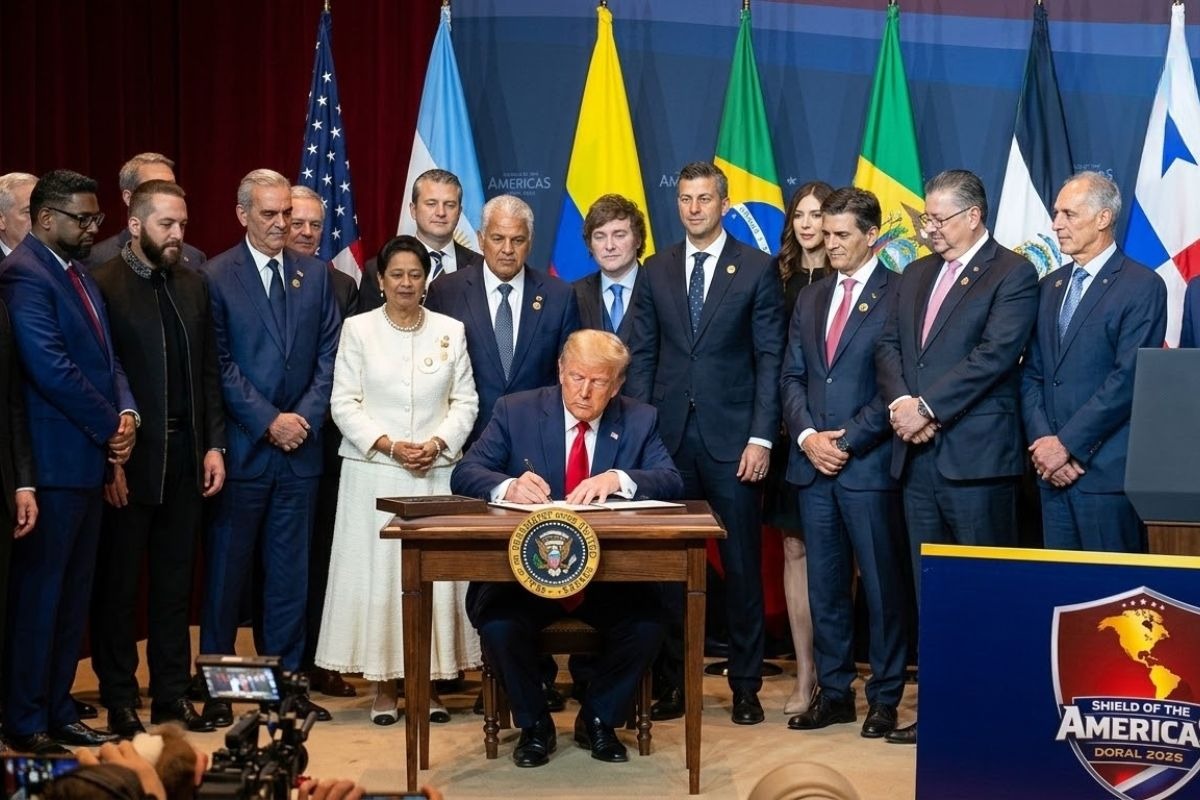
Last Saturday (7), the Latin American extreme right gave a public demonstration of political alignment with the United States by participating in the “Shield of the Americas” summit, called by President Donald Trump at his resort in Doral, Florida.
The meeting brought together 12 leaders from the region close to Washington and served as the stage for the announcement of a military coalition aimed at combating drug trafficking cartels on the continent, presented by the White House as a security initiative, but interpreted by analysts as part of a strategy to isolate the influence of other trading partners in Latin America.
The initiative was presented by the North American government as part of the so-called “Donroe Doctrine”, a concept adopted by the White House to describe its “security” strategy for the hemisphere.
For political scientist Ana Prestes, this is an attempt to reaffirm Latin America as a zone of influence for the United States and limit the advance of other trading partners, especially China.
According to Trump, the United States will not allow “hostile foreign influences to gain ground in this hemisphere” and will ensure that “the Western Hemisphere returns to being a priority [para os EUA]”.
In his speech this Saturday, the president announced the creation of a regional coalition against drug cartels.
“We are announcing a new military coalition to eradicate the criminal cartels that plague our region,” he said. Trump also said that “the heart of the agreement is the commitment to use lethal military force to destroy cartels and terrorist networks once and for all.”
Among those present were Javier Milei (Argentina), Nayib Bukele (El Salvador), Daniel Noboa (Ecuador), Rodrigo Chaves (Costa Rica), José Raúl Mulino (Panama), Santiago Peña (Paraguay), Luis Abinader (Dominican Republic), Irfaan Ali (Guyana), Kamla Persad-Bissessar (Trinidad and Tobago), Nasry Asfura (Honduras), Rodrigo Paz (Bolivia) and José Antonio Kast, president-elect of Chile.
Brazil, Mexico and Colombia were left out of the meeting, countries that concentrate a large part of the population, economy and political weight of Latin America and which are governed by the left.
Asked about the absences, the State Department stated that the meeting prioritized governments that already maintain closer cooperation with Washington in the area of security.
Trump stated that the new structure will make it possible to coordinate regional actions and, if necessary, carry out high-precision attacks against cartel members.
During the meeting, Trump stated that he had acted directly to boost the electoral campaigns of allies in the region and suggested that some of the governments present turned to him in search of political support.
“Some of you were a few points behind in the polls and then went up like a rocket,” he said. According to Trump, several Latin American leaders asked for his political support during election campaigns: “many of you asked me for help. And we helped.”
The statements were received with applause by the government officials present, who heard without dispute the North American president claiming to have interfered in electoral campaigns in the region.
Trump criticizes Mexico, confirms Venezuela under guardianship and makes new threat to Cuba
Donald Trump also used the summit to attack left-wing governments in Latin America and reinforce Washington’s line of political confrontation in the region.
When addressing drug trafficking, the North American president stated that the epicenter of violence on the continent would be in Mexico and accused the country’s cartels of fueling much of the crime in the hemisphere.
“The epicenter of cartel violence is in Mexico. Mexican cartels fuel and organize much of the bloodshed and chaos in this hemisphere,” he said. According to Trump, “the United States government will do whatever is necessary to defend our national security.”
The president also suggested that the Mexican State was losing control over parts of the territory. “The cartels are ruling Mexico. We cannot allow this. It is very close to us,” he said, defending the use of military force against these organizations.
Trump also addressed the situation in Venezuela and stated that Washington began working directly with the government installed after the fall of Nicolás Maduro. According to him, the United States maintains a close relationship with the current Venezuelan president, Delcy Rodríguez.
“We are working closely with the new president of Venezuela, Delcy Rodríguez,” he said. Trump added that recognition of the new government has already been formalized by Washington: “I am pleased to say that this week we formally recognize the Venezuelan government.”
In the speech, the North American president indicated that the relationship with Caracas also involves economic agreements supervised by Washington. According to him, oil exploration and the sale of Venezuelan gold will now take place in partnership with North American companies.
Trump also dedicated part of his speech to Cuba, stating that the country is going through a deep economic crisis and suggesting that the current political system was nearing its end.
“Cuba is at the end of the line. They don’t have money, they don’t have oil,” he declared. For the president of the United States, the country would be “in its last moments of life as it is today”.
Also read: The White House’s digital sadism in the face of the deaths of Iranians
Also read: Iran announces Mojtaba Khamenei as the country’s new supreme leader
Source: vermelho.org.br