Published 02/26/2026 16:41 | Edited 02/26/2026 17:55
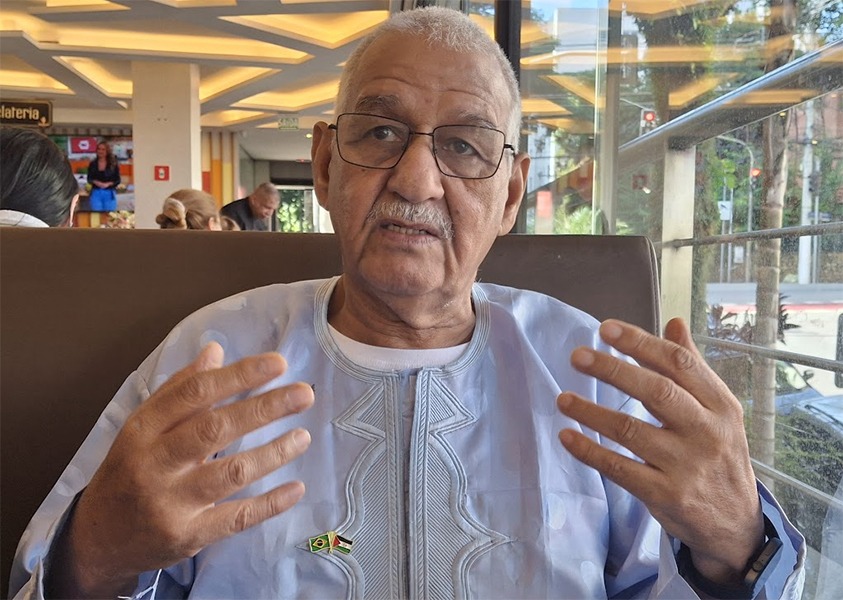
“The Proclamation of the Sahrawi Arab Democratic Republic (SADR) on February 27, 1976 was not a symbolic and passing event, but a decisive foundational act that transformed the national struggle from a revolution into a State”, summarizes diplomat and writer Ahmed Mulay Ali Hamadi in an interview.
Representative of the Polisario Front in Brazil, Ahmed describes the victory over Spanish colonialism and, currently, the bloody confrontation with the Kingdom of Morocco that “blocks access to our immense mineral and fishing riches, making use of a wall of more than 2,700 kilometers, more than eight million mines and an army of 150 thousand men to violate our territory and our sovereignty”.
Faced with these obstacles, Ahmed calls on the Brazilian government to join the 84 countries that already recognize the existence of SADR in order to break the shackles of the last colony in Africa and “reorganize the relationship between law and power, between history and future”. Check it out in full below.
The Saharawi people remember, this February 27th, five decades since the proclamation of their Republic, the occupation by the Kingdom of Morocco and forced exile. What is most striking about this process?
The proclamation of the Sahrawi Arab Democratic Republic (SADR), made on February 27, 1976 by the Popular Front for the Liberation of Saguia el-Hamra and Río de Oro (Front Polisario), is part of one of the longest and legally defined – although politically stagnant – decolonization processes in the contemporary international order.
Fifty years after this event, Western Sahara continues to be a paradigmatic case of the disconnect between the norms of law and their application, an aberrant violation that compromises the very coherence of the international legal system as a whole. This is not a case of common “territorial conflict”, but a case of direct application of the right of people to freely determine their political destiny, with serious consequences for the occupied, victims of the most cruel abuses and persecutions.
The ceasefire of September 6, 1991 between the two parties to the conflict and the creation of the United Nations Mission for the Referendum in Western Sahara (Minurso), established by UN Security Council Resolution 690, in accordance with the agreement proposals accepted by Morocco and the Polisario Front, formalized an international legal commitment with the aim of completing the decolonization process. There was a clear determination that the Sahrawi population should be heard, which has logically been disregarded, as the occupants know the result.
The Court of Justice of the European Union (CJEU) itself introduced a particularly relevant legal dimension by stating that Western Sahara has a “distinct and separate” status from the Kingdom of Morocco. The CJEU has established that no international agreement can be applied to the territory or its natural resources without the consent of the Sahrawi people.
Without any justification, Western Sahara remains on the United Nations agenda as a territory pending decolonization. Several UN resolutions support the right to self-determination of the Sahrawi people, but without a definitive solution.
Meanwhile, our immense mineral and fishing riches – considered the greatest in the world – continue to be plundered by the neighboring kingdom, which uses a wall of more than 2,700 kilometers, more than eight million mines and an army of 150,000 men to violate our territory and sovereignty.
How was the decision made for the process of building the Republic?
The declaration came at a time of legal vacuum following the withdrawal of Spanish colonialism and attempts to impose new realities on the ground. The choice was clear: be annexed, incorporated or even devoured, or reaffirm the national legitimacy resulting from the will of the people. Former Polisario Front secretary-general and martyr Ualy Mustafa Sayed’s assertion was that sovereignty should not be granted but earned.
At that decisive moment, the liberation movement transformed into a state with its own institutions: political leadership, administrative apparatus, external representation and a military force to protect national decisions. The State was not an organizational luxury, but an existential necessity.
Within a few weeks, international recognition began to arrive from Africa, Latin America and other parts of the world. Accession to the African Union was the culmination of a process of consolidating the legal status of the Sahrawi State in continental space.
This recognition was not just a formal gesture; it was the recognition of the existence of a political entity with institutions, representation and a people. It was a diplomatic gain that established the principle that the Republic is not an idea, but a recognized political reality.
The price of the declaration was all-out war.
Exactly. Therefore, our Republic did not have a peaceful opportunity to build its institutions; He was born under bombings and grew up in a context of long military confrontation. However, the nascent State did not back down, organized its ranks, developed its military capabilities and imposed itself on the conflict.
The military proved that the declaration of independence was not empty and that its political legitimacy was supported by its capacity for resistance and deterrence, the consecration of which resulted in its recognition.
What were the main achievements from a social point of view?
First, it is important to emphasize that building in times of war is even more difficult than fighting. However, this phase saw the establishment of the first foundations of an organized state, with legislative and executive institutions operating in exceptional circumstances; a civil administration in the fields based on popular participation; a free public education and health system, despite limited resources; a social organization that preserved national unity and identity.
The camps were transformed from a place of refuge to a place of organization. People have been transformed from victims of displacement to a disciplined community that manages its own resources.
This founding phase was not a period of waiting, but a period of asserting its presence, where the Republic established its legitimacy, fought wars in defense of its decisions, guaranteed recognition and built its institutions under fire. In this way, the solid foundations were laid for what followed: declared legitimacy, diplomatic presence, military capacity and an organized society. We demonstrate our ability to rise into the storm… and remain.
Tell us a little about the history of the Saharawi people.
Since the 15th century, with the beginning of contact with Portuguese expansion, the Sahara lands entered the orbit of imperial ambitions. At the beginning of the 20th century, the situation worsened under the weight of French and Spanish colonialism. The Sahrawis resisted French expansion until 1934 and continued to face Spanish colonialism until their withdrawal in 1976. The confrontation was not equal in terms of equipment and weapons, but resistance was an act of conscience before being an act of pure force, in defense of sovereignty and the rejection of assimilation.
In February 1958, Western Sahara witnessed one of the most tragic chapters of that period: the “Écouvillon” campaign. Not only military sites were targeted, but also civilian gatherings and sources of livelihood were hit. Missiles rained down on unarmed civilians, aircraft were mobilized, men, women and children were murdered and injured, livestock was burned and the horizon turned to fire and smoke. All in an attempt to destroy the environment that fueled the resistance. But the pain became an even more cohesive collective memory, which later resulted in awareness and reinforcement of the effectiveness of resistance through more rigorous organization and a clearer vision of the way forward.
And the conflict enters a new phase after Spain’s withdrawal.
Precisely, under pressure from the fighting, with the entry of Moroccan forces. In February 1976, the camps were bombed, mainly in the Um Dreiga area, with napalm and phosphorus, along with attacks on civilians in El Ghal, Amgala and Tfariti, in one of the most brutal episodes of the modern conflict. The sand caught fire, innocent people were slaughtered and injured, and the land was transformed into a scene of smoke and flames. However, the idea has not become extinct and the identity has not dissipated, because what is established in the collective consciousness transcends the impact of weapons.
Memory tells us that a mother looked for her son in the smoke, calling his name, almost suffocating, while the sand around her was still burning. She posed no threat to anyone, but she carried a life she was trying to save. At that moment, the difference between those who have power and those who have rights is revealed; power can impose silence, but it cannot take away legitimacy and, over time, the victim becomes a moral witness to the justice of their cause.
From this belief arises his commitment to the establishment of his independent State – the Sahrawi Arab Democratic Republic – as a political expression of an unshakable will, an unchanging identity and an unshakable right. Experience has shown that force can alter the balance of power, but it cannot put an end to a cause that is rooted in the conscience of a people.
What is the main lesson left by these years of resistance and struggle in such unequal conditions?
The Sahrawi Republic becomes a solid factor of stability because it starts from a clear premise: there can be no lasting peace without political justice, nor long-term stability without a radical solution to the sources of the conflict. When geography is framed by legitimacy rather than the current balance of power, it transforms from a theater of friction into a space of empowerment and integration, and bridges of cooperation extend to encompass the entire region. At this point, the State is no longer just a political label, but a practical formula for reorganizing the relationship between law and power, between history and future.
There are 50 years of struggle in all areas that demonstrate to the world our ability to resist and remain united in search of freedom, whatever the cost. Therefore, everyone must contribute their part, each in their own way, to force the International Community to respect the right to self-determination of the Sahrawi people.
Source: vermelho.org.br