Published 02/26/2026 17:18 | Edited 02/26/2026 18:50
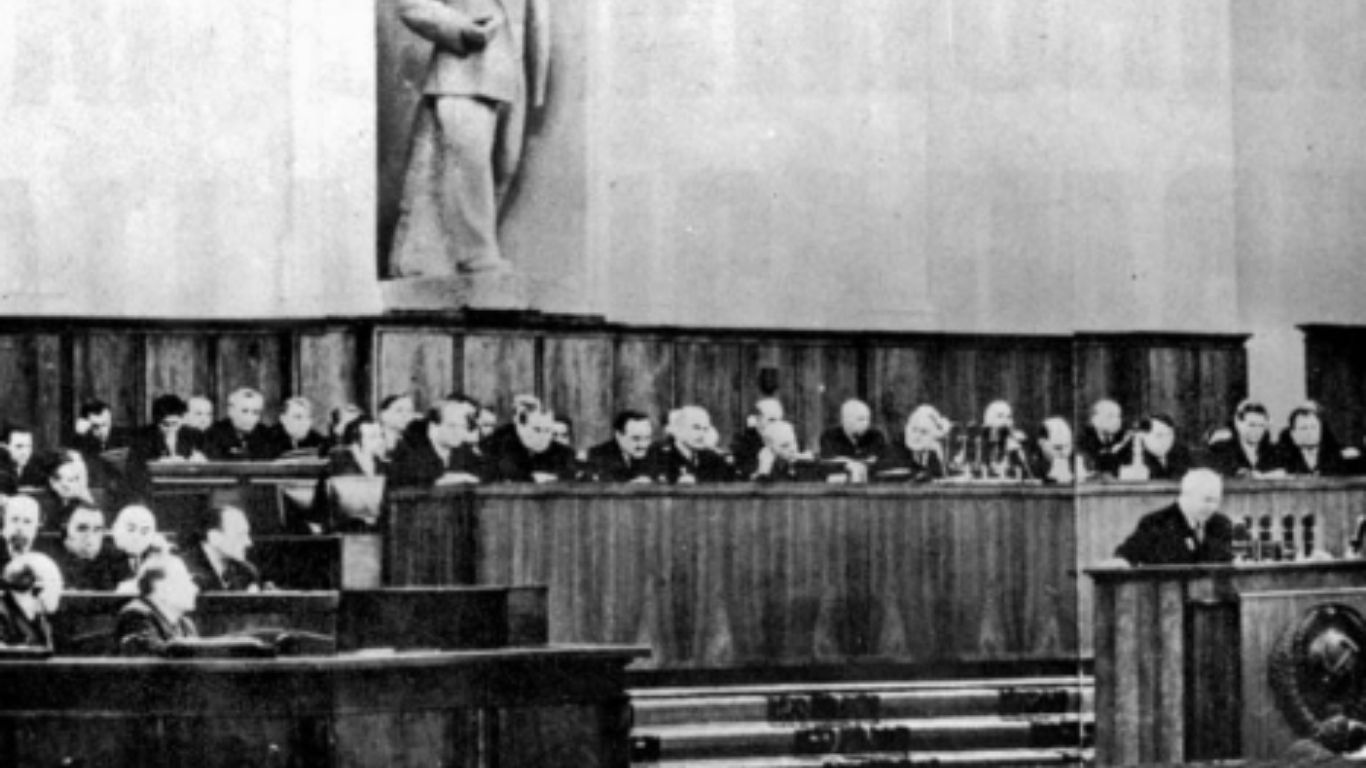
Exactly 70 years ago, on February 25, 1956, the international communist movement suffered one of its deepest blows, delivered not by imperialism, but from within the Central Committee of the Communist Party of the Soviet Union itself. Nikita Khrushchov, in a closed session after the 20th Congress of the CPSU, delivered the infamous “Secret Report”, entitled “On the cult of personality and its consequences”.
The document, which “was never submitted for the approval of the delegates” nor appeared in official minutes, became the starting point of the revisionism that tried to bury the work of Josef Stalin and, consequently, the very cohesion of the world revolutionary struggle.
Khrushchev’s maneuver meant ignoring socialist conquests
As highlighted by the journalist, historian, former Italian senator and co-founder of ALN with Carlos Marighela, José Luiz Del Roio, in a recent interview with the channel Tutameia“the report was political infamy deliberately leaked to the West”.
Del Roio recalls that Khrushchev’s maneuver “aimed at isolating Stalin by attributing to him the origin of all evils, ignoring the colossal achievements of socialist construction”.
By attributing errors and purges to a single man, the report not only damaged the memory of the leader who led the victory over Nazi fascism, but opened the floodgates for the demoralization of millions of activists and the fragmentation of parties across the globe.
The impact of “de-Stalinization” in Brazil
In Brazil, the impact was seismic. The former PCB capitulated to the theses of “de-Stalinization” and the “peaceful path” to socialism, abandoning the revolutionary perspective in favor of an alliance subordinated to the national bourgeoisie.
It was in this scenario of internal crisis that the proletarian and revolutionary nucleus, led by João Amazonas, Maurício Grabois, Pedro Pomar and Diógenes Arruda Câmara, raised the flag of Marxist-Leninist resistance. For these leaders, accepting the report meant accepting ideological disarmament in the face of imperialism.
The reorganization of the Communist Party of Brazil (PCdoB), in February 1962, was the answer given. By rescuing the original name and the Manifesto-Program, the founders of the PCdoB aligned themselves with the international wing that, like the Chinese communists, perceived Khrushchevism as the seed of capitalist restoration – which was later carried out with Gorbachev. Historical documents of the party, preserved by the Maurício Grabois Foundation, reaffirm that the report was a revisionist disqualification of the USSR’s achievements. The coherence of Diógenes Arruda, João Amazonas, Maurício Grabois and Pedro Pomar prevented the dilapidation of Marxism-Leninism in Brazil, which later resulted in the vigor that the Party needed to overcome the leaden years and resist the dictatorship with the historic Araguaia Guerrilla.
Del Roio clearly summarizes what was at stake: “Stalin’s legacy is proof that it is possible to win”, he stated. By taking over an agrarian and besieged country, Stalin coordinated the transformation of the USSR into an industrial and military power capable of crushing Hitler’s war machine. For the historian, the 1956 report was a crime against historical truth, serving as a weapon in imperialism’s ideological war to divide the socialist camp.
Seventy years later, the balance carried out by the PCdoB, consolidated from its 8th Congress in 1992, remains dialectical and current. The party recognizes the errors and violations of socialist legality of the period, but rejects the liberal narrative that tries to equate communism with fascism. It values industrialization and the geopolitical role of the USSR, while criticizing the revisionism that weakened the workers’ state.
Today, the debate takes on new contours with the resolutions of the Communist Party of the Russian Federation, which seeks to review Khrushchev’s report.
Source: vermelho.org.br