Published 02/10/2026 10:54 | Edited 02/10/2026 17:59
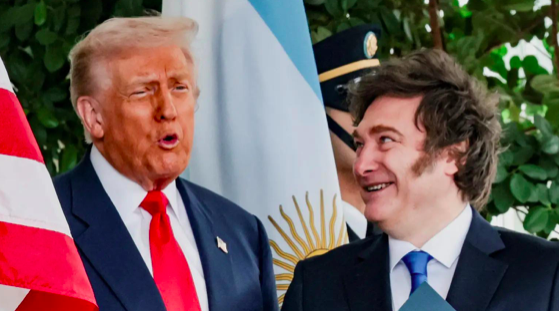
The trade agreement signed last Thursday (5) between Argentina and the United States consolidates the Javier Milei government’s alignment with Washington and formalizes a deeply unequal relationship between the two countries.
The new agreement expands the opening of the Argentine market and incorporates rules that align the country with Washington’s regulatory standards in strategic sectors, from health to energy.
The text imposes 113 obligations on the Casa Rosada, compared to just two assumed exclusively by the USA. The result is an asymmetrical arrangement that restricts the Argentine State’s ability to formulate its own industrial policies.
The agreement provides for the elimination of tariffs on more than 1,600 Argentine items, while Argentina removes or reduces import taxes on more than 200 North American products, including machinery, transportation equipment, medical devices, chemical inputs and technological goods.
Annual quotas were also set for food and automobiles produced in the USA, which will be able to enter the Argentine market with tariff benefits.
Among the points highlighted by the Argentine government is the increase in the beef quota for the North American market, which could reach 100 thousand tons.
The Trump administration presented the measure as an instrument to expand the supply of products and contain internal inflationary pressures, especially in the food sector. By facilitating the entry of Argentine meat, Washington seeks to increase competition and reduce prices for North American consumers.
These tariff provisions, however, are accompanied by commitments that go beyond trade in goods.
The text provides for coordination in areas such as critical minerals, energy and economic security, in addition to establishing restrictions on the acquisition of sensitive technologies — such as nuclear reactors and enriched fuel — from countries not aligned with the United States.
It also prioritizes North American investments in the exploration of lithium, copper and energy infrastructure and foresees alignment in commercial practices related to “third countries”, a reference associated, in the current international context, with China.
As a result, the agreement is in line with North American foreign policy aimed at reorganizing production chains and containing Chinese influence in Latin America, inserting Argentina into this geoeconomic arrangement.
The negotiation was authorized by Mercosur, which allowed Argentina to sign the pact bilaterally. Still, the movement could generate internal friction within the bloc, especially with Brazil, Argentina’s main trading partner.
Source: vermelho.org.br