Published 05/02/2026 17:50
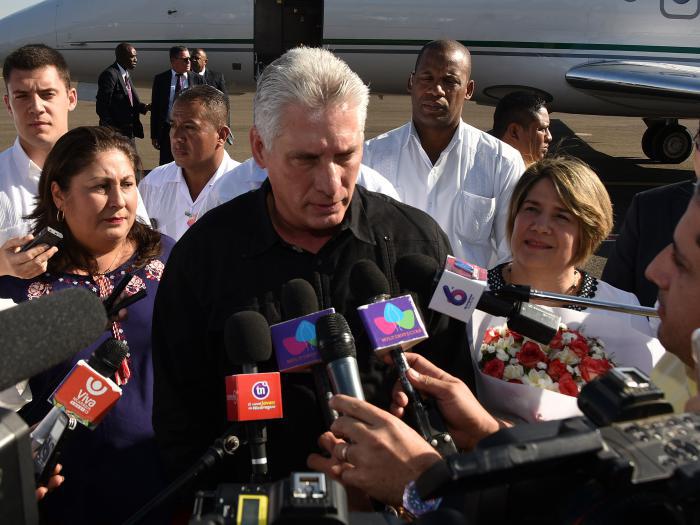
The president of Cuba, Miguel Díaz-Canel, stated this Thursday (5), in a press conference with national and foreign journalists, that the United States is promoting “economic suffocation” against the island, but guaranteed that the country will not surrender to external pressure.
“The option of surrender is not Cuba’s option,” he declared. “The resistance of the Cuban people is not a resistance to endure; it is a resistance of creation. I resist, but I overcome myself.”
Díaz-Canel said that Cuba is going through a “complex moment”, made worse by the energy blockade imposed by Washington, which, according to him, tries to prevent the arrival of fuel to the country. Still, he insisted that the island is “a country of peace” and that its defense doctrine is based on sovereignty and non-aggression.
Read more: Thousands march in Havana against US aggression and in defense of the Revolution
“We are not a threat to the United States,” he said. “It is a sovereign duty to prepare for defense.”
The statement comes after the US government intensified measures that affect the island’s oil supply and kept Cuba on the list of countries that allegedly sponsor terrorism — a classification that Havana considers “slanderous” and a “political instrument”.
Dialogue under conditions
Despite the criticism, the Cuban president reiterated his willingness to dialogue with Washington, as long as basic principles are respected.
“Cuba is willing to dialogue on any topic, without pressure, without preconditions, in a position of equals and with respect for our sovereignty,” he said.
He stated that, throughout recent history, there have been moments of bilateral cooperation on migration, environmental and security issues, and that these channels could be resumed if there is “mutual respect”.
Energy at the center of the crisis
The energy crisis was the most detailed topic of the conference. According to Díaz-Canel, the naval blockade of Venezuela and the measures adopted by Washington in recent months have drastically reduced the entry of fuel into the country since December.
The shortage affects electrical generation, transport, agriculture and basic services.
The government, however, maintains that it has accelerated the transition to renewable sources. In 2025, according to him, more than 900 megawatts were recovered in distributed generation and 1,000 megawatts were installed in solar parks, increasing the share of renewables in the electrical matrix from 3% to 10%.
“If we didn’t have these thousand solar megawatts, we would be experiencing successive total blackouts,” he said.
The updated plan envisages achieving between 15% and 20% renewable generation in the short term, expanding photovoltaic systems with storage, installing 5,000 solar modules in isolated homes and another 5,000 in hospitals, nursing homes and polyclinics.
The president also defended expanding the exploration of national heavy oil, associated gas and biogas, in addition to investing in his own refining.
“We have to learn to live with our own energy sources,” he said.
Military preparation
Asked about an official note that mentioned plans for a possible state of war, Díaz-Canel stated that the country had merely updated its defense mechanisms within the doctrine of “the war of the entire people”.
“We are not declaring war. We are preparing,” he said. “A Revolution that does not know how to defend itself hardly survives.”
He highlighted that Cuba “is a country of peace” and that its defensive structure does not include aggression against other countries.
Venezuela and international support
The president also addressed the relationship with Venezuela, which he classified as a supportive partnership and not economic dependence.
According to him, the blockade of Venezuelan oil has impacted Cuban supplies, but bilateral cooperation will continue.
Díaz-Canel mentioned demonstrations of support from countries such as Russia, China, Mexico and members of the Non-Aligned Movement, and defended the Global South’s articulation against what he called a hegemonic offensive.
“The world cannot allow itself to be humiliated nor allow force to replace multilateralism,” he said.
Economic reforms
Internally, the government is preparing structural reforms, including greater autonomy for state-owned companies and municipalities, restructuring of the state apparatus and review of the basic food basket distribution model.
According to the president, it is necessary to overcome “egalitarianism” and move towards a more equitable system, based on local production.
“We will eat what we produce,” he said.
He also mentioned encouraging municipal exports, greater openness to foreign investment and the participation of Cubans residing abroad in productive projects.
Youth and mobilization
Díaz-Canel reserved part of the press conference to praise the role of Cuban youth, which he classified as “creative, bold and committed”.
“There is no unity or continuity without young people,” he said.
According to him, the popular mobilization following the recent events in Venezuela demonstrates that the country maintains political cohesion.
In closing, the president reiterated that Cuba is not isolated and that the blockade will not achieve its objective.
“There is a lot to defend,” he said. “And these people have demonstrated, throughout history, that they know how to resist and advance.”
Source: vermelho.org.br