Published 02/04/2026 11:20 | Edited 02/04/2026 11:47
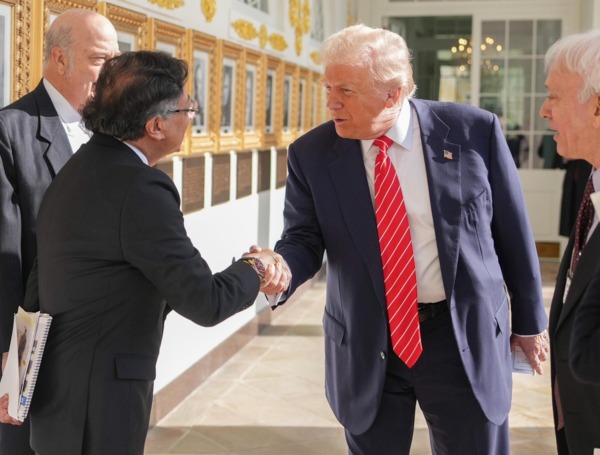
After months of public accusations, sanctions and threats, the President of Colombia, Gustavo Petro, met this Tuesday (3) with the President of the United States, Donald Trump, at the White House.
The meeting, marked by the effort to rebuild dialogue, ended with cordial statements and the promise of cooperation in the “fight against drug trafficking”, but without announcing concrete agreements.
The meeting comes after a year of open tension between Bogotá and Washington. Trump called Petro an “illegal drug leader”, imposed sanctions on the Colombian leader, revoked his visa and applied restrictions to members of his government and family members.
After the US military operation that overthrew Nicolás Maduro in Venezuela, the Republican insinuated that Colombia could be the target of similar action, accusing the country of flooding the United States with cocaine.
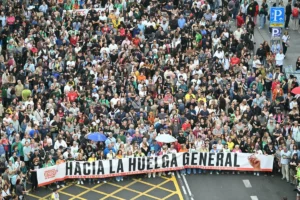
Petro criticized the action and even classified it as “kidnapping”. He also said that the Caribbean has become the “eye of the storm” of US foreign policy. Before the trip, he called for demonstrations and stated that he would go to the White House to “defend the nation”. Thousands gathered in Bogotá’s Plaza Bolívar while the meeting took place in Washington.
Participating in the meeting, on the North American side, were Vice President JD Vance, Secretary of State Marco Rubio and Senator Bernie Moreno, of Colombian origin.
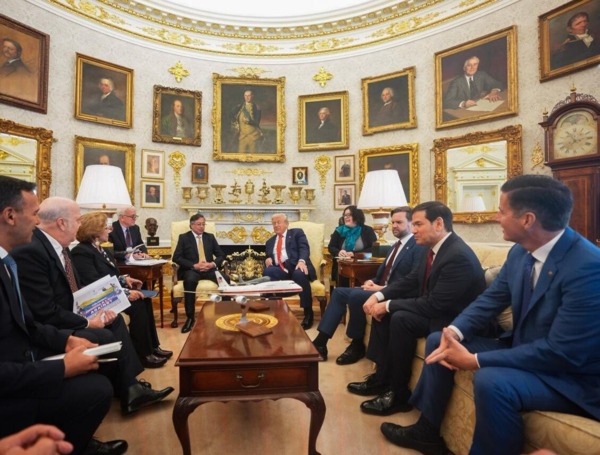
The presence of the latter, one of Petro’s strongest detractors in the United States, caused surprise. Firstly, because the presence of congressmen is not common in this type of meeting; second, because Moreno warned that the future of the bilateral relationship would depend on the total eradication of coca cultivation.
Petro was accompanied by Defense Minister Pedro Sánchez, Ambassador Daniel García-Peña and Foreign Minister Rosa Villavicencio in Colombia. García-Peña carried a folder with the inscription “Colombia, America’s number 1 ally against narcoterrorism”.
This week’s meeting marks a rhetorical inflection. Asked by journalists if an agreement had been reached to contain the flow of drugs from Colombia to the United States, Trump replied: “We worked on it and we got along very well.”
He also said that “we weren’t exactly the best of friends” and that they were “also working on other things, including sanctions.” In a written message delivered to Petro, he recorded: “Gustavo – A great honor – I love Colombia.”
Petro classified the meeting as “positive” and stated that it was a dialogue “between different people, but without humiliation”. “We don’t hit or scratch each other, we look for solutions”, he declared after the meeting.
The Colombian also said that it was a conversation “of equals”. Petro rated the meeting with a “nine” rating and stated that he did not dedicate “not one second” to discussing the sanctions against him and his family or his visa.
Drug trafficking at the center of the agenda
The fight against drug trafficking was presented as a common point between governments with divergent positions on regional policy. Both did not mention any goals or work together.
Petro reiterated that cooperation must focus on organized crime structures. He argued that anti-drug policy cannot penalize farmers involved in subsistence economies and insisted that eradication must be manual and carried out by the farmers themselves.
Data presented by the Colombian government indicate that, since the beginning of the mandate, 810 extraditions have been carried out — a higher number than that recorded in previous governments: 760 under Iván Duque, 751 in Álvaro Uribe’s second term and 724 in Juan Manuel Santos’ first term.
As of December 31, according to the Colombian Ministry of Justice, around 2,800 tons of cocaine had been seized. Voluntary substitution programs for illicit crops total approximately 30 thousand hectares registered.
The voluntary substitution program envisages that farmers stop planting coca leaves in exchange for state support to migrate to legal activities, such as agricultural production or community projects.
Adhesion depends on a formal agreement between the government and the communities, with provision for technical assistance and economic support during the transition.
Washington had denied Colombia annual certification in anti-drug policy, an instrument provided for in North American legislation that can restrict financial assistance and support in multilateral organizations.
The Colombian government contests the framework and maintains that the repressive effort cannot be dissociated from the social and economic dimensions of the problem.
Source: vermelho.org.br