Published 01/25/2026 15:20 | Edited 01/25/2026 15:21
Fifteen years after the outbreak of the Arab Spring, the romantic narrative of spontaneous uprisings driven by social media gives way to a more critical reading. The digital mobilizations that overthrew long-standing regimes also operated as instruments of hybrid warfare: they channeled dissatisfaction, but were unable to build sovereign, stable and socially inclusive power projects. The result, across much of the region, was the collapse of Arab nationalism, state fragmentation and the return of even harsher forms of authoritarianism.
Social networks functioned as mass accelerators, not as architects of institutions. Politics was replaced by emotional waves, slogans and street pressure, creating the ideal scenario for external interventions, regional rearrangements and the consolidation of actors aligned with the strategic interests of the United States and its allies in the Gulf. Societies that maintained some political and economic stability, with a large middle class, plunged into chaos and impoverishment.
From rebellion to repression: the Tunisian case
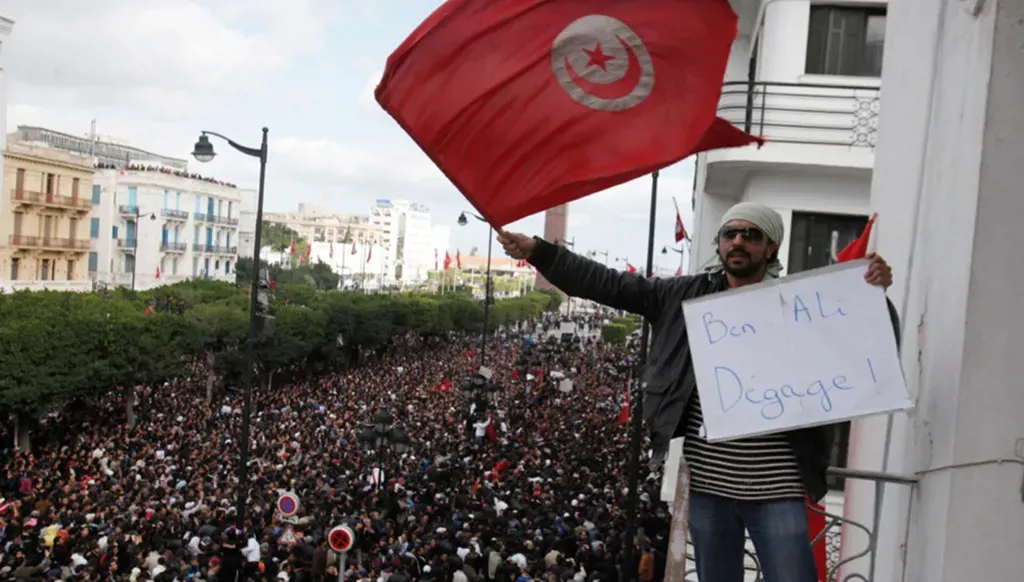
Tunisia, the birthplace of the Arab Spring, clearly illustrates this cycle. The recent arrest of activist and lawyer Ayachi Hammami, reported by Human Rights Watch, symbolizes the closure of political space under President Kais Saied. The country that for years was presented as a “democratic exception” returned to authoritarian practices, with systematic persecution of the opposition and concentration of power in the Executive.
The Tunisian trajectory highlights how the overthrow of Ben Ali in 2011 did not result in a consolidated democracy, but in a fragile transition, easily reversed when North American digital platforms lost their mobilizing interest and the State recomposed its control mechanisms.
The domino effect and the power vacuum
The collapse of the Tunisian regime triggered a domino effect. Mubarak fell in Egypt, Gaddafi was brutally murdered in Libya, Ali Abdullah Saleh was deposed in Yemen. In all these cases, the fall of the regime was not accompanied by solid institutional pacts. What followed was a power vacuum exploited by armed forces, militias, extremist groups and external powers.
In Libya, Gaddafi’s intervention and lynching paved the way for a permanent civil war, fragmenting the country and transforming it into an arms corridor and regional instability. In Egypt, the election of Mohamed Morsi revealed the limits of formal democracy in the face of an intact “deep state,” which quickly reorganized the 2013 coup and brought Abdel Fattah el-Sisi to power — in a more repressive regime than Mubarak. What we have in Egypt today is the guarantee that no Arab Spring will happen again.
Social networks as a vector of destabilization
Digital platforms played a central role in this process. At the same time as they broke the state monopoly on information, they facilitated disinformation operations, extreme polarization and large-scale emotional manipulation. Algorithmic logic rewards conflict, not mediation; the rupture, not the construction. In all the countries they visited, fortunes were invested in boosting posts to ensure widespread support.
In this environment, external agendas found fertile ground. The selective promotion of “democracy” coincided with the weakening of nationalist regimes historically less aligned with Washington, while Gulf monarchies (authoritarian, religious, violent and corrupt) — politically stable, economically central and strategically allied with the US — emerged as new poles of regional power.
Gulf strengthened, historic capitals emptied
The geopolitical impact of the Arab Spring was clear: the center of gravity of the Arab world moved from Cairo, Damascus and Baghdad to Doha, Abu Dhabi and Riyadh. The Gulf monarchies not only survived the protests but expanded their economic, diplomatic and media influence, often financing political and military forces in destabilized countries.
This rearrangement favored a regional order more aligned with North American interests, based on the containment of Arab nationalism, the weakening of strong secular states and the permanent management of instability as a tool of control.
Extremism, fear and the pretext of order
The chaos generated by the fall of the regime also opened space for groups such as the Islamic State, whose rise served as justification for military interventions, states of exception and the suspension of civil liberties. The promise of “order” came to legitimize authoritarianism, while the structural causes — inequality, corruption and economic dependence — remained intact or worsened.
In Egypt and Tunisia, the lessons learned by the regimes were clear: control the internet, criminalize protests and prevent any repetition of the 2011 mobilization cycle. Preventative repression became state policy.
Syria, Gaza and the uncertain future
The fall of Bashar al-Assad, in December 2024, reignited the debate about a possible “second Arab Spring”. However, the rise of Hayat Tahrir al-Sham, with extremist roots, and Syrian territorial fragmentation highlight the risks of repeating the same script: overthrowing without rebuilding, mobilizing without organizing.
In the post-Gaza war period, the region remains marked by unresolved conflicts, the circulation of weapons and the permanent instrumentalization of crises, keeping the Middle East in a state of controlled boiling.
Democracy desired, sovereignty denied
Polls indicate that the majority of Arabs continue to desire democracy. The paradox is that recent experiences have associated “democratic transition” with state collapse, violence and loss of sovereignty. Social networks, far from being neutral tools of emancipation, proved to be effective weapons of hybrid warfare: capable of mobilizing crowds, but incapable of protecting societies from the authoritarian backlash that followed.
The Arab Spring did not fail due to too many people on the streets, but due to the absence of autonomous political projects in the face of a digital environment colonized by external interests. The story remains open, but the lesson is harsh: without sovereignty, organization and social control over technology, the revolt can only be the first act of authoritarian restoration.
Source: vermelho.org.br