Published 01/16/2026 16:11 | Edited 01/16/2026 17:21
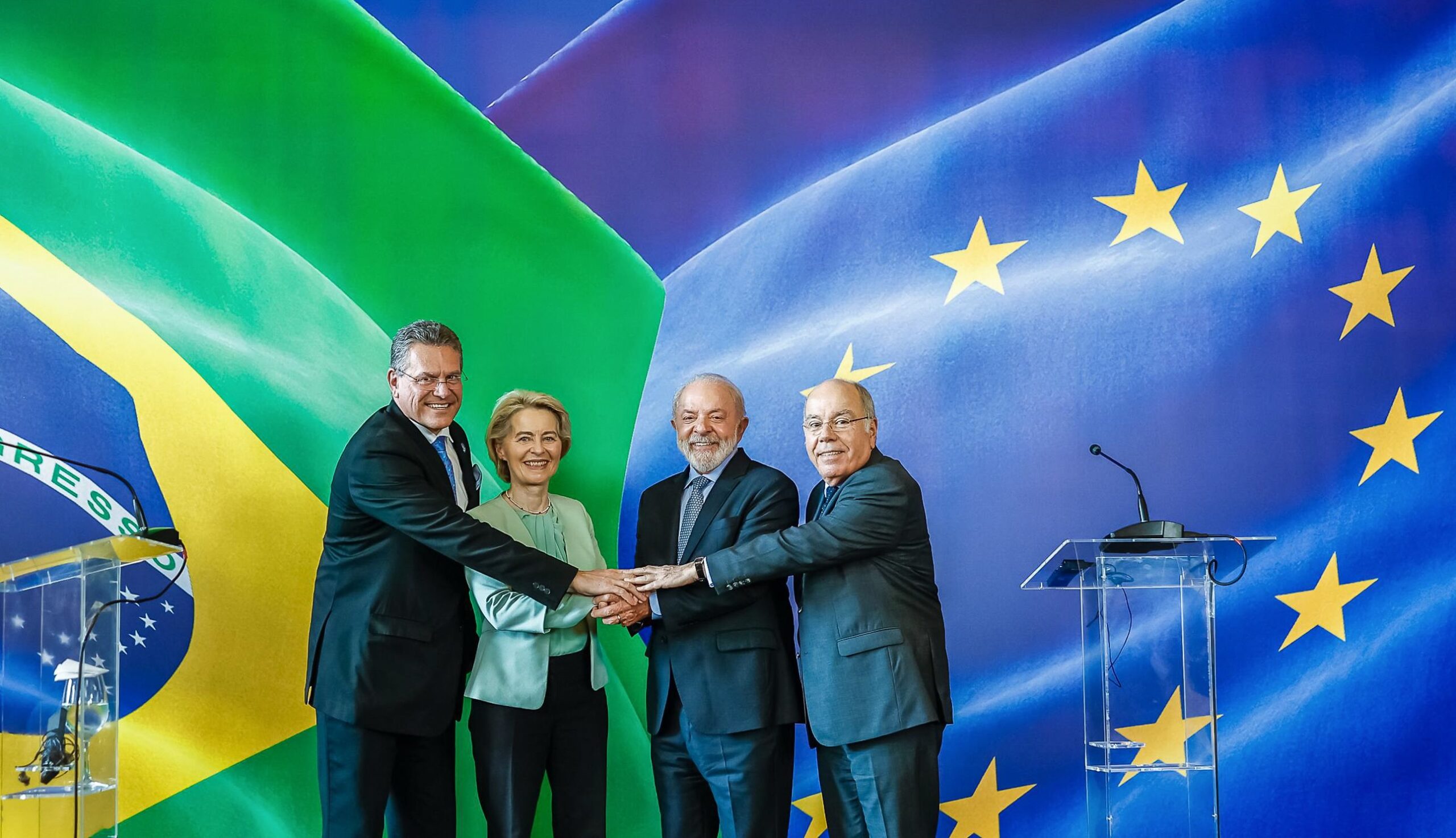
When speaking to the press this Friday (16), after a meeting at the Itamaraty Palace with the president of the European Commission, Ursula von der Leyen, President Luiz Inácio Lula da Silva made it clear that the resumption and conclusion of the agreement between Mercosur and the European Union (EU) are part of a deliberate foreign policy strategy for his third term. According to Lula, restoring the partnership with the EU “on new bases” was a priority since the beginning of the government, after more than 25 years of negotiations marked by impasses.
The president highlighted that the signing scheduled for this Saturday (17), in Asunción, represents the creation of one of the largest free trade areas in the world, bringing together around 720 million people and a combined GDP of US$22 trillion. Lula celebrated the closing of the agreement between Mercosur and the European Union as a civilizational milestone. “Tomorrow, in Asunción, we will make history”, he stated.
Lula recalled that resuming negotiations has been a priority since the beginning of his third term. “There were more than 25 years of suffering and attempts to reach an agreement,” he said, highlighting that the final text only advanced because it was aligned with the objectives of reindustrialization, social justice and environmental sustainability in Brazil.
Trade with development, not automatic liberalization
In an analytical and political tone, Lula stressed that trade liberalization cannot be an end in itself. “Trade liberalization and openness only make sense if they are capable of promoting sustainable development and reducing inequalities,” he stated. The president emphasized that the agreement preserves the role of the State in strategic areas such as health, industrial development, innovation and family farming.
At this point, Lula sought to dismiss historical criticisms of the treaty, highlighting that Brazil will not accept the perpetuation of a model based exclusively on the export of commodities. “We are already major suppliers of agricultural products to the European Union, but we will not limit ourselves to the eternal role of commodity exporters”, he said, defending the expansion of production and export of industrial goods with greater added value.
He highlighted that the agreement includes provisions to attract European investments in high-value-added industrial sectors, especially in the areas of energy and digital transition. Lula also mentioned strategic partnerships in critical minerals — such as lithium, nickel and rare earths — essential for batteries, green technology and productive sovereignty. “We want to produce, not just deliver resources”, he reinforced.
According to him, “more trade and more investments mean new jobs and opportunities on both sides of the Atlantic”, as long as they are accompanied by public policies capable of inducing development.
Agreement is “pact of values”, says Lula
Lula also highlighted that the treaty goes beyond the economic dimension. The agreement, according to the president, incorporates commitments to the environment, tackling climate change, the rights of indigenous peoples, workers’ rights and gender equality — binding clauses that, according to him, guarantee that trade liberalization does not translate into a race to the bottom. He stated that the partnership reinforces shared values between Mercosur and the European Union, such as respect for democracy, the rule of law and human rights.
In this context, the president presented the agreement as a political gesture in defense of multilateralism, in contrast to protectionist and unilateral tendencies on the international scene.
“Opening only makes sense if it promotes sustainable development and reduces inequalities”, he stated, making it clear that the Brazilian State will maintain its active role in health, innovation, family farming and industrial policy.
Strategic chains and energy and digital transitions
The president also highlighted that the partnership includes strategic value chains for energy and digital transitions, a theme later reinforced by Ursula von der Leyen. For Lula, this aspect is fundamental to insert Brazil into sectors with greater technological density and reduce external vulnerabilities.
He recalled that, in his third term, Mercosur has already concluded agreements with the European Union, EFTA and Singapore, and stated that the government will continue working to open new markets, citing negotiations with Canada, Mexico, Vietnam, Japan and China.
Ursula von der Leyen praises Lula’s “political leadership”
European Commission President Ursula von der Leyen called the agreement the “achievement of a generation” and directly credited Lula with the successful conclusion of the negotiations. “His personal commitment, passion and skillful leadership were enormous,” he said. She reinforced that the pact represents “the power of friendship between people” and rejected the view of trade as a zero-sum game: “Everyone wins — with jobs, opportunities and mutual trust.”
Ursula also celebrated the strategic alignment on critical minerals, stating that the partnership will help reduce dependence on coercive actors and ensure that local communities are the main beneficiaries of responsible exploration.
Ratification and implementation
Although signed tomorrow, the agreement still needs to be ratified by the European Parliament and Mercosur national congresses. In Brazil, the text will be submitted to the National Congress, where it already has support from the government and productive sectors. Lula and Ursula agreed that the signature is just the “first step” — true success will come when companies and citizens feel the concrete benefits.
Closing his speech, Lula adopted a broader political tone by stating that the agreement is “good for Brazil, good for Mercosur, good for Europe and, above all, very good for the democratic world and for multilateralism”. The declaration summarizes the Brazilian government’s understanding that the treaty is not only commercial, but also a geopolitical landmark, at a time of disputes over rules, markets and values in the international system.
Source: vermelho.org.br