Published 01/04/2026 11:52 | Edited 01/04/2026 13:18
Until this Sunday morning (4), numerous demonstrations against the United States military attacks on Venezuela and the kidnapping of former president Nicolás Maduro were scheduled in different parts of the world, denouncing imperialist aggression and the violation of national sovereignty.
In the interior of Venezuela, popular resistance is organized around the Chavista leaders, who call for unity and the rejection of foreign intervention. Internationally, outrage is spreading, with diverse voices – including that of Pope Leo XIV – condemning the military escalation and demanding respect for international law.
Internal Resistance in Venezuela
In Venezuela, Maduro’s supporters remain mobilized, despite the persecution and media campaign against the former president. On Saturday (3), thousands occupied the streets of Caracas, Barinas and Anzoátegui, gathering around the Miraflores Palace to demand Maduro’s release and denounce the US bombings. The demonstrations echoed slogans such as “The united people will never be defeated”with red flags flying in defense of the homeland.
The mayor of Caracas, Carmen Teresa Meléndez, and vice president Delcy Rodríguez took the front line, declaring a “state of emergency” and calling on the people to resist the occupation. “Venezuela will not be anyone’s colony,” said Rodríguez. Even with the attacks on military installations, the core of Chavista power remains active, and today smaller mobilizations continue in several cities, demanding proof of Maduro’s life, kidnapped with his wife Cilia Flores and taken to the USA on charges of narco-terrorism.
Protests around the world
In more than 80 cities, crowds rose up against imperialist aggression. In Latin America, acts took place in Colombia, Costa Rica and Brazil – in Brasília, protesters gathered in front of the Venezuelan Embassy, holding flags and posters for sovereignty. Presidents Lula (Brazil), Gustavo Petro (Colombia) and Miguel Díaz-Canel (Cuba) denounced the intervention.
In Europe, London, Paris, Athens, Madrid and Rome were the scene of protests with slogans such as “Hands off Venezuela” e “Defend sovereignty”. In London, members of the British Communist Party demonstrated in front of the US Embassy, uniting Venezuelan and Palestinian flags against imperialism. In Portugal, the PCP (Portuguese Communist Party) called for acts against the war and in defense of self-determination.
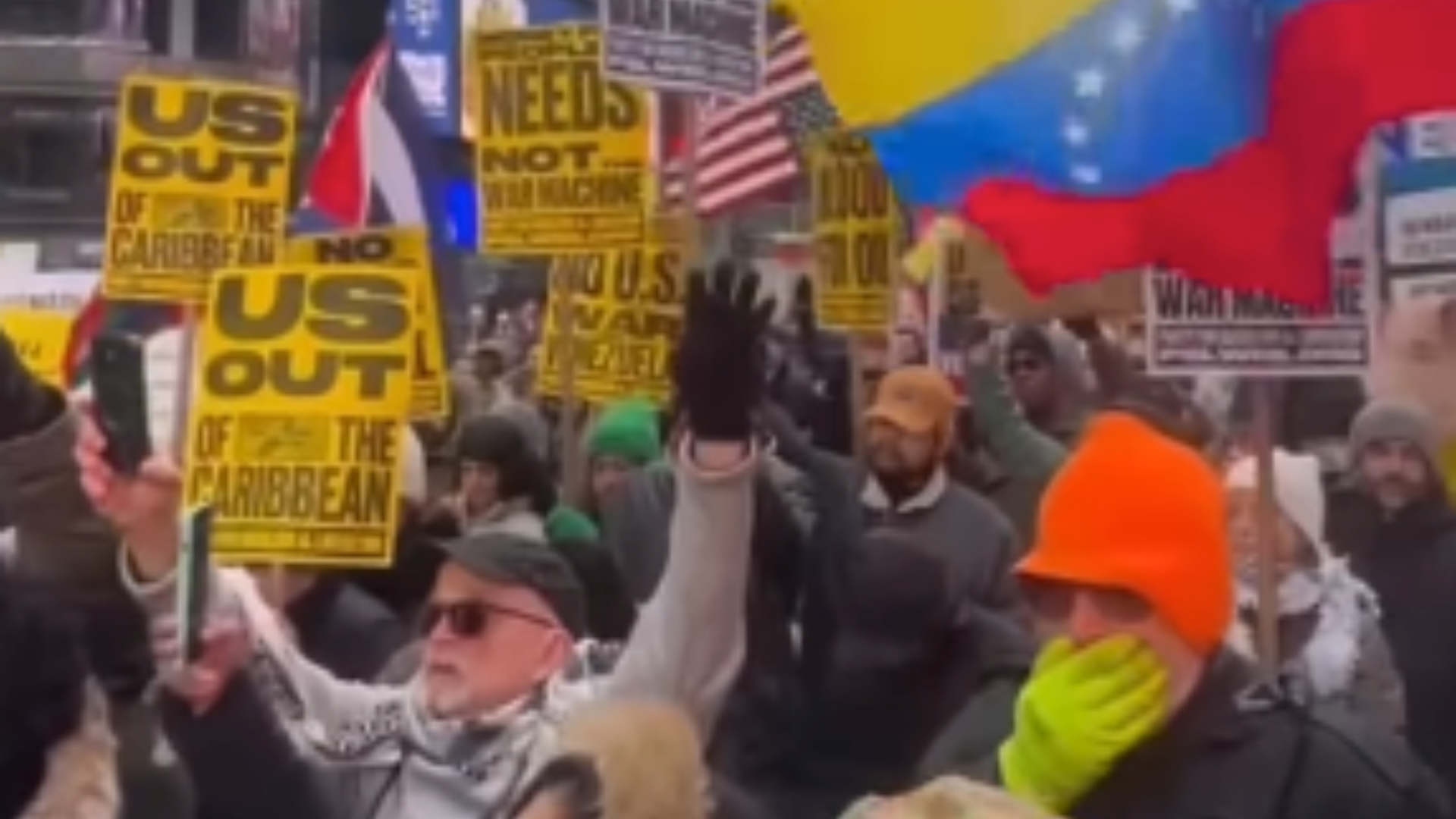
In the United States, protests in New York, Atlanta and Washington DC brought together hundreds who demanded social investments instead of wars, organized by movements such as the People’s Forum. Russia and China denounced the action as “hegemonic”.
International condemnation
The North American offensive provoked strong reactions from several states and global leaders. Pope Leo XIV, in a speech at the Vatican, declared that “no nation has the right to kidnap political leaders and bomb sovereign peoples”, calling for dialogue and respect for human dignity. Countries such as Mexico, Bolivia, Nicaragua and Iran also spoke out against the action, classifying it as a “political kidnapping” and a “crime against peace”. The African Union released a statement demanding Maduro’s immediate release and condemning the violation of Venezuelan sovereignty.
The reactions expose global polarization: on the one hand, progressive and popular forces that defend sovereignty; on the other, sectors aligned with imperialism that justify the intervention as a supposed fight against crime. So far, there are no reports of violent escalation this Sunday, but Venezuela has requested an urgent meeting at the UN Security Council. The future remains uncertain, with the US yet to present a post-capture plan, while international pressure grows for Maduro’s release and an end to the aggression.
Source: vermelho.org.br