Published 01/03/2026 18:34
The imperialist attack by the United States against Venezuela and the kidnapping of President Nicolas Maduro had a negative impact on major media outlets, this Saturday (3), inside and outside Latin America. In general, the main publications rejected the armed intervention led by Donald Trump.
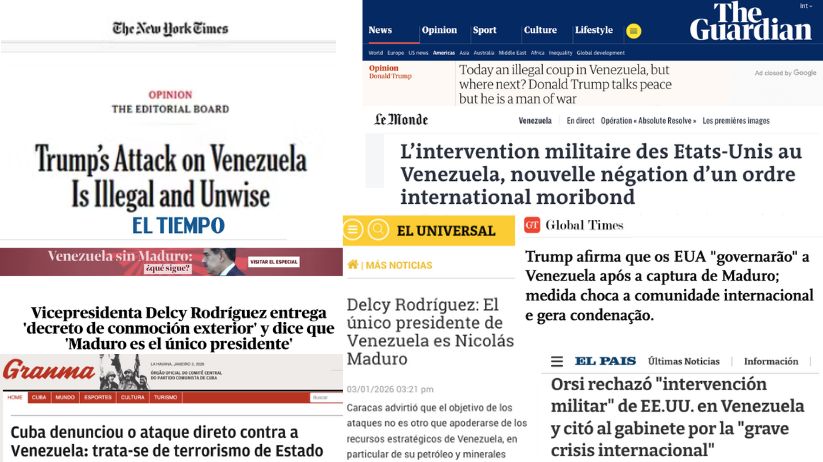
Although critical of Maduro, the main US newspaper, the The New York Times highlighted, in an editorial, that Trump “has not yet offered a coherent explanation for his actions in Venezuela” and that he is “pushing the country into an international crisis without valid reasons”.
The publication classified the false justification used by the White House of fighting alleged narco-terrorists as “government military adventurism” and considered that, throughout history, governments “have labeled leaders of rival nations as terrorists, seeking to justify military incursions as police operations.”
He also highlighted that Venezuela is being subjected to “new guise imperialism, which represents a dangerous and illegal approach to the US role in the world”.
Also read: Lula condemns attack on Venezuela; Russia convenes Security Council
The international affairs commentator for the British newspaper The Guardian, Simon Tisdall, argued that the US coup against Venezuela “is illegal, unprovoked and destabilizing at regional and global levels. It subverts international norms, ignores sovereign territorial rights and could create a situation of anarchy within Venezuela itself.”
Furthermore, he stated that “Trump’s reckless action should finally put an end to his always misleading characterization of himself as a ‘global peacemaker’” and gave a direct message to Keir Starmer, Prime Minister of the United Kingdom, and other European leaders that it is time they “publicly recognize him (Trump) for what he (Trump) is: a global warmonger, a universal threat.”
Among its main headlines, the German website German wave points out the illegality of the incursion, bringing repercussion from world leaders, with President Lula as one of the first mentioned.
Furthermore, the report argues that, according to Marc Welle, analyst at think tank Chatham House, from the United Kingdom, “Trump’s operation in Venezuela does not meet any of the requirements required by international law.”
In Spanish The Countryone of its columnists, Macarena Vidal Liy, says that Venezuela has been the Republican president’s great obsession and that “Maduro’s capture evokes the last US military intervention in Latin America: the invasion of Panama to depose then-president Manuel Noriega, just before Christmas in 1989. The American operation also recalls the beginning of the war in Iraq in more than one sense.”
Article The Worldfrom France, says that “the military intervention of the United States in Venezuela represents yet another denial of an international order in decline.”
The newspaper also gave space to the full note issued by the Venezuelan government, which highlights: “The objective of this attack is nothing less than to seize Venezuela’s strategic resources, particularly oil and minerals, trying to forcibly break the nation’s political independence.”
In China, the Global Times emphasized, in its main headline, that US action “shocks the international community and generates condemnation”. The article also reports a position issued by the Chinese Ministry of Foreign Affairs, according to which US hegemonic acts “seriously violate international law and Venezuela’s sovereignty, and threaten peace and security in Latin America and the Caribbean region. China is firmly opposed to this.”
Latin America
The potential for a regional crisis caused newspapers and websites in Latin America to dedicate even more space to the crisis, warning especially about Venezuela’s sovereignty and the search for a peaceful way out.
O The Universal, of Mexico, and the Page 12from Argentina, highlighted the speech of the vice-president of Venezuela, Delcy Rodrigues, demanding the “immediate release of Nicolás Maduro and his wife” and reaffirming that Maduro “is the only president of Venezuela”.
Newspaper from Colombia, a neighboring country to Venezuela that has also been intimidated by the US, the The Time also highlighted Delcy’s speech, as well as the The Thirdfrom Chile, which also highlighted President Gabriel Boric’s rejection of the attack.
Already the The Countryfrom Uruguay, opened space for President Yamandu Orsi’s position of rejecting “military intervention” and in defense of the permanent search “for a peaceful solution to the Venezuelan crisis”.
The newspaper’s Cuban website Granma dedicated its main space to the position issued by the country’s president, Miguel Díaz-Canel Bermúdez, according to which “Cuba denounces and urgently demands a response from the international community against the US criminal attack on Venezuela”.
Source: vermelho.org.br