Published 12/28/2025 1:27 pm
“It is high time that communists openly expose, before the whole world, their way of thinking, their objectives and their tendencies, opposing the legend of the specter of communism to a manifesto from the party itself.” It was with these words that, in 1848, the young Karl Marx (1818-1883) and Friedrich Engels (1820-1895) justified the publication of the Communist Manifesto.
Launched as a “theoretical and practical program” of the League of Communists, the book became one of the greatest bestsellers of all time, with more than 500 million copies sold – and it also became one of the most influential political works in history. However, 177 years after its first edition, the Manifesto was unable to bury the “legend of the spectrum”. Far from it. In 2025, the specter of communism remains in vogue, haunting not only Europe – but Asia and, above all, America.
See the Chilean example. After 26 years, the Communist Party of Chile (PCC) returned to run for president, launching lawyer Jeannette Jara, former Minister of Labor in the Gabriel Boric government. By winning the primary elections in June, she became the first communist in history to unify the entire left in the country around a candidacy for the Palacio de La Moneda.
However, in the campaign, in addition to Boric’s growing unpopularity, Jara had to face vigorous anti-communist propaganda and was defeated in the second round by the ultra-rightist José Antonio Kast by 58.17% to 41.83% of the valid votes.
“This election was decided less by competing economic projects and more by anxiety – the fear of crime, the fear of instability and the fear of social change itself. The right has learned to harness these fears effectively,” summarized political scientist CJ Atkins, editor-in-chief of People’s World.
On the other hand, the representation of the left took a leap forward in the Chilean National Congress – and the communists benefited from this advance. Named Unity for Chile, Jara’s coalition went from 53 to 61 federal deputies and from 17 to 20 senators. The PCC went from ten to 11 deputies in the Chamber, consolidating itself as the largest group of a communist party in the Americas.
“Victims”?
The specter of communism also landed in Honduras, where the November 30 presidential election saw a prolonged and – fraudulent – vote count. During the election campaign, North American President Donald Trump arrived on the scene to boast that candidate Rixi Moncada, supported by President Xiomara Castro, was “close to communism”. In addition, Trump declared support for conservative Nasry Asfura, from the National Party.
In response to US interference, Moncada’s campaign reacted with a humorous spot. In the play, a voter talks to two ghosts about the “risks” of a new triumph of the left in the country. In the end, the presidential candidate replies: “The ghost of communism returns with the same old stories, but reality speaks louder”.
However, Moncada was unable to stop the far-right wave radiating across the Americas. She only received 19.19% of the valid votes, while the winner, Nasry Asfura, had 40.27%. “As the electoral process was sabotaged and manipulated, the Honduran people continue their fight for democracy,” said the Communist Party of Honduras in a statement.
The spectrum still reached Canada, but was demoralized in time. An aberrant Monument to the Victims of Communism, opened at the end of 2024 in the capital Ottawa, turned out to be a joke. Canadians were already questioning the cost of such a controversial and useless work – US$7.5 million, of which US$6 million were public resources.
But the greatest embarrassment occurred in the disclosure of the 533 alleged victims of socialist governments who would have their names inscribed on the “Wall of Remembrance”. Before the tribute, historians and activists pointed out that at least 330 “victims” were, in reality, Nazis, fascists or war criminals. Cornered, the Canadian authorities gave up their bravado.
“Positively distinct stage”
For all intents and purposes, in 2025 the communists won many hauntings. Marxist-Leninist parties reacted in various ways to the ultra-rightist wave around the world: holding congresses, mobilizing the bases, holding debates in parliaments, warning against fascist, anti-democratic threats and other setbacks, contesting elections and, finally, resisting.
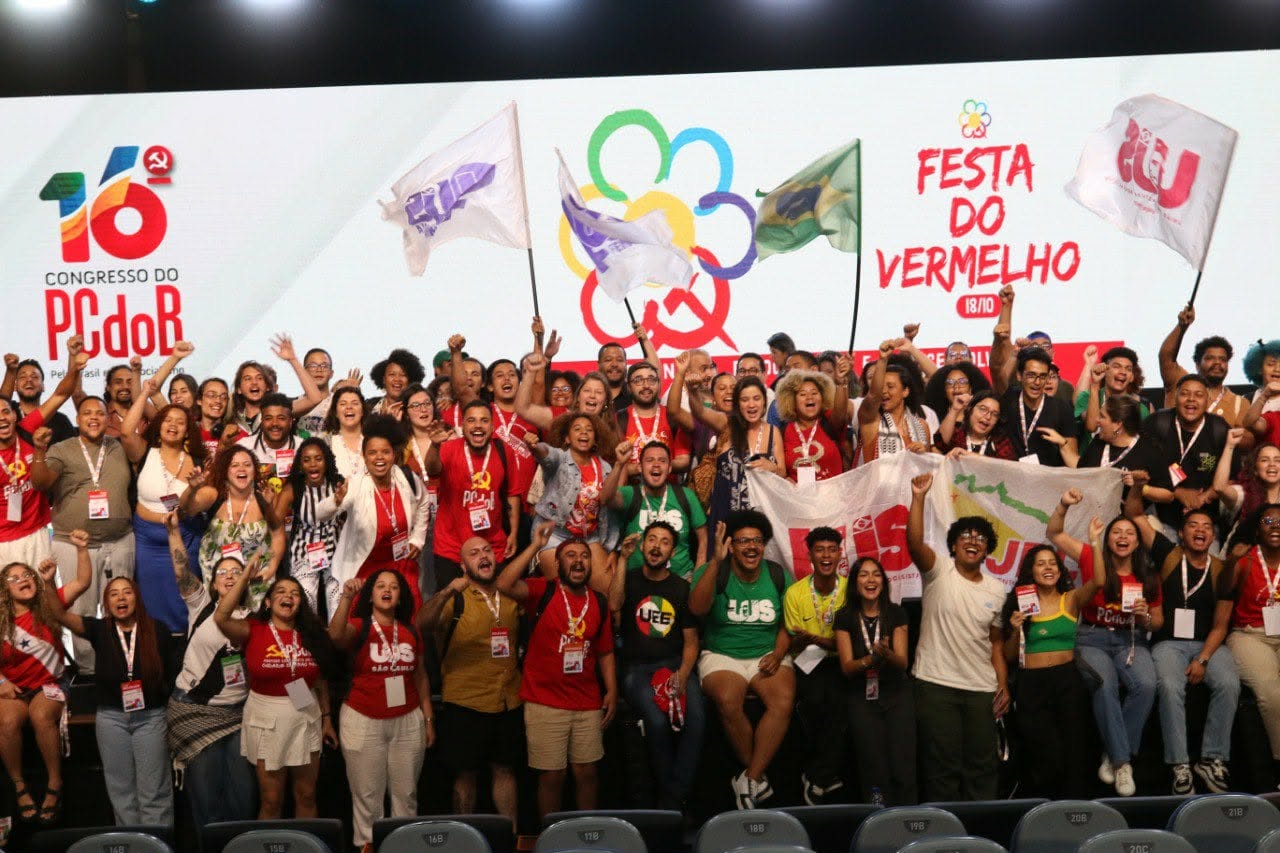
The PCdoB (Communist Party of Brazil) held its 16th National Congress in October, in Brasília. Throughout 2025, the communists saw their bench increase from seven to nine deputies in the Federal Chamber, with the inauguration of Nurse Rejane (RJ) and Professor Marcivânia (AP). The longest-running party in the country, founded in 1922, is part of the federal government and has been successfully responsible, since 2023, for the Ministry of Science, Technology and Innovation.
In the Political Resolution approved at the 16th Congress, the PCdoB reaffirmed its identity as a “party of socialism”, which “integrates the theoretical current of Marxism-Leninism”. The document indicates that the party exercises “the political representation of the working class and all workers”, being “revolutionary” and “proletarian”. It is the biggest ideological demarcation made by Brazilian communists since their 8th Congress, held in February 1992, less than two months after the end of the Soviet Union.
The PCdoB also took stock of the international communist movement and recalled that the Soviet debacle in 1991 imposed a “situation of strategic defense”. But recent factors – such as “the growing resistance of the people” and “the successes of socialism in China and other countries” – are beginning to improve the conditions for struggle. “Overall, it appears that communist and revolutionary forces still face a period of strategic defensiveness, however at a stage positively different from that of three decades ago”, points out the Political Resolution.
In 2025, another historic communist party, that of Uruguay (PCU), held its 23rd Congress, amid the celebrations of its 105th anniversary. For Uruguayans, 2025 was marked by the return of the Broad Front to power, after five years, and the death of former president José “Pepe” Mujica.
The challenges of the new left-wing government were the topic of the 23rd Congress, in December. Its General Resolution advocates a communist party “committed to the achievement of a political and social synthesis that transcends capitalism. A Party for the advancement of democracy, towards an advanced democracy, on the path to socialism. A Party for the Revolution.”
The PCU is at the base of the Yamandú Orsi administration and demands more commitment from the government to the workers’ agenda. Orsi took office on March 1, after winning – by a small margin (52% to 48%) – the second round of the national election in November 2024. It was the last victory for the left in presidential elections in Latin America. In the same vote, the communists elected six representatives to the Chamber and two to the Senate. One of the elected senators, Óscar Andrade, is the new secretary general of the PCU.
Europa
In Europe, the challenge of historic communist parties – such as Greece (KKE, founded in 1918) and Portugal (PCP, 1921) – is to combat the ascendant extreme right. The KKE called its 22nd Congress for January 29, 30 and 31, 2026. In Portugal, the PCP dared to launch António Filipe for the presidential elections, which are also scheduled for January 2026. The candidacy is the PCP’s response to the implosion of the “geringonça” – the coalition that, in addition to the communists, brought together the Socialist Party and the Left Bloc.
The actions of communist parties and the recurrence of the “spectrum legend” in 2025 only confirm that communism is becoming stronger as an ideological, political and economic alternative to capitalism. If we believe what we have seen in the year that is about to end, communism is showing signs of strength, vitality and hope.
Source: vermelho.org.br