Published 10/20/2025 12:26 | Edited 10/20/2025 1:20 pm
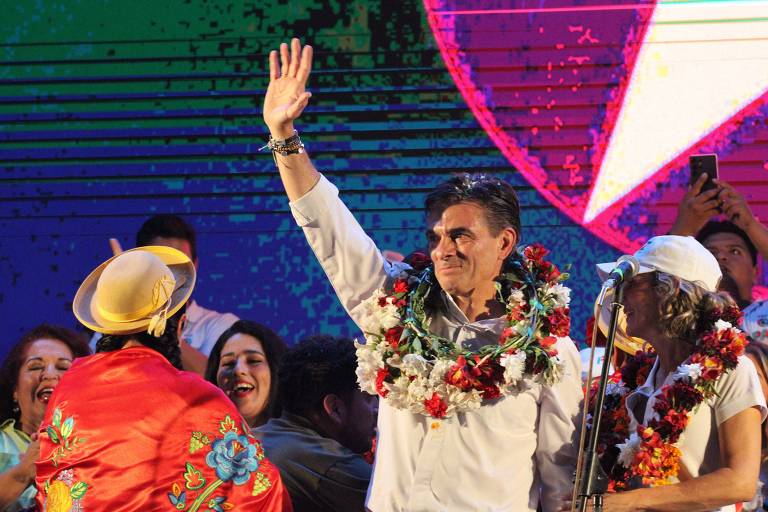
Senator Rodrigo Paz Pereira, from the Christian Democratic Party (PDC), was elected president of Bolivia this Sunday (19) with 54.5% of the votes, in an election that ends two decades of progressive governments of the Movement to Socialism (MAS) and marks the return of the right to power.
The victory of the liberal candidate occurs amidst a context of economic instability and political fragmentation, in a country that, under the cycle started by Evo Morales, experienced its longest period of growth, social inclusion and sovereign affirmation.
With participation between 85% and 89% of the 7.9 million eligible voters, the second round was the first in Bolivian democratic history and passed without incident, according to the Supreme Electoral Court.
Former president Jorge “Tuto” Quiroga, from the conservative Libre alliance, obtained 44.5% of the votes and conceded defeat. Paz’s inauguration is scheduled for November 8, in La Paz.
Son of former president Jaime Paz Zamora (1989–1993), the new president, aged 58, was born in exile during the military dictatorships and was raised between Europe and South America.
Graduated in Economics and International Relations, with a master’s degree in the United States, he had a political career as mayor of Tarija, deputy and senator.
During the campaign, he tried to sell an image of a modern and conciliatory manager, but his political base is anchored in the business elites of Santa Cruz de la Sierra, the main economic center and bastion of the Bolivian right.
In his victory speech, Paz stated that the country is entering a new stage and promised to “govern with everyone”, in reference to the fragmentation that marked the last years of dispute between the MAS and the conservative opposition.
He said that he intends to prioritize “work, legal security and strong institutions” and declared that “ideology is not enough to eat”.
The words summarize the economic orientation that guides his proposal: a program of “capitalism for all”, aimed at liberalizing the market, formalizing small businesses and reducing the role of the State as an inducer of development.
The new government promises public spending cuts of around US$1.5 billion, the elimination of fuel subsidies and tax reform to relieve business sectors.
The austerity discourse is presented as a path to stability, but it tends to directly affect policies that guaranteed, during the previous cycle, income growth and an increase in domestic consumption.
With accumulated annual inflation of around 25% and a drop in investments in natural gas, Bolivia is facing a recession, dollar shortages and fuel shortages, a situation that is already causing price increases and weakening the purchasing power of working families.
Peace also takes place in the midst of a profound disarticulation in the popular field. Legally prevented from running, Evo Morales launched a campaign for invalid votes that reached 19% of voters and denounced political persecution after having his candidacy vetoed.
The current president, Luis Arce, gave up seeking re-election, weakened by the fiscal crisis and the break with Morales. The result exposed the fragmentation of the MAS and the erosion of the redistributive model in the face of inflationary pressure and the legislative siege imposed by conservative sectors.
Paz’s victory consolidates a reconfiguration of Bolivian political power and could inaugurate a period of liberal predominance in the discourse and conduct of the State.
The new president promises to decentralize the budget and grant greater administrative autonomy to departments, but the lack of a parliamentary majority should force him to negotiate with the forces that until recently formed the opposition.
The challenge for Paz will be to stabilize public accounts without increasing impoverishment, as the cut in subsidies and investments tends to affect the popular classes that have supported the internal market over recent years.
In the external scenario, the change of government also redesigns Bolivia’s international positioning.
While Argentine Javier Milei hailed Paz’s victory as the “end of 21st century socialism”, Chilean Gabriel Boric spoke of “cooperation between brotherly countries”. Itamaraty had not yet commented as of this Monday morning (20).
The new government signals a rapprochement with Washington and a review of the foreign policies inherited from the MAS, which prioritized the Brics, South American integration and the defense of national sovereignty over strategic resources.
Bolivia thus enters a phase of uncertainty. The discourse of conciliation and administrative efficiency may gain support among the urban middle sectors, but the fiscal content of the program — with cuts in subsidies and dependence on credit — threatens to accentuate social inequality and weaken the advances of the previous period.
Paz promises “capitalism for all”, but the challenge that awaits him is to prevent this formula from translating into adjustment for the many and prosperity for the few.
Source: vermelho.org.br