Published 02/09/2025 11:51 | Edited 02/09/2025 13:39
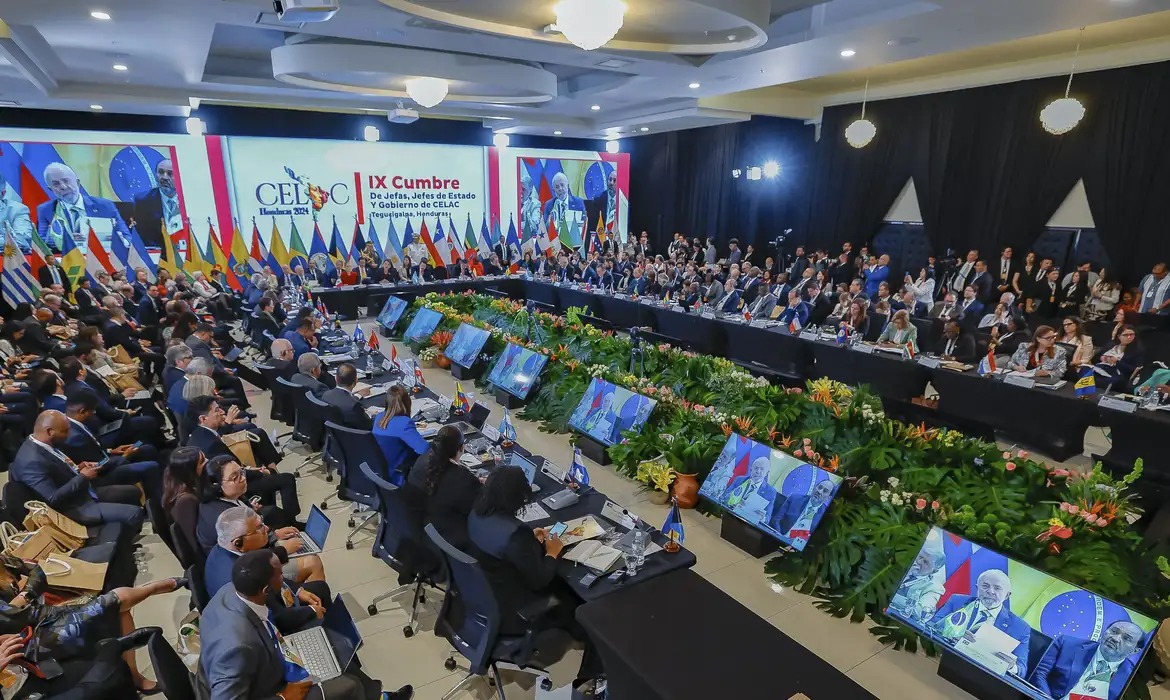
The community of Latin American and Caribbean states (Celac) held an emergency meeting on Monday to discuss US military climbing in the Caribbean.
The regional bloc requested the immediate withdrawal of US troops, denounced external interference and reaffirmed the region as a peace zone.
The crisis was detonated by sending war ships and a nuclear submarine to the Venezuelan coast, under the justification for combating drug trafficking, considered without proof by Latin American governments.
The call came from the Presidency Pro Tempore da Colombia, held by Chancellor Rosa Yolanda Villavicencio Mapy.
The extraordinary meeting, in virtual format, was supported by the 2011 Celac Statute, which allows emergency meetings in the face of threats to regional peace. According to the Colombian Chancellery, the goal was to ensure a collective reflection on the preservation of sovereignty, political independence and territorial integrity of states.
In the statement, the countries reinforced repudiation of any form of external interference and stressed the need to reinforce dialogue and cooperation channels.
Celac recalled that Latin America and the Caribbean were declared a peace zone in 2014, a commitment that cannot be reduced to a symbolic document. For the block, the region’s stability depends on joint and coordinated responses to transnational challenges.
The Colombian minister pointed out that respect among nations must be the “backbone” of the international order.
She acknowledged that freedom of navigation is foreseen by maritime law, but warned that the sending of military vessels accompanied by belligerent rhetoric goes beyond the border between presence and coercion.
“We rejected the logic of intervention and reaffirmed the United Nations Charter,” said Villavicencio.
The meeting has consolidated a collective position contrary to US climbing, seen as a dangerous precedent for the entire region. The decision also expands Washington’s diplomatic isolation, already contested in multilateral instances and on the continent itself.
US forces in the Caribbean
Military movement has intensified in recent days. In late August, Destroier USS Sampson docked in Panama, while the USS Lake Erie missile launcher crossed the peaceful to the Caribbean.
The Uss Jason Dunham and USS Gravery were already in the region, as well as the amphibious ship ship USS Iwo Jima.
Two support ships with capacity for more than 4,500 soldiers complete the detachment. Washington did not report the exact location of the Nuclear submarine USS Newport News, also displaced.
According to the Venezuelan government, the group reaches eight vessels, with over 1,200 missiles and 4,200 mobilized soldiers.
In an official statement, the White House states that the operation aims to combat drug trafficking. However, in July, the State Department offered a reward of $ 50 million for the capture of Nicolás Maduro, accused of heading the “Cartel dos Sóis”.
The complaint, rejected by Caracas and without official evidence, was accompanied by the statement by spokesman Karoline Leavitt that the US would use “all the strength” against Venezuela.
The military presence was classified as a violation of the Tlatelolco Treaty, signed in 1967 and ratified by Washington in 1971, which prohibits nuclear weapons in Latin America and the Caribbean.
Caracas denounces that the simple possibility of nuclear submarine carries atomic weaponry threatens the region’s statute as a denuclearized zone.
Anti -drug justification was also countered by different governments. The Colombian minister recalled that US operations are based on belligerent rhetoric. Already Cuba stated that the DEA reports are not based on facts, and Nicaragua argued that any threat of use of force endangers regional peace.
Venezuela denounces unprecedented threat
President Nicolás Maduro said, on Monday, that Venezuela faces the biggest threat of the last 100 years on the continent. In a statement to the international press, he accused the US of resorting to “maximum military pressure” after the failure of his sanctions and blockages.
“We declare the maximum preparation for the defense of Venezuela,” he said. The head of state classified the climb as “extravagant, immoral, criminal and bloody.”
Maduro also compared the offensive to the so -called “cannhy diplomacy”, an imperial strategy of the nineteenth century now resumed under the logic of monroe doctrine.
He stated that Venezuela has resisted more than a thousand coercive measures, maintains its economy recovering and strengthens emerging powers, citing the BRICS. “The Lima group disappeared. The governments that attacked us were isolated,” he said.
Defense Minister Vladimir Padrino López stressed that the operation has no relationship with drug trafficking. He highlighted UN reports that point out that 87% of South America’s drug production originates in Colombia, Ecuador and Peru, and leaves mainly through the Pacific, where the US did not mobilize fleets. For the general, the attitude reveals “an obvious dual moral.”
Caracas also denounced the presence of troops and missiles ready to invade Venezuela and mobilized thousands of citizens in the Bolivarian militia. The internal strategy seeks to combine popular resistance with diplomatic denunciation, projecting the threat not as an isolated attack on the country, but as a risk to the entire Latin American region.
Reactions and developments
In addition to Celac, the Bolivarian alliance for the peoples of our America (Alba) had already condemned the climb. Colombian President Gustavo Petro said the US make a mistake by trying to turn Venezuela into a “new Syria”, with a risk of dragging his own Colombian territory for the conflict. Nicaragua and Cuba also reaffirmed support to the Venezuelan government and defended the regional unit in the face of external provocation.
The joint position reflects the Latin American effort to reject the logic of intervention and strengthen the diplomatic way. Venezuela’s complaint in multilateral instances points to the attempt to extend support in the global south and reinforce already established treaties against the militarization of the region.
The US, in turn, supports the narrative of fighting drug trafficking, while increasing direct pressure on Caracas with war presence and rewards against Maduro. The reactive climbing memories of the Cold War and the Missile Crisis, evoked by chancers and diplomats as a reference to nuclear risk.
The crisis, therefore, establishes itself as a crossroads: on the one hand, Washington bets on open military pressure; On the other hand, Latin America tries to consolidate itself as a space for sovereignty and peace, refusing interference and denouncing the imbalance created by the movement of foreign troops.
Source: vermelho.org.br