Published 27/07/2025 15:59
The Javier Milei government has its main achievement as a trophy so far: the dizzying fall of inflation. After reaching 25% monthly peaks in December 2023, the rate fell to 1.6% in June 2025-a brand that refers to pre-standing stability times. However, this monetary victory has a very high social cost: the collapse of purchasing power, the shot of poverty and the corrosion of the basic life conditions of the majority of the population.
Cutting public spending, eliminating subsidies and imposing an initial devaluation of the weight were pillars of Milei’s economic plan, which, in addition to reducing inflation, reached tax surplus. But this “bitter medicine” has generated serious side effects: real drop in wages, increased informal work, collapse in consumption and accelerated impoverishment of medium and popular sectors.
Hunger surplus: the daily crisis
The contrast between macroeconomic indicators and life on the streets is stark. Although the Argentine weight stabilized and prices rise more slowly, Argentines are increasingly indebted to pay for food. According to the Institute of Statistics and Social and Economic Trends, 91% of households contracted debt by 2024 – and 58% did to purchase food.
The initial nominal devaluation followed by an appreciation of the royal exchange rate has transformed Argentina into an expensive dollar country, but with salaries among the lowest in Latin America. The result is a dual economy, where only exporting sectors and high -income segments can breathe, while the rest of society is experiencing a process of continuous impoverishment.
The collapse of consumption and the new standard of living
The crisis is expressed in habits changes: Consumers have started to buy less, look for discounts and prioritize basic foods in small quantities, often using credit card instead of money. Sight consumption has become a luxury.
In addition, the rents fired, especially in the Metropolitan region of Buenos Aires, where the average spends on housing represents 44.5% of the renters’ income. This data, ignored by the basket of goods used to calculate official inflation, indicates that the index disclosed does not accurately reflect the reality of the majority.
The account of the cuts: health, education and pensions
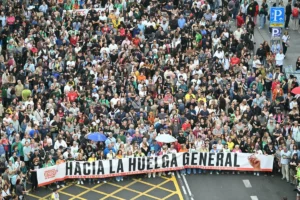
The fight against inflation was made based on radical cuts in the public budget. Infrastructure, health and education works were paralyzed. Retirees – among the most affected – receive the equivalent of 300 monthly dollars, below the minimum necessary to live with dignity. Every week, protesters gather in front of Congress to demand readjustments, while Milei promises to veto any project that increases spending.
The dismantling of the state generates a widespread sense of abandonment. Without public network capable of damaging the effects of the crisis, the population uses informality, indebtedness or family solidarity to survive.
The risk of the economic “chicken flight”
Milei’s economic trajectory keeps similarities with plans applied in Argentina’s recent past: a spending cut shock that reduces inflation, but does not solve the country’s structural bottlenecks. The indiscriminate opening to imports, combined with a valued currency, threatens local industry and employment.
Experts warn that the current cycle is just a “chicken flight” – a fragile and short recovery. Without investment in infrastructure, tax reform, regional integration and policies that articulate growth with income distribution, Argentina can repeat its history of neoliberal promises that collapse in the face of inequality.
The challenge of the next step
Reducing inflation was a necessary but clearly insufficient step. The challenge now is to regain the population’s consumption capacity, reactivate the quality job market and restore essential public services.
The question that is imposed is: How long will Milei be able to support the policy of the crunch without breaking the Argentine social fabric? “Inflationary miracle” can become a distributive nightmare – and political cost can come as fast as the fall in inflation.
Source: vermelho.org.br