Published 02/03/2026 17:57 | Edited 02/03/2026 18:03
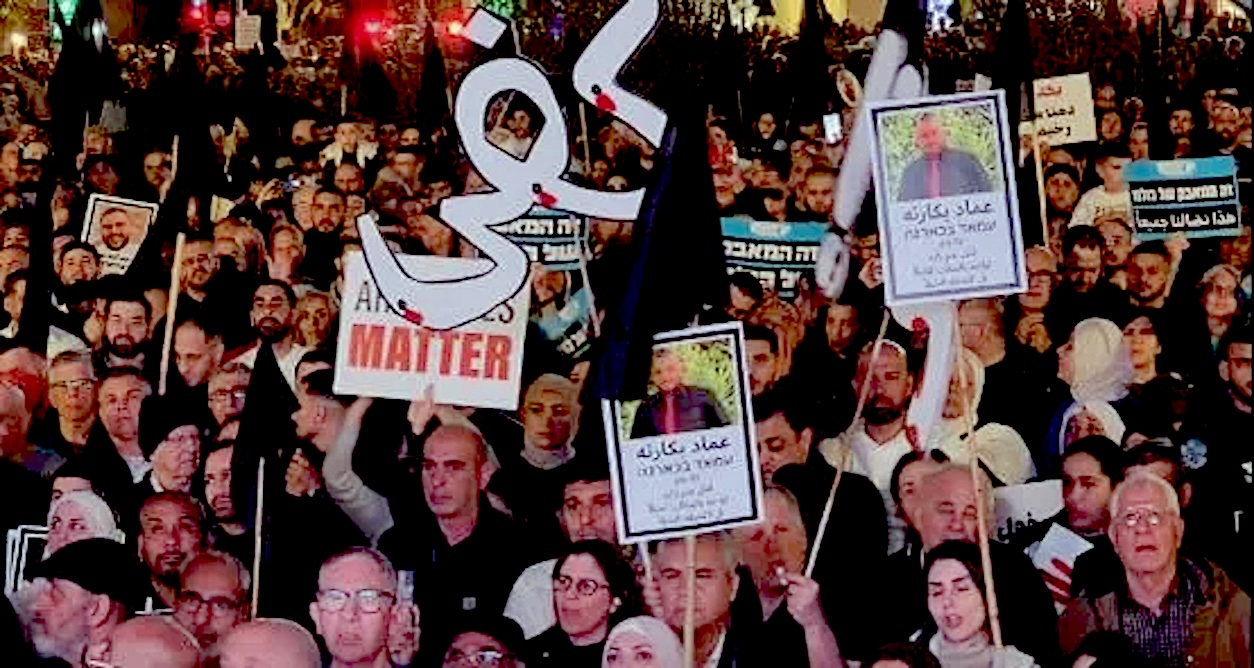
Under the sky of Tel Aviv, 70 thousand people transformed Habima Square into a sea of mourning and resistance. Hundreds of black flags fluttered in the wind as Arabs and Jews marched together from the esplanade of the Art Museum, carrying photos of murdered young people and shouting in unison: “Police, police, the blood of our children is not cheap.”
The “March of the Black Flags”, organized by the Arab Monitoring Committee with the support of Hadash and the Communist Party of Israel (Maki), became the largest joint Arab-Jewish protest in Israel’s recent history — an act of collective despair in the face of 27 homicides recorded in January 2026 alone in Arab society, 24 of them by gunfire.
The silent massacre
The numbers reveal a deliberately ignored humanitarian crisis: according to Abraham Initiatives, 13 of January’s 27 victims were 30 years old or younger. Armed gangs control entire neighborhoods, dispute land with extreme violence and operate with impunity in cities such as Lod, Nazareth and Rahat.
The root of the problem is structural: only 3% of homicide investigations in the Arab community result in convictions, compared to 65% in cases involving Jewish citizens. Meanwhile, it is estimated that more than 400,000 illegal weapons circulate in Arab communities — many of them smuggled with the collusion of networks that even include state agents, according to previous parliamentary investigations.
The politics of abandonment
For protesters, violence is not an accident, but political. “This is a common fight between Arab-Palestinians and Jewish citizens of Israel,” said Professor Barak Medina, former rector of the Hebrew University, to deafening boos when Netanyahu’s name was mentioned.
The right-wing coalition government, with National Security Minister Itamar Ben Gvir — whose image was toppled in a domino installation by activists — is accused of maintaining a “tacit agreement” with Arab criminal organizations: neglecting the internal security of these communities in exchange for political neutrality.
As Jamal Zahalka, president of the Monitoring Committee, denounced: “Ben Gvir is the Minister of Crime”. Netanyahu’s recent visit to the Negev, following the death of a Bedouin by police officers, was interpreted as political theater: “He looked for a scapegoat and continued the attack against us”, criticized the mayor of Rahat, Talal al-Kirnawi.
The alliance that scares the right
The magnitude of the mobilization — with 140 buses bringing protesters from Jerusalem to Rahat — reveals an unprecedented coalition. Lawyers in robes, Hadash-Ta’al parliamentarians, veteran actress Rivka Michaeli and grieving mothers like Khatam Abu Fana, who lost her son Firas, shared the same platform.
“I’m not here to cry, but to scream,” she said, transforming personal pain into a collective demand: “I want protection for mothers who haven’t felt this pain yet.”
At the end, deputy Ayman Odeh summarized the moment: “70 thousand protesters came today… Arabs and Jews, all together, with a clear message: no more abandonment. We want to live.”
The confrontation in the streets
The reaction from the right was immediate and violent. At the end of the rally, masked groups — some with Netanyahu’s faces printed on posters — surrounded the protesters shouting “traitors” and making comparisons with Hamas. Roei Star, recently caught using pepper spray against protesters, led part of the group.
The police had to intervene to protect families looking for their buses. The episode exposes the open wound in Israeli society: while progressive Arabs and Jews build bridges of solidarity, the right radicalizes the discourse of exclusion, transforming public security into a weapon of segregation.
The beginning of a fight
Faced with a State that has for decades denied effective protection to 20% of its population — Arab Israeli citizens —, the Tel Aviv protest signals a turning point. It is not just about fighting crime, but about demanding the fundamental right to life with dignity. As it echoed in the square: “Arab lives matter.”
In a country divided by ethnic and political conflicts, the Arab-Jewish union for common security represents not only a demand for justice, but an existential challenge to the ethnic state project defended by the current governing coalition.
The fight, as Odeh promised, “is just the beginning”. And the 70,000 bodies in that square are proof that, even under occupation and discrimination, hope still marches — hand in hand, under black flags that announce mourning, but also rebirth.
Source: vermelho.org.br